
 Back
Back





IN THE HIGH COURT OF JUDICATURE FOR RAJASTHAN AT JODHPUR
Madan Gopal Vyas, J.
Union of India, through the General Manager, Western Railway (Now North Western Railway), Bombay Central, Bombay (Now Jaipur) and ors. –Appellant
Versus
Madanlal S/o Shankerlal Sehlot - Respondent
S.B. Civil First Appeal No. 33/1991
Decided On : 24-04-2024
CIVIL APPEAL - DEMOLITION OF SHOPS - Public Premises (Eviction of Unauthorized Occupants) Act, 1971 - Sections 5, 9, 10 - The court discussed the provisions of the Public Premises (Eviction of Unauthorized Occupants) Act, 1971, particularly Sections 5, 9, and 10. Section 5 allows the Estate Officer to order the eviction of unauthorized occupants, while Section 10 states that such orders are final and cannot be challenged in civil suits. The court interpreted these provisions to conclude that the learned trial court lacked jurisdiction to hear the case, as the shops were found to be on railway premises, thus affirming the legality of the demolition and the finality of the Estate Officer's order.
Fact of the Case:
The plaintiff-respondent owned three shops outside the Railway Station, which were demolished by Railway Officers without showing any authorization. The plaintiff sought damages for the demolition, claiming the shops were not on railway land. The defendants argued the shops were unauthorized constructions on railway premises and cited the Public Premises Act for their actions.
Finding of the Court:
The court found that the learned trial court erred in determining that the shops were on municipal land. Evidence indicated the shops were indeed on railway premises, and the demolition was conducted following proper legal procedures under the Public Premises Act.
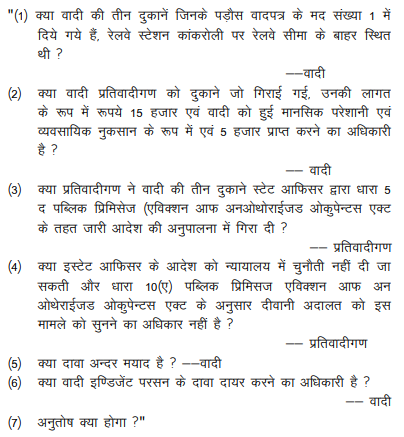
Issues: 1. Whether the shops were situated outside the precincts of the Railway Station. 2. Whether the plaintiff was entitled to damages for the demolition. 3. Whether the orders of the Estate Officer could be challenged in civil court.
Ratio Decidendi: The court held that the learned trial court misapplied the law by asserting jurisdiction over a matter that was conclusively governed by the Public Premises Act. The finality of the Estate Officer's order under Section 10 of the Act precluded the plaintiff from seeking redress in civil court.
Final Decision: The appeal was allowed, the judgment and decree of the learned trial court were quashed, and the plaintiff's suit was rejected.
JUDGMENT :
Madan Gopal Vyas, J.
1. The present civil first appeal under Section 96 read with Order 41 Rule 1 of CPC has been preferred by the defendants-appellants against the judgment and decree dated 27.01.1990 passed by the learned Additional District Judge, Rajsamand (hereinafter referred to as "the learned trial Court") in Civil Original Suit No.2/85 whereby the suit preferred by the plaintiff-respondent seeking decree against the defendants-appellants - Union of India for awarding Rs.10,000/- damages, has been allowed.
2. The facts in nutshell as stated in the suit by the plaintiff-respondent are that three shops ad-measuring 25x8 Sq. ft. were situated outside the precincts of Railway Station, Kankroli (hereinafter referred to as "the suit shops in question"). It is submitted that in the said shops, the plaintiff and his tenants were running a grocery shop and a cycle repair shop. On 13.07.1981 at about 9:00 - 9:30 AM, Railway Officers alongwith 100 persons came and started demolishing the shops. When the plaintiff objected the same and demanded authorization document for damages from demolishing the shops, the officers of the Railway did not show any order to the plaintiff and demolished the shops. The plaintiff filed a suit seeking damages to the tune of Rs. 15,000/- for demolition and Rs. 5,000/- for mental agony. It was averred that the defendants had no legal right to demolish the shops in question, and therefore, the plaintiff is entitled to damages. In the plaint, it was further stated that on 12.06.1981, the plaintiff served the notice under Section 80 of the CPC upon the defendants demanding the aforesaid amount but they have not paid the amount, therefore, the suit seeking the aforesaid reliefs was preferred by the plaintiff.
3. The defendants-appellants submitted written submissions to the suit denying the facts made in the suit and specifically submitted that the shops in question have been illegally constructed in the precincts of the railway station, therefore, the plaintiff is an encroacher. It is submitted that under Section 5 of The Public Premises (Eviction of Unauthorized Occupants) Act, 1971 (hereinafter referred to as "the Act of 1971"), proceedings were initiated against the plaintiff-respondent and an order dated 18.01.1978 was passed by the Estate Officer for removing the encroachment and the plaintiff was informed regarding the same. Since the plaintiff failed to remove the encroachment, therefore, the shops were demolished on 13.07.1981. In the written statement, it was further stated that in view of Section 10 of the Act of 1971, the order passed by Estate Officer is final and the same cannot be questioned in any suit, application or execution proceeding. It was also stated in the written statement that the suit is barred by limitation, and therefore, the same may be dismissed.
4. On the basis of pleadings of the parties, the learned trial Court framed as many as 7 issues which are as follows :-
5. In support of his case, the plaintiff examined 5 witnesses and produced documentary evidence and the defendants-appellants examined 3 witnesses and produced documentary evidence. Thereafter vide impugned judgment and decree dated 27.01.1990, the learned trial Court decreed the suit, hence the present first appeal.
6. Challenging the impugned judgment and decree dated 27.01.1990, learned counsel for the defendants-appellants submits that the learned trial Court has wrongly decided issue Nos.1, 2 and 4 to 7. It is submitted that the learned trial Court has wrongly held that the shops in question are situated over the land of Municipality. It is submitted that the plaintiff has not produced any evidence, oral or documentary to prove that the shops are constructed over the land of Municipality and are not situated on the land of Railways. It is submitted that if the statements of DW-1 (Dharma Kumar Handa) are seen, he has specifically stated that before conducting the demolition proceedings, a notice was served
The finality of orders issued by the Estate Officer under the Public Premises (Eviction of Unauthorized Occupants) Act, 1971, cannot be challenged in civil court, affirming the authority of the Estat....

Quasi-criminal proceedings under Order 39 Rule 2-A CPC require proof beyond doubt of willful injunction disobedience; appellate courts cannot reverse trial credibility findings absent perversity, esp....


The court emphasized the necessity for the Appellate Authority to determine land classification and occupancy rights prior to issuing eviction orders.

Tenants cannot be forcibly dispossessed without legal grounds, and tenancy agreements must be upheld, as reaffirmed by the court.

The court affirmed that a Civil suit is maintainable when a demolition notice is contested, emphasizing that limitations apply only where expressly provided, allowing full examination of possession c....


The main legal point established in the judgment is the lack of authority of the Estate Officer and the maintainability of the writ petition under Article 226 of the Constitution of India.



An indispensable Tool for Legal Professionals, Endorsed by Various High Court and Judicial Officers
Please visit our Training & Support
Center or Contact Us for assistance

Scan Me!
India’s Legal research and Law Firm App, Download now!


For Daily Legal Updates, Join us on :



 Back to top


