
 Back
Back





IN THE HIGH COURT OF JUDICATURE FOR RAJASTHAN AT JODHPUR
YOGENDRA KUMAR PUROHIT, J.
Devendra Singh S/o Shri Shambhu Singh – Appellant
Versus
State Of Rajasthan, Through Pp – Respondent
S.B. Criminal Writ Petition No. 370 of 2019, S.B. Criminal Writ Petition No. 369 of 2019
Decided on : 03-09-2024
Inherent Powers - Judicial Review - Section 482 Cr.P.C. - The court discussed the inherent powers under Section 482 Cr.P.C. to expunge adverse remarks, emphasizing the necessity of natural justice and the exceptional nature of such powers.
Fact of the Case:
The petitioner challenged the adverse remarks made by the Sessions Judge against police officials in a judgment, questioning the legality of such remarks and the circumstances under which judicial review could be exercised.
Finding of the Court:
The court found that the Sessions Judge failed to provide an opportunity for the police officials to defend themselves before making disparaging remarks, violating principles of natural justice.
Issues: Whether inherent powers can be exercised to expunge adverse remarks against individuals, and under what circumstances judicial review can be applied.
Ratio Decidendi: The court held that inherent powers under Section 482 Cr.P.C. can be exercised to expunge remarks if they violate natural justice or are unnecessary for the case's resolution.
Result: The disparaging remarks against the police officials were set aside due to the lack of opportunity for them to be heard.
ORDER :
"10. Before switching to examine the legality and propriety of the strictures passed against the petitioner by the learned Sessions Judge in its judgment dated 06.01.2014, the twin questions of great significance have cropped up for judicial scrutiny, i.e., (i) Whether inherent powers can be exercised by this Court for expunging the adverse remarks made against an individual including a police officer?, and (ii) Under what circumstances such power of judicial review can be exercised? For eliciting answer to both the questions, I feel inclined to examine them in the light of facts of the case and the legal precedents on which reliance is placed by the learned counsel for petitioner.
The extraordinary jurisdiction conferred on this Court under Section 482 Cr.P.C. is in the nature of inherent powers and such power can be exercised to prevent abuse of the process of any Court or to otherwise secure the ends of justice. The issue concerning scope and object of Section 561-A Cr.P.C. (1898), which is pari-materia to Section 482 Cr.P.C. (1973), came up for consideration before the Constitution Bench of Supreme Court in case of State of Utter Pradesh Vs. Mohd. Naim (AIR 1964 SC 703), more particularly with reference to exercise of inherent powers for obliterating adverse remarks against an individual in the judgment. Speaking for the Court, Justice S.K. Das, while answering the question in affirmative, held:
“The second point for consideration is this, has the High Court inherent power to expunge remarks made by itself or by a lower court o prevent abuse of the process of any court or otherwise to secure the ends of justice? There was at one time some conflict of judicial opinion on this question. The position as to case-law now seems to be that except for a somewhat restricted view taken by the Bombay High Court, the other High Courts have taken the view that though the jurisdiction is of an exceptional nature and is to be exercised in most exceptional cases only, it is undoubtedly open to the High Court to expunge remarks from a judgment in order to secure the ends of justice and prevent abuse of the process of the court ----------We think that the view taken in the High Courts other than the High Court of Bombay is correct and the High Court can in the exercise of its inherent jurisdiction expunge remarks made by it or by a lower court if it be necessary to do so to prevent abuse of the process of the court or otherwise to secure the ends of justice; the jurisdiction is however of an exceptional nature and has to be exercised in exceptional cases only . (emphasis supplied)"
11. In Naranjan Patnaik Vs. Sashibhusan Kar and Anr. [(1986) 2 SCC 569], Supreme Court, while following the verdict of Constitution Bench in Mohd. Naim’s case (supra), further elaborated that harsh or disparaging remarks are not to be made against persons and authorities whose conduct comes into consideration before courts of law unless it is really necessary for the decision of the case, as an integral part thereof to animadvert on that conduct.
14. In Manish Dixit & Ors. Vs. State of Rajasthan [(2001) 1 SCC 596], Supreme Court further clarified that castigating remarks to ensue serious consequences on future career may not be made without giving opportunity of being heard to the incumbent. The Court held:
“Even those apart, this Court has repeatedly cautioned that before any castigating remarks are made by the Court against any person, particularly when such remarks could ensue serious consequences on the future career of the person concerned he should have been given an opportunity of being heard in the matter in respect of the proposed remarks or strictures. Such an opportunity is the basic requirement, for, otherwise the offending remarks would be in violation of the principles of natural justice.”
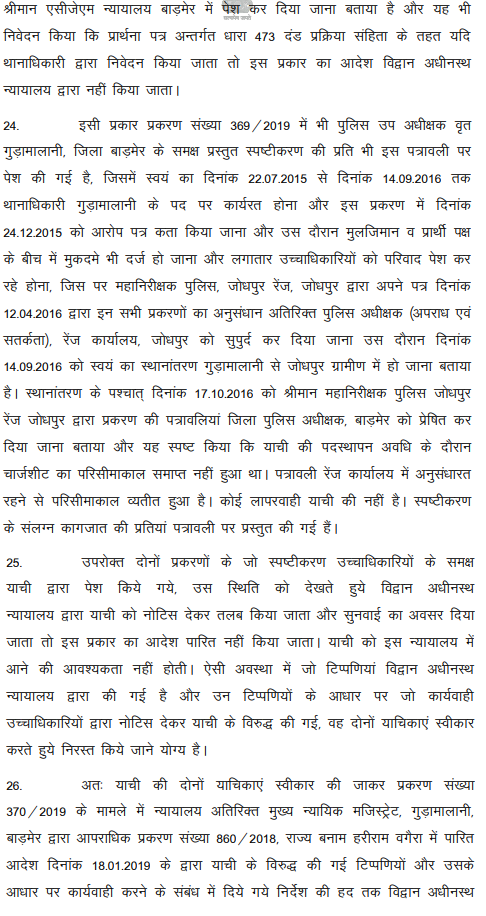
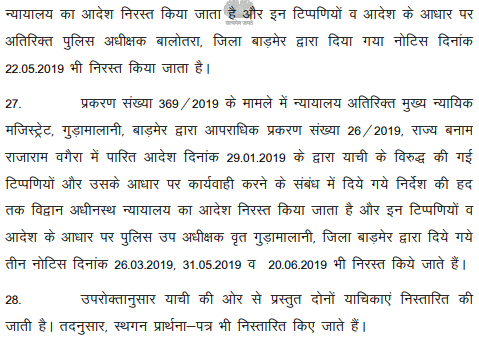
Thus, answer to the first question is in affirmative but subject to certain restrictions. As regards second question suffice it to say that power of judicial rev
AI
Judicial review under Section 482 Cr.P.C. allows expunging adverse remarks if natural justice is violated and such remarks are not essential for the case.

The High Court has inherent jurisdiction to expunge remarks made by itself or lower courts to secure justice, but this power is to be exercised in exceptional cases only.

Judicial remarks against individuals must comply with principles of natural justice, necessitating notice and an opportunity for a hearing before issuing adverse comments, particularly for officials.


Adverse remarks – There is difference between criticising erroneous orders and criticising a Judicial Officer – First part is permissible – Second category of criticism should best be avoided – No co....
Remarks by higher courts against subordinate judicial officers must be necessary and justified to uphold judicial dignity and independence.

The court emphasized that adverse remarks against individuals must adhere to principles of natural justice, requiring an opportunity to be heard before such comments are made.

Adverse remarks against public servants must be justified by evidence and made only after affording an opportunity to explain their conduct; mere negligence does not equate to wilful negligence under....

Judicial remarks that carry civil consequences must not be made without an opportunity for the affected party to be heard, adhering to principles of natural justice.



An indispensable Tool for Legal Professionals, Endorsed by Various High Court and Judicial Officers
Please visit our Training & Support
Center or Contact Us for assistance

Scan Me!
India’s Legal research and Law Firm App, Download now!


For Daily Legal Updates, Join us on :



 Back to top


