
 Back
Back





HIGH COURT OF JUDICATURE FOR RAJASTHAN AT JODHPUR
FARJAND ALI, J.
Raju Ram Choudhary, S/o Lt. Sh. Moola Ram Choudhary - Petitioner
Versus
State Of Rajasthan, Through Pp - Respondent
S.B. Criminal Writ Petition No. 1292 of 2025
Decided On : 13-01-2026
| Table of Content |
|---|
| 1. challenge against adverse remarks in prior orders (Para 1 , 3) |
| 2. arguments on jurisdiction and necessity of remarks (Para 2 , 4 , 5) |
| 3. court's analysis on the necessity of remarks (Para 6 , 7 , 9 , 10 , 11) |
| 4. principle of natural justice and limitation of remarks (Para 8 , 12) |
| 5. final order for expunging remarks without affecting jurisdiction (Para 13 , 14 , 15) |
ORDER :
FARJAND ALI, J.
1. The present writ petition has been filed by the petitioner under Article 226 of the Constitution of India seeking expunction of certain adverse, sweeping and stigmatic remarks recorded against him and the investigating agency in two orders passed by the courts below, namely, the order dated 28.07.2022 (Annex.5) passed by the learned Sessions Judge, Jodhpur in Criminal Revision No.32/2022 and the subsequent order dated 01.03.2025 (Annex.7) passed by the learned Chief Judicial Magistrate, Balesar in Criminal Case No.170/2022.
2. The writ petition does not assail the jurisdiction of the courts below to entertain the proceedings nor does it seek interference with the operative directions issued therein insofar as they relate to remand or reconsideration. The grievance raised is confined to the recording of adverse remarks which, according to the petitioner, were unnecessary for adjudication, travel beyond the scope of the proceedings, attribute motives and lapses to the investigating officer, and were made without affording any opportunity of hearing.
3. Background facts leading to passing of the impugned orders are that pursuant to registration of the criminal case, investigation was conducted and a report under Section 173 of the Code of Criminal Procedure was submitted before the competent Magistrate. Dissatisfied with the conclusion of the investigation, the complainant moved an application under Section 190 of the Code seeking summoning of additional accused. The learned Magistrate declined the prayer by order dated 04.05.2022. Aggrieved thereby, the complainant preferred a revision petition. The revisional court, by order dated 28.07.2022, set aside the order of the Magistrate and remanded the matter for reconsideration. While doing so, the revisional court recorded certain observations touching upon the investigation and the conduct of the investigating officer. Upon remand, the Magistrate reconsidered the matter and passed a fresh order dated 01.03.2025, wherein further observations of a similar nature were recorded. It is the remarks contained in these two orders which are sought to be expunged by way of the present writ petition.
4. Learned counsel for the petitioner submitted that the courts below, while exercising limited jurisdiction under Sections 190 and 397 of the CrPC, exceeded their remit by recording conclusions on disputed questions of fact and by attributing negligence and impropriety to the investigating officer. It was contended that such remarks were not essential for the decision of the matter and have serious civil and service consequences, yet were recorded without issuing notice or granting an opportunity of hearing.
5. Per contra, learned Public Prosecutor supported the impugned orders and submitted that the observations were made in the context of ensuring fairness in investigation and protection of the complainant’s rights.
6. This Court has heard learned counsel for the parties and has carefully perused the impugned orders.
7. The scope of consideration in the present writ petition is limited to examining whether the remarks recorded in the impugned orders were warranted, necessary and within the permissible bounds of the jurisdiction exercised by the courts below. This Court is not concerned with the merits of the allegations or the correctness of the investigation.
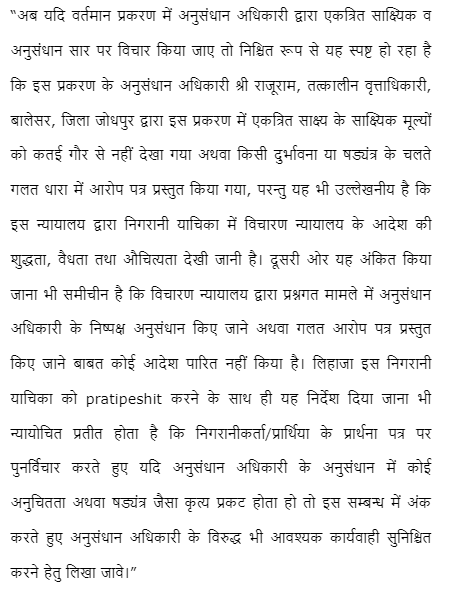
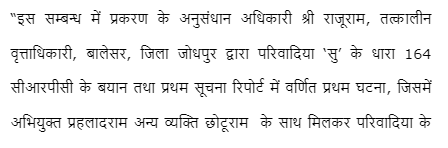
8. For proper appreciation of the controversy, this Court considers it appropriate to extract the relevant remarks which are under challenge.
In the order dated 28.07.2022, at page 19, the revisional court observed as under:
Similarly, in th
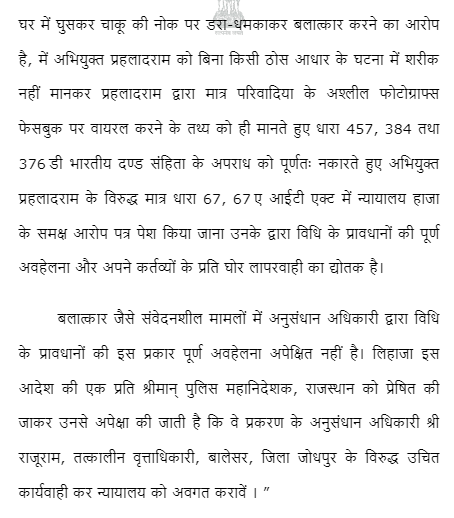
AI
Judicial remarks that carry civil consequences must not be made without an opportunity for the affected party to be heard, adhering to principles of natural justice.

Disparaging remarks against an Investigating Officer must meet a triple test of fairness, evidence, and necessity for the case's resolution.

Judicial remarks against individuals must comply with principles of natural justice, necessitating notice and an opportunity for a hearing before issuing adverse comments, particularly for officials.

The court emphasized that adverse remarks against individuals must adhere to principles of natural justice, requiring an opportunity to be heard before such comments are made.
Adverse judicial remarks against an Investigating Officer cannot be made without granting an opportunity for hearing, violating natural justice principles.


The High Court has inherent jurisdiction to expunge remarks made by itself or lower courts to secure justice, but this power is to be exercised in exceptional cases only.

Adverse remarks against public servants must be justified by evidence and made only after affording an opportunity to explain their conduct; mere negligence does not equate to wilful negligence under....



An indispensable Tool for Legal Professionals, Endorsed by Various High Court and Judicial Officers
Please visit our Training & Support
Center or Contact Us for assistance

Scan Me!
India’s Legal research and Law Firm App, Download now!


For Daily Legal Updates, Join us on :



 Back to top


