
 Back
Back





IN THE HIGH COURT OF JUDICATURE FOR RAJASTHAN AT JODHPUR
Nupur Bhati, J.
Anwar Ali Khan S/o Sultan Khan and ors. - Appellants
Versus
Marwar Muslim Education and Welfare Society, Jodhpur through its General Secretary and ors. – Respondents
S.B. Civil Misc. Appeal No. 2393/2024
Decided On : 26-09-2024
Injunction - Membership Dispute - CPC Sections 39, 104 - The court interpreted the provisions of the CPC regarding temporary injunctions and the scope of ad-interim relief, concluding that the trial court's decision to address membership issues was premature and not aligned with the relief sought.
Fact of the Case:
The appellants filed a suit for declaration and permanent injunction against the defendants for unlawfully rejecting their life membership and removing them from the voter list, seeking a temporary injunction to participate in upcoming elections.
Finding of the Court:
The court found that the trial court's order rejecting the injunction was based on an issue not pleaded by the appellants, but the matter could still be addressed in the pending suit.
Issues: Whether the trial court erred in adjudicating the membership issue at the ad-interim stage and whether the application for temporary injunction was rendered infructuous due to the completion of elections.
Ratio Decidendi: The court held that the trial court should not have addressed the merits of the membership issue at the ad-interim stage, as it was not part of the relief sought in the application for temporary injunction.
Result: The civil misc. appeal was disposed of, with the stay application also disposed of.
JUDGMENT :
Nupur Bhati, J.
1. The appellants/plaintiffs have preferred the instant misc. appeal under Order 43 Rule 1 (r) read with Section 104 of the Code of Civil Procedure, 1908 (‘CPC’) challenging the order dated 21.06.2024 passed by learned Additional District Judge No.7, Jodhpur Metropolitan, Jodhpur (‘Trial Court’) in Civil Misc. Application No.25/2024, whereby the learned Trial Court has rejected the prayer for ad-interim injunction and an erroneous finding with respect to appellants’ membership has been given, which was neither the subject-matter of the suit nor even pleaded by the appellants.
2. The facts apposite for the purpose of disposal of this misc. appeal are that the appellants/plaintiffs filed a suit for declaration and permanent injunction against the respondents/defendants before the learned Trial Court. The appellants/plaintiffs filed the suit assailing the action of the defendants No.1 to 6, whereby without having any authority or right and in gross violation of the Constitution of the Society, the life membership of the appellants has been rejected by the defendants and their names have been ordered to be removed from the voter list/list of life members. Along with the suit, the appellants/plaintiffs filed an application seeking temporary injunction under Order 39 Rule 1 & 2 read with Section 151 CPC with the prayer that the defendants be restrained from creating any hurdle in the way of appellants’ participation in the elections as voter and candidate(s), which were to be held on 23.06.2024.
3. The defendants No.1 to 7 filed reply to the application under Order 39 Rule 1 & 3 CPC while denying the contents thereof. In the reply, the defendants while defending rejection of appellants’ membership from the defendant-Society have raised various preliminary objections with respect to locus of the appellants to maintain the suit, conduct of the appellants and application forms submitted by the appellants/plaintiffs etc.
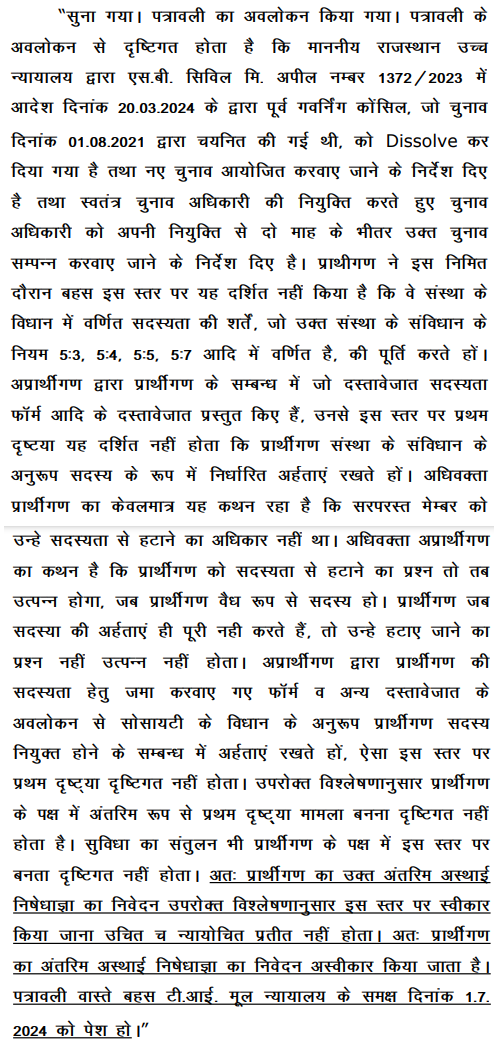
4. The learned Trial Court vide order impugned dated 21.06.2024, after considering the rival submissions made by the parties, proceeded to reject the prayer of the appellants and posted the matter for arguments on temporary injunction application on 01.07.2024.
5. Learned counsel appearing for the appellants submits that while exceeding the prayer, at ad-interim stage, the learned Trial Court ought not to touch the merits of the main suit, when the relief sought in the prayer has a nexus with the main relief sought in the suit itself. Learned counsel for the appellants submits that by way of filing application under Order 39 Rule 1 & 2 CPC, the appellants prayed that the defendants be restrained from creating any hurdle in the way of appellants’ participation in the elections and be permitted to participate in the elections in the capacity of voters and contest the election. Learned counsel for the appellants submits that the learned Trial Court has adjudicated upon the point of membership of the appellants, which was not even prayed or pleaded by the appellants, either in the suit or in the application seeking temporary injunction and thus non-suited the appellants at the threshold, at ad-interim stage, causing serious prejudice. He further submits that the issue before the learned Trial Court was pertaining to the legality of the power exercised by the defendants, inasmuch as they usurped the power of the Governing Council/General Council and removed the names of the appellants from the list of voters/list of life membership.
7. On the other hand, learned counsel appearing for the respondents submits that elections have already been conducted as per the Schedule and the result has also been declared thereafter. Learned counsel for the respondents submits that essentially the application under Order 39 Rule 1 & 2 CPC has been rendered infructuous. And, this fact has not been disputed by the learned counsel for the appellants/plaintiffs. Learned counsel for the respondents relied upon judgment in Man
AI
The court emphasized that issues not pleaded should not be adjudicated at the ad-interim stage of injunction applications.


The proper forum for shareholder disputes regarding oppression and mismanagement lies with the National Company Law Tribunal, not civil courts, and ad interim injunctions should not interfere with co....

Corporate governance principles require that allegations of oppression and mismanagement in public companies are addressed within the framework of the Companies Act, specifically through appropriate ....


[The court established that consent terms in electoral disputes are binding and that the rejection of nominations must be based on clear and consistent grounds, emphasizing the rights of members in t....

Approaching the court with clean hands, the binding nature of a decree passed in a suit under Order I, Rule 8 of the CPC, and the significance of the absence of a prayer for permanent injunction in t....

The court ruled that the balance of convenience favors allowing the electoral process to proceed without injunction, as the plaintiff failed to demonstrate irreparable harm and lacked a substantive c....
The Court emphasized that the public interest in maintaining the integrity of the electoral process outweighs individual claims, and statutory provisions bar injunctions against government bodies per....

An appeal against an ad interim injunction does not lie under Order XLIII Rule 1(r) of the CPC; such issues must be addressed through appropriate proceedings under Article 227 of the Constitution.



An indispensable Tool for Legal Professionals, Endorsed by Various High Court and Judicial Officers
Please visit our Training & Support
Center or Contact Us for assistance

Scan Me!
India’s Legal research and Law Firm App, Download now!


For Daily Legal Updates, Join us on :



 Back to top


