
 Back
Back





IN THE HIGH COURT OF JUDICATURE FOR RAJASTHAN AT JODHPUR
SHREE CHANDRASHEKHAR, KULDEEP MATHUR, JJ.
Union Of India – Appellant
Versus
Ajay Kumar S/o Late Shri Rajendra Kumar – Respondent
D.B. Civil Writ Petition No. 12554 of 2024
Decided on : 01-10-2024
Compassionate Appointment - Employment - IPC Sections 420, 467, 468, 471, 120-B - The court emphasized that mere acquittal does not guarantee compassionate appointment; the employer must consider the nature of the acquittal and any incriminating evidence before making a decision.
Fact of the Case:
The respondent sought compassionate appointment after the death of his father, a railway employee, who was facing criminal charges. The request was denied based on the nature of the acquittal, which was deemed not honorable due to moral turpitude.
Finding of the Court:
The court found that the Tribunal correctly ruled that the absence of incriminating evidence against the respondent should have led to a reconsideration of his application for compassionate appointment.
Issues: Whether the denial of compassionate appointment based on the nature of the acquittal was justified, considering the lack of incriminating evidence against the respondent.
Ratio Decidendi: The court held that an acquittal, even if based on the benefit of doubt, does not automatically disqualify a candidate for compassionate appointment, and the employer must evaluate the circumstances of the acquittal.
Result: The writ petition is dismissed, upholding the Tribunal's order for reconsideration of the respondent's application for compassionate appointment.
ORDER :
Per, Kuldeep Mathur,J.
The instant writ petition is directed against the order dated 23.01.2024 passed by the learned Central Administrative Tribunal, Jodhpur Bench (hereinafter referred to as ‘the learned Tribunal’) in OA No.275/2018: “Ajay Kumar v. Union of India & Ors.”., whereby, the petitioner- Railways has been directed to consider the case of the respondent for appointment on compassionate grounds on a suitable post being dependent family member of a deceased employee namely Rajendra Kumar.
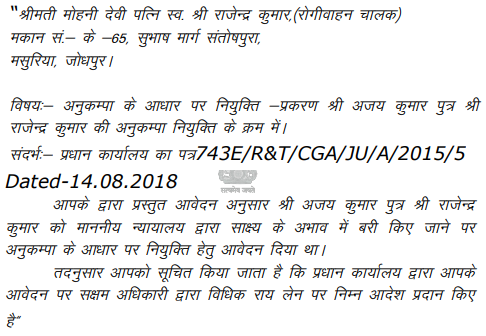
2. Facts of the case in brief are that the father of the respondent (hereinafter, referred to as, ‘deceased employee’) while working on the post of Ambulance Driver with petitioner-Railways passed away on 09.08.2014. At the time of the demise, the deceased employee was facing criminal trial for the offences punishable under sections 420, 467, 468, 471 and 120-B of the IPC in connection with FIR dated 08.08.2012. It is pertinent to mention here that in the aforesaid criminal case, the respondent and his mother were also made accused for the same offence. The competent criminal court after conducting criminal trial against the respondent and his mother vide judgment and order dated 17.02.2018 acquitted them from the charges by extending them benefit of doubt. The application dated 19.09.2014 filed by the mother of the respondent to the competent authority seeking appointment of his son i.e., the respondent on compassionate grounds came to be rejected vide communication dated 23.08.2018 on the ground that the acquittal of the respondent in criminal case involving moral turpitude was not an honorable acquittal.
3. Mr. Abhishek Sharma, learned counsel appearing on behalf of the petitioner- Railways vehemently and fervently submitted that the learned Tribunal while directing the competent authority of the railway department to consider the case of the respondent for appointment on compassionate ground failed to appreciate that the FIR dated 08.08.2012 was lodged by the complainant-Rajendera Kumar against the accused persons stating inter alia that the accused persons allured job aspirants seeking employment in the railways, to secure appointment in their favour and in order to deceive them, they not only got an application form filled up but also conducted a dummy written and medical examination. So much so, a forged appointment order for the post of Ticket Checker was also issued in favour of the complainant. As per the FIR, the written and medical examination was conducted in the presence of respondent. Learned counsel contended that looking to the seriousness of the allegations against the deceased employee and the respondent, mere acquittal in the criminal case would not automatically make the respondent entitled to compassionate appointment. The competent authority of the petitioner- Railways after considering all the relevant factors relating to the antecedents of the respondent in its discretion has rightly turned down the request made by the respondent to provide him compassionate appointment in the railways. It was urged that a perusal of the order dated 17.02.2018 passed by the competent criminal court clearly shows that the respondent had been acquitted on the basis of being extended the benefit of doubt.
To buttress these submissions, reliance has been placed on the following judgments:-
1. “Union of India & Ors. v. Methu Meda”: (2022)1 SCC 1
2. “The State of Madhya Pradesh & Ors. v. Bhupendra Yadav”: 2023 AIR (SC) 4553.
4. Per contra, Mr. Anirudh Purohit, learned counsel for the respondent, submitted that the learned Tribunal has rightly allowed the Original Application No.275/2018 preferred by the respondent. It was urged that the respondent was acquitted of all the charges levelled against him by the competent criminal court.
As a matter of fact, the order of the learned Tribunal dated 23.01.2024 would indicate that the learned Tribunal after going through the entire order passed by the competent criminal court opined that no
AI
Compassionate appointment cannot be denied solely based on an acquittal involving moral turpitude without considering the evidence and circumstances of the case.


Dependents entitled to compassionate appointment despite deceased employee's abated criminal case and dropped enquiry; presumption of innocence applies, no vicarious disqualification without proven g....


The mere pendency of a criminal case does not automatically disqualify a candidate for compassionate appointment; each case must be assessed on its own merits.

Suppression of criminal case information does not automatically disqualify compassionate appointment; objective evaluation required.
The acquittal in a criminal case does not automatically entitle a candidate for appointment, and the employer has the right to consider the antecedents of the candidate.
An acquittal based on benefit of doubt does not guarantee eligibility for employment in disciplined services, allowing employers discretion in hiring.



An indispensable Tool for Legal Professionals, Endorsed by Various High Court and Judicial Officers
Please visit our Training & Support
Center or Contact Us for assistance

Scan Me!
India’s Legal research and Law Firm App, Download now!


For Daily Legal Updates, Join us on :



 Back to top


