
 Back
Back





IN THE HIGH COURT OF JUDICATURE FOR RAJASTHAN AT JODHPUR
SHREE CHANDRASHEKHAR, MADAN GOPAL VYAS, JJ.
State of Rajasthan – Appellant
Versus
Ugam Singh S/o Shri Bhopal Singh – Respondent
D.B. Criminal Appeal No. 188 of 1996
Decided On : 04-11-2024
(A) Indian Penal Code - Sections 302 and 34 - Acquittal appeal against judgment in Sessions Case No. 47 of 1992 - Convicts charged with murder - Prosecution failed to prove intent to kill; injuries were inflicted in the heat of the moment - No motive established for murder - Acquittal upheld due to lack of evidence linking accused to fatal blow - Judicial norms dictate caution in overturning acquittals. (Paras 4, 9, 13)
(B) Acquittal - Presumption of innocence - High Court's power to review evidence in acquittal appeals is limited; must respect trial court's findings unless perverse or illegal. (Paras 13, 14)
ORDER :
1. This acquittal appeal has been filed to challenge the judgment rendered in Sessions Case No. 47 of 1992 on 13th September 1995 and the order of sentence passed against Hukam Singh, Madan Singh and Phool Singh on the same day.
2. In Sessions Case No. 47 of 1992, the aforementioned convicts were sent up for trial on the charge under section 302 and section 302 read with section 34 of the Indian Penal Code. The prosecution case as narrated by the informant Arjun Singh is that on 22nd July 1992 the accused persons attacked his father Bhanwar Singh and caused serious injuries on his head and body with a common intention to cause his death. On the basis of his written statement given to the Officer In-charge of Desuri around 2.30 pm on 2nd July 1992, a first information report vide Case No. 60 of 1992 was registered against the accused persons under Section 302 read with 34 of the Indian Penal Code. The Investigating Officer prepared inquest report and sent the dead body of Bhanwar Singh for post-mortem examination. This is the case of prosecution that on the basis of the disclosures given by the accused persons the crime weapon was recovered and sent for chemical examination to the FSL at Jaipur. After the investigation, a charge-sheet was filed against Hukam Singh, Madan Singh and Phool Singh and the charges were framed against them as aforesaid.
3. During the trial, the prosecution examined 38 witnesses and produced 61 material articles to support the charges framed against the aforementioned accused persons. On the other hand, the accused persons referred to the statements of Kheemaram vide Exhibit-1, Sawaram vide Exhibit-2, Laluram vide Exhibit-3, Smt. Lacchi vide Exhibit-4 and Devi Chand vide Exhibit-5 to demonstrate contradiction and improbability in the prosecution story.
4. The learned Sessions Judge referred to the statement of Paka Ram who tendered evidence as PW-20 and other witnesses to come to a conclusion that the prosecution miserably failed to prove the charge under section 302 or under section 302 read with 34 of the Indian Penal Code. For arriving at such a conclusion, the Sessions Judge held that there was no motive on the part of the accused persons to commit murder and the occurrence took place in the heat of the moment.
5. Mr. Deepak Choudhary, the learned Additional Advocate General refers to the medical evidence tendered by Dr. Manoj Kumar Saxena who was examined as PW-8 to support the present Acquittal Appeal on the ground that the number of injuries and the vital part of the body on which those injuries were caused are sufficient reasons to conclude that the accused persons had requisite intention and knowledge that death would be caused on account of such assault on Bhanwar Singh.
6. As PW-8, Dr. Manoj Kumar Saxena rendered his opinion that the injury Nos. 1 and 2 were sufficient to cause death.
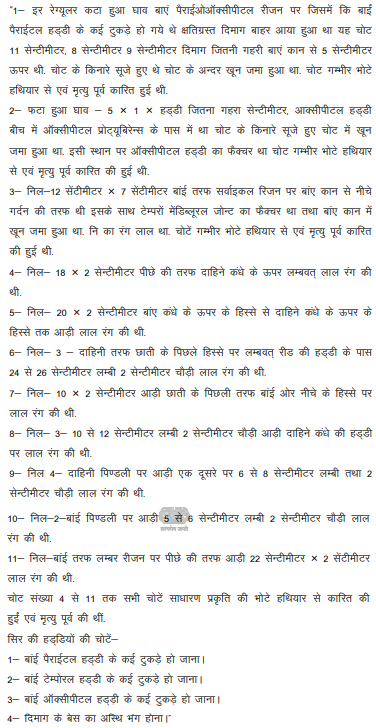
7. The following injuries were found on the person of Bhanwar Singh:
[English Translation]
“1. Irregular incised wound on left parieto-occipital region in which left parietal bone was broken into pieces and brain was exposed. This injury was 11 cm, 8 cm, 9 cm deep as far as brain and 5 cm above left ear. Edges of injury were swollen and blood was collected inside the injury. Injury was caused by a blunt weapon and before death.
2. Incised wound 5x1 cm deep as far as bone, occipital bone in the middle near occipital protuberance. Edges of injury were swollen and blood was collected inside the injury. There was fracture of occipital bone at the same place. Injury was caused by a blunt weapon and before death.
3. Contusion Mark - 12 cm x 7 cm on left cervical region below left ear towards neck along with temporomandibular joint. There was a fracture and blood had accumulated in the left ear. The wound was red in colour. The injuries were caused by a blunt weapon and before death.
4. Contusion Mark - 18 x 2 cm was red in colour, vertically on the back side above the right shoulder.
5. Contusion Mark - 20 x 2 cm was red
AI
The court upheld the acquittal due to insufficient evidence of intent to kill, emphasizing the presumption of innocence in criminal cases.

The judgment emphasizes the principles regarding the powers of the Appellate Court in dealing with appeals against acquittals, including the double presumption in favor of the accused and the require....

The prosecution must establish charges beyond reasonable doubt, especially when witness credibility is in question.

The presumption of innocence and the burden of proof require that the prosecution must establish intent and sufficient evidence for a murder conviction.
The prosecution must prove guilt beyond reasonable doubt, with the trial court's acquittal upheld due to insufficient evidence against the accused under murder charges while their conviction for grie....
The court upheld the trial court's acquittal on murder charges citing insufficient evidence, while affirming the conviction for grievous and simple hurt based on reliable testimonies.

The appellate court must uphold acquittals unless the prosecution's evidence conclusively proves guilt beyond reasonable doubt, affirming the presumption of innocence.
The appellate court cannot overturn an acquittal unless the trial court's decision is perverse or fundamentally flawed, emphasizing the presumption of innocence and the burden of proof on the prosecu....



An indispensable Tool for Legal Professionals, Endorsed by Various High Court and Judicial Officers
Please visit our Training & Support
Center or Contact Us for assistance

Scan Me!
India’s Legal research and Law Firm App, Download now!


For Daily Legal Updates, Join us on :



 Back to top


