
 Back





2025 Supreme(Raj) 873
HIGH COURT OF RAJASTHAN (JAIPUR BENCH)
MR. JUSTICE MAHENDAR KUMAR GOYAL, J
Deepak Yadav S/o Shri Gajraj Yadav - Appellant
Versus
State of Rajasthan - Respondent
CW / 18358 / 2024
Decided On : 11-02-2025
Important Points
Subject
Administrative Law - Writ Jurisdiction
Act Referred
Headnote
(A) Constitution of India - Article 226 - Writ petition - Petitioners challenged the allotment of land to a different entity without demonstrating locus standi or violation of legal rights - Court emphasized the necessity of establishing a legal injury to maintain a writ petition. (Paras 3, 4, 5, 6, 7, 8)
(B) Locus Standi - The principle of locus standi requires that a petitioner must show a personal legal grievance or injury to maintain a writ petition under Article 226. (Paras 5, 6, 7)
Facts of the case:
The petitioners contested the allotment of land made by the Board of Infrastructure Development to a different entity, claiming a lack of legal standing.
Findings of Court:
The court found that the petitioners failed to establish any breach of legal or fundamental rights, leading to the dismissal of the writ petition.
Issues: The main issues were whether the petitioners had locus standi to challenge the allotment and if they suffered any legal injury.
Ratio Decidendi: The court ruled that a writ petition under Article 226 requires the petitioner to demonstrate a personal legal grievance or injury, which the petitioners failed to do.
Result: Writ petition dismissed.
Advocate Appeared:
Mr. Sumer Saini
Judgment / Order
JUDGMENT :
1. This writ petition is filed with following prayers:
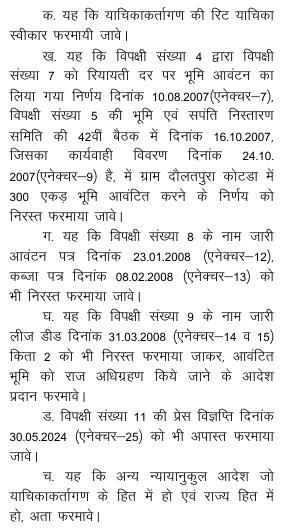
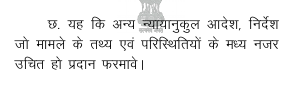
2. The petitioners have come out with a plea that although, the respondent No.4-Board of Infrastructure Development and Investment Promotion took a decision in its meeting dated 10.08.2007 to allot the subject piece of land in favour of the respondent No.7, i.e., International Amusement Limited; but, the allotment letter and possession letter were issued in favour of the respondent No.8-International Amusement and Infrastructure Private Limited; both having different identities.
3. However, the memo of the writ petition does not reflect locus of the petitioners to assail the aforesaid action. Despite repeated requests of this Court, learned counsel for the petitioners is not able to satisfy as to violation of any of their legal or fundamental right under the orders impugned in the writ petition.
4. It is trite law that to maintain a writ petition under Article 226 of the Constitution of India, the petitioner has to plead and establish breach of his legal and/or fundamental right or a corresponding legal obligation upon the respondent qua him. A Constitution Bench of the Hon’ble Supreme Court has held in the case of Calcutta Gas Company (Proprietary) Ltd. Vs. State of West Bengal and others: Civil Appeal No.138/1961.
“(5) The first question that falls to be considered is whether the appellant has locus standi to file the petition under Art. 226 of the Constitution. The argument of learned counsel for the respondents is that the appellant was only managing the industry and it had no proprietary right therein and, therefore, it could not maintain the application. Article 226 confers a very wide power on the High Court to issue directions and writs of the nature mentioned therein for the enforcement of any of the rights conferred by Part III or for any other purpose. It is, therefore, clear that persons other than those claiming fundamental rights can also approach the Court seeking a relief thereunder. The Article in terms does not describe the classes of persons entitled to apply thereunder; but it is implicit in the exercise of the extraordinary jurisdiction that the relief asked for must be one to enforce a legal right. In state of Orissa v. Madan Gopal, 1952 S C R 28 : (AIR 1952 S C 12) this Court has ruled that the existence of the right is the foundation of the exercise of jurisdiction of the Court under Art. 226 of the Constitution. In Charanjit Lal Chowdhuri v. Union of India, 1950 S C R 869 : (AIR 1951 S C 41), it has been held by this Court that the legal right that can be enforced under Art. 32 must ordinarily be the right of the petitioner himself who complains of infraction of such right and approaches the Court for relief. We do not see any reason why a different principle should apply in the case of a petitioner under Art. 226 of the Constitution. The right that can be enforced under Art. 226 also shall ordinarily be the personal or individual right of the petitioner himself, though in the case of some of the writs like habeas corpus or quo warranto this rule may have to be relaxed or modified.”
5. Further, a learned Single Judge of this Court, in S.B. Civil Writ Petition No.18255/2015: Rajasthan State Roadways Employees Union (AITUC) Vs. State of Rajasthan & Others vide order dated 18.02.2016, while, declining to enter into merits of the case for the reason that the petitioner-Unions had no locus standi to challenge the modified scheme, held as under:-
“In my considered opinion, the merits of the case do not require any address for the reason that the Unions apparently have no locus standi to lay a challenge to the modified scheme notified on 29.05.2015, the subsequent notification of the routes dated 02.09.2015 and the invitation of the applications from private bus operators on 08.09.2015. It is no more res integra that the jurisdiction under Article 226 of the Constitution of India is not available at large but the power of judicial revi









