


 Back
Back





2025 Supreme(Raj) 1197
HIGH COURT OF JUDICATURE FOR RAJASTHAN BENCH AT JAIPUR
MR. JUSTICE AVNEESH JHINGAN, J
Purshottam Lal Jagnani S/o Sh. Teja Ram Jagnan - Appellant
Versus
Shri Thakur Ji Laxminath Ji Trust - Respondent
S.B. Civil Writ Petition No. 14502/2017
Decided On : 28-01-2025
Advocate Appeared:
For the Petitioner: Mr. Ajeet Kumar Bhandari, Sr. Adv. assisted by Mr. Jai Sharma
For the Respondent: Mr. M.M. Ranjan, Sr. Adv. with Mr. Rohan Agarwal
A corrigendum issued to correct a typographical error has retrospective effect and does not alter vested rights under the Rajasthan Rent Control Act.
Headnote:
(A) Rajasthan Rent Control Act, 2001 - Section 3(viii) - Quashing of certificate for recovery of possession - The petitioner challenged the applicability of the Act to the Trust's property, arguing that a corrigendum was not retrospective. The court held that the corrigendum was curative and related back to the original notification. (Paras 3, 8, 11)
(B) Legal Principles - A corrigendum can only correct typographical errors and cannot alter vested rights or the effect of law. The court emphasized that retrospective operation is permitted only for curative statutes. (Paras 9, 10)
Facts of the case:
The petitioner was a tenant of the Trust, which issued notices for eviction. The petitioner contested the applicability of the Rajasthan Rent Control Act based on a corrigendum issued in 2018.
Findings of Court:
The corrigendum was deemed curative and related back to the original notification, thus affirming the Trust's exemption from the Act.
Issues: Whether the corrigendum was retrospective and the applicability of the Act to the Trust's property.
Ratio Decidendi: The court ruled that the corrigendum corrected a typographical error and did not create new rights or exemptions, thus maintaining the original notification's effect.
Result: Writ petition dismissed.
Order :
1. This petition is filed seeking quashing of certificate for recovery of possession dated 09.05.2017 and order of the Appellate Authority dated 26.02.2013.
2. The petitioner – Purshottam Lal Jagnani (now represented through legal representatives) by rent note dated 01.11.1971 was inducted as tenant by the respondent No.1 – Shri Thakur Ji Laxminath Ji Trust (for brevity ‘the Trust’). The rent of the shop was Rs.324/-, payable after interval of six months. The trust on 11.10.2002 issued a notice to the petitioner for vacating the premises. The Trust again gave a notice on 23.02.2006 for vacating the premises and terminating the tenancy with effect from 12.04.2006. On failure of the petitioner to vacate the premises, the application filed by petitioner for issuance of a certificate for recovery of possession and for payment of mesne profit was allowed on 26.02.2013. The appeal filed by the petitioner was dismissed on 09.05.2017 and hence, the present petition.
3. The only one issue raised by learned senior counsel for the petitioner is that the corrigendum published in Rajasthan Gazette Extra-ordinary dated 02.02.2018 modifying the notification dated 14.09.2005 is not retrospective. The property of the trust till Feb. 2018 was not exempted from applicability of Chapter II and III of the Rajasthan Rent Control Act, 2001 (for brevity ‘the Act’) and the proceedings for eviction could have been undertaken only under the Act. Reliance is placed upon decisions of the Supreme Court in the case of The Strawboard Manufacturing Co. Ltd. Vs. Gutta Mill Workers’ Union reported in AIR 1953 SC 95; Maharaja Shri Umaid Mills Ltd. Pali Vs. Industrial Tribunal Jaipur and Ors. reported in AIR 1954 Raj. 274; and Kapoorchand Vs. State of Rajasthan reported in 1962 Rajasthan 258
4. As per contra, the plea now being raised was not raised before the Rent Tribunal. Further that the corrigendum was issued only to correct the typographical error. That the petitioner is not disputing that the Notification under Section 3 (viii) of the Act and the corrigendum is pertaining to the Trust.
5. The Rajasthan Rent Control Act, 2001 (for short ‘the Act’) received the assent of the President on 25.02.2003 and published in Rajasthan Gazette Extra-ordinary on 11.03.2003. Section 3 of the Act stipulates the premises to which Chapter II & III of the Act are not applicable. As per Section 3 (viii) of the Act, the premises belonging to religious, charitable or educational trust specified by the State Government by notification in the Official Gazette are out of ambit of the Act.
6. The notification dated 14.09.2005 was issued under Section 3 (viii), that the Chapter II & III of the Act were not applicable to the properties owned by the Trust. The name of the Trust in the Notification was mentioned as “Thakur Shri Laxminath Ji Trust, Jhunjhunu” instead of “Shri Thakurji Laxminath Ji Trust, Jhunjhunu”. The error was rectified by the corrigendum published in Rajasthan Gazette Extra-ordinary dated 02.02.2018.
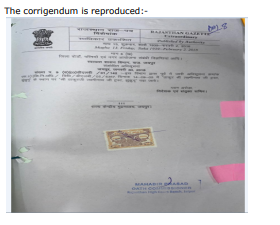
7. It is not the case set up by the petitioner that notification dated 14.09.2005 does not relate to trust or there exists another trust by the name mentioned in the notification dated 14.09.2005.
8. The contention that corrigendum dated 30.01.2018 is prospective and the non applicability of Chapter II and III of the Act shall be from 30.01.2018 has fallacy. The corrigendum issued is curative and shall relate back to the date of issuance of notification under Section 3(viii) of the Act. The consequence of acceptance of the argument would be that corrigendum issued to carry out correction in earlier notification shall grant a fresh exemption to trust from applicability of Chapter II and III of the Act. In other words, the corrigendum shall be a new notification which is against the explicit language used.
9. It would be fruitful to refer the following decision of the Supreme Court.
In Government of India and Ors. vs. Indian Tobacco Association reported in (2005) 7 SCC 396












