
 Back
Back





IN THE HIGH COURT OF JUDICATURE FOR RAJASTHAN AT JAIPUR
ANOOP KUMAR DHAND, J.
Sangam Chaudhary W/o Shri Vishvendra Singh - Appellant
Versus
The State of Rajasthan - Respondent
S.B. Civil Writ Petition Nos. 3425, 6663 of 2025
Decided On : 20-08-2025
Certainly. Based on the provided legal document, here are the key points:
The court has taken up multiple writ petitions together due to common issues of law and fact, and has decided the matter through a single order (!) .
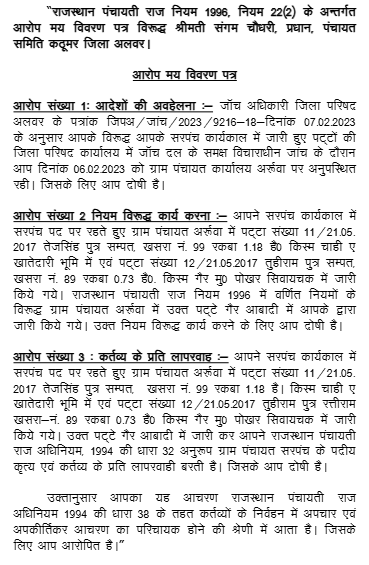
The petitioner, who is currently serving as Pradhan, was issued a charge-sheet related to alleged misconduct during her previous term as Sarpanch, specifically regarding issuing pattas outside the abadi land. The allegations stem from a complaint and subsequent enquiries, including a survey, which found prima facie evidence against her (!) (!) .
The petitioner challenges the legality of the charge-sheet and suspension order, asserting that previous enquiries cleared her of such misconduct and that the current proceedings are unwarranted and delayed. She also claims that internal correspondence suggesting the enquiry was unnecessary has no legal sanctity (!) (!) (!) (!) .
The respondent argues that misconduct allegations can be pursued even for actions during a previous term, and that suspension and enquiry are within the authority's powers under the relevant legislation. They emphasize that the correctness of the allegations cannot be judicially assessed at this stage (!) (!) .
The court observed that misconduct allegations related to actions during a previous term are permissible to be investigated, and that the authority's internal notes or correspondence do not have legal sanctity. The court clarified that the internal notes are merely administrative and do not create legal rights (!) (!) .
The court noted that the delay in initiating proceedings does not bar the enquiry, as the law permits investigations into past misconduct even after the expiry of the term of office, provided the misconduct occurred during the previous tenure. The provisions explicitly allow for such enquiries to be continued or initiated later (!) (!) (!) .
The court emphasized that the correctness of the charges and allegations is not to be decided at this stage, as the matter is subject to ongoing enquiry, and that the court should not interfere unless procedural irregularities are evident. The enquiry officer is to reach independent conclusions based solely on the evidence (!) .
Suspension, being a temporary administrative measure, is not equivalent to penalty, but it should be exercised with caution. The court acknowledged that elected representatives are different from employees, but also emphasized that the court has a responsibility to intervene in cases of apparent misconduct or procedural irregularities (!) .
The court rejected the writ petitions, holding that the proceedings and suspension orders are within the legal framework. It directed the authorities to complete the ongoing enquiry within three months, ensuring that the process is fair and not influenced by extraneous observations (!) (!) .
The court clarified that its observations are only for the purpose of disposal and should not influence the ongoing enquiry. The authorities are instructed to conclude the enquiry based on the merits and provide a fair opportunity of hearing to the petitioner (!) (!) .
All pending applications, including stay applications, were also rejected, reaffirming that the authorities should proceed with the enquiry expeditiously and conclude it within the stipulated time frame (!) .
The legal principles affirm that an enquiry can be initiated and continued even after the expiry of the term of the office, and that suspension is a temporary administrative action that does not amount to penalty. The proceedings are to be conducted fairly, respecting the rights of the elected representative (!) (!) (!) .
Please let me know if you need a more detailed analysis or specific legal advice related to this case.
| Table of Content |
|---|
| 1. common issues of law and fact in writ petitions. (Para 1 , 2 , 3) |
| 2. petitioner's arguments on charge-sheet and suspension. (Para 4 , 5 , 6) |
| 3. state's opposition regarding complaints and suspension. (Para 7 , 8 , 18) |
| 4. court's observations on procedural issues and authority. (Para 9 , 10 , 11 , 12) |
| 5. legal grounds for suspension under the act. (Para 13 , 14 , 15 , 16) |
| 6. court's restraint in influencing ongoing enquiry. (Para 17 , 19) |
| 7. final decision and instructions for timely enquiry. (Para 20 , 21 , 22 , 23) |
ORDER :
1. Since common question of facts and law are involved in these writ petitions, therefore, with the consent of counsel for the parties, all the matters are taken up and heard together for final disposal and are being decided by this common order.
2. S.B. Civil Writ Petition No.6663/2025 has been submitted against the impugned order dated 25.04.2025 by which the petitioner has been placed under suspension by the respondents in exercise of the powers contained under Section 38 of the Rajasthan Panchayati Raj Act, 1994 (hereinafter referred to as “the Act of 1994”).
3. S.B. Civil Writ Petition No.3425/2025 has been submitted by the petitioner against the charge-sheet issued to her under Rule 22(2) of the RAJASTHAN PANCHAYATI RAJ RULES , 1996 (hereinafter referred to as “the Rules of 1996”).
4. Learned Senior Counsel for the petitioner submits that the petitioner is presently serving as the elected Pradhan for the year 2025. A charge-sheet has been issued to the petitioner under Rule 22(2) of the Rules of 1996 pertaining to an incident that occurred during her tenure as Sarpanch in the year 2017. It is alleged that the petitioner had issued Pattas outside the abadi land, i.e., in Gair Mumkin Siwai Chak. Learned counsel further submits that thrice enquiries were conducted in the matter. In the first enquiry, it was found that in all eight pattas were issued, out of which six pattas were issued within the abadi land and two pattas were issued outside the abadi land. In the second enquiry, no charges were found to be proven against the petitioner. However, in the third enquiry, which was conducted with the help of DGPS survey, it was again alleged against the petitioner that two pattas of land were issued by her outside the abadi land. Learned counsel further submits that the identification of the nature of land is not within the competence of the Sarpanch and it was the duty of the Revenue Officer to identify the nature of the land. Therefore, under these circumstances, even if two pattas were found to have been issued outside the abadi land, the petitioner cannot be held liable for any error.
5. Learned Senior Counsel for the petitioner submits that the incident pertains to the year 2017, i.e., for the earlier term of the petitioner as Sarpanch, which was completed in the year 2020 and thereafter, the petitioner was re-elected as Pradhan in the year 2020. Learned counsel submits that there was no reason or occasion available with the respondents to conduct the enquiry, after the completion of the petitioner’s earlier term. Learned counsel further submits that a complaint was lodged against the petitioner in the year 2022, which remained pending for three years and all of sudden not only the charge-sheet has been served upon the petitioner but she has also been placed under suspension. Learned counsel submits that the enquiry pertains to documentary evidence, therefore, suspension of the petitioner is wholly unwarranted, as she is not going to influence the enquiry proceedings. Learned counsel submits that at one point of time, the Commissioner, Department of Panchayat Raj has recorded a finding in the note-sheet that the enquiry into the matter has already been completed on an earlier occasion and accordingly, the Commissioner was of the opinion that there was no need to initiate a fresh enquiry against the petitioner. Learned counsel submits that, under these circumstances, interference of this Court
AI
Elected officials can be charged and suspended for past misdeeds, with ongoing inquiries permissible regardless of the term expiration, illustrating the accountability of public representatives under....

The court upheld the suspension of an elected representative based on prima facie evidence of misconduct, emphasizing that judicial review cannot interfere with charge-sheets unless issued by an inco....
The court established that suspension of a Sarpanch is permissible when an inquiry is initiated under the relevant provisions of the Rajasthan Panchayati Raj Act and Rules.

The court established that the suspension under Section 38(4) of the Rajasthan Panchayati Raj Act, 1994, was justified when the petitioner was found involved in a corruption case and the procedural r....
Point of law: power of suspension may be invoked by the State Government, if the proceedings have been commenced for removal of a member as provided under subsection (1) of Section 39 of the Act of 2....
The court affirmed that the State Government can suspend a Sarpanch based on inquiry initiation, even without a preliminary report, provided the member is given an opportunity to explain.
Suspension of an elected representative is valid when misconduct is established, with the suspension being justified under relevant statutory provisions, ensuring accountability and public confidence....
The court affirmed that suspension of an elected representative can occur based on a preliminary enquiry report without prior hearing, provided the charges are grave enough to warrant such action.
Suspension of an elected representative must be based on sufficient grounds and objective satisfaction, not arbitrary or politically motivated actions.



An indispensable Tool for Legal Professionals, Endorsed by Various High Court and Judicial Officers
Please visit our Training & Support
Center or Contact Us for assistance

Scan Me!
India’s Legal research and Law Firm App, Download now!


For Daily Legal Updates, Join us on :



 Back to top


