Back
Back





2026 Supreme(Raj) 121
IN THE HIGH COURT OF JUDICATURE FOR RAJASTHAN AT JODHPUR
SUNIL BENIWAL, J.
Ankur Maglani S/o Ramesh Kuamr Maglani – Appellant
Versus
State of Rajasthan – Respondent
S.B. Civil Writ Petition No. 19691 of 2025
Decided On : 23-01-2026
For the Appellants : Muktesh Maheshwari, Gaurav Ranka
For the Respondents: Rajesh Parihar, Nishant Gaba
A writ petition lacks maintainability if the petitioner fails to demonstrate locus standi and necessary parties are not joined in the proceedings.
Headnote:(A) Rajasthan Public Trust Act, 1959 - Section 38 - Maintainability of writ petition - Preliminary objections raised on grounds of lack of locus standi, non-joinder of necessary parties and absence of cause of action - The Court held that the petitioner, in individual capacity, cannot question the order regarding Trust management issues; Trust is a necessary party to the proceedings. (Paras 2-4)
(B) Locus Standi - Essentiality - Petitioner failed to demonstrate authorization from Trust to file writ, rendering it unmaintainable - Precedents affirming need for locus standi. (Paras 2A, 2B)
(C) Necessary Parties - Suit against Trust requires Trust to be included as a party; non-joinder leads to dismissal. (Paras 2B)
Findings of Court:
Writ petition dismissed as it lacked necessary standing and parties involved, upholding preliminary objections.
Issues: Maintainability of writ petition based on locus standi, necessary parties, and cause of action.
Ratio Decidendi: Petitioner’s incapacity to maintain writ in absence of proper authorization from Trust and necessary parties established.
Result: Writ petition dismissed.
| Table of Content |
|---|
| 1. preliminary objections to writ jurisdiction. (Para 1) |
| 2. respondents argue against petitioner's standing. (Para 2) |
| 3. petitioner's defense of standing. (Para 3) |
| 4. court's analysis on locus standi. (Para 4) |
| 5. court rules on maintainability. (Para 5) |
| 6. conclusion: petition dismissed. (Para 6 , 7) |
ORDER :
1. Heard learned counsel for the parties on the preliminary objections raised by the private respondents No.3 & 4 with regard to the maintainability of the present writ petition.
2. Learned counsel appearing on caveat on behalf of the private respondents No.3 & 4 has raised following preliminary objections :-
A. It is submitted that the petitioner has no locus standi to file the present writ petition in the following manner :-
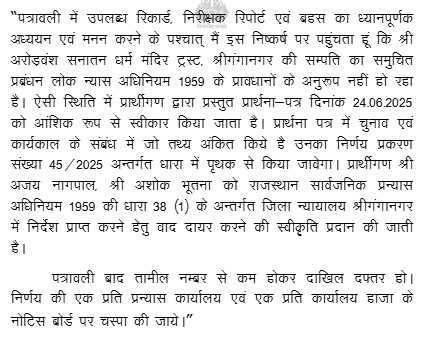
I. It is submitted that the private respondents preferred an application under Section 38 of the Rajasthan Public Trust Act, 1959 (‘the Act’) against Shri Arorvansh Sanatan Dharam Mandir Trust, highlighting various irregularities committed by the sitting trustees in the management of the Trust affairs. It is also submitted that since the application was submitted against the Trust, therefore, the petitioner in individual capacity could not have any grievance against an order, which has been passed on the application filed by the respondents under Section 38 of the Act.
II. It is submitted that after passing of the impugned order, a suit has been instituted against the Trust and not against the petitioner in his personal or individual capacity and for this reason too, the present writ petition filed by the petitioner is not maintainable.
III. In the writ petition it has nowhere been mentioned anything about the locus of the petitioner or under what capacity the present writ petition has been filed. It is submitted that there is no resolution of the Trust authorizing the present petitioner to file the present writ petition nor it is claimed anywhere in the writ petition that petitioner has been authorized by the Trust to file the present writ petition.
IV. It is submitted that no adverse or coercive direction has been issued against the petitioner and therefore, no cause of action arises for the petitioner to invoke the extra-ordinary writ jurisdiction of this Court.
V. While referring to the application submitted by the private respondents under Section 38 of the Act, it is submitted that in the application the allegations were with regard to mismanagement of the Trust. The petitioner is unauthorizedly occupying the position of the President and further misusing the trust property. It was also contended that the tenure of the present petitioner was already over and misusing his position, the tenure was got extended. It is further submitted that the managing trustee, in complete violation of the bye-laws, is neither maintaining nor providing the accounts and that mass-scale irregularities are being committed by the managing trustees of the Trust. The contents of the application itself indicated that power under Section 38 of the Act is invoked by the private respondents raising an issue with regard to mismanagement of the Trust and therefore, permission was sought that they may be allowed to institute appropriate civil suit against the Trust. It is submitted that a reply to the said application was filed by the petitioner as the President of the Trust.
Based on the above submissions, it is contended that the writ petition is not maintainable at the instance of the present petitioner.
VI. In support of the submissions made, learned counsel for the respondents has relied on the judgment passed by the Division Bench of this Court in Income Tax Contigent Employees Union & Anr. Vs. Union of India & Ors. (DBCWP No. 16777/2019), decided on 10.01.2022, wherein it was held that the writ petition filed without proper authorization is liable to be dismissed.
Further reliance has been placed on the judgment passed by the Allahabad High Court in the case of Suresh Agarwal & Anr. Vs. State of U.P. & Ors. 2016 Supreme