Back
Back





2025 Supreme(Raj) 2631
HIGH COURT OF JUDICATURE FOR RAJASTHAN AT JODHPUR
MANOJ KUMAR GARG, RAVI CHIRANIA, JJ.
Jaimal And Anr. - Appellants
Versus
State - Respondent
D.B. Criminal Appeal No. 73 of 1996
Decided On : 09-10-2025
For the Appellant : Mr. Rdss Kharlia, Ms. Kinjal Purohit
For the Respondent: Mr. Pawan Kumar Bhati, Pp
The convicting based solely on circumstantial evidence and extra-judicial confessions requires corroborative proof and must adhere to well-established principles regarding such evidence.
Headnote:(A) Indian Penal Code, 1860 - Sections 302, 34, and 404 - Criminal Appeal against conviction - Appellants challenged life imprisonment sentence imposed on them for murder and theft - No direct evidence produced; case based on circumstantial evidence and extra-judicial confession - Importance of corroboration for extra-judicial confession emphasized. (Paras 1, 25, 28)
(B) The conviction can only stand if the prosecution has provided evidence beyond reasonable doubt; various witnesses turned hostile, raising concerns about reliability of the evidence. (Paras 12, 16, 20)
(C) Circumstantial evidence must satisfy five principles established by Supreme Court; in this case, the chain of evidence was not proved, leading to the conclusion that conviction should be quashed. (Paras 20-28)
Facts of the case:
The FIR was registered by Raja Ram based on information regarding the discovery of a deceased body in a field. The appellants were accused of murder and theft without direct evidence linking them to the crime. Witnesses presented by the prosecution were often declared hostile, undermining the prosecution's case.
Findings of Court:
The prosecution failed to prove its case beyond reasonable doubt due to numerous contradictions and lack of reliable evidence. The appeal was allowed, leading to the quashing of the initial judgment.
Issues: The key issue was whether the prosecution could establish the presence of the accused at the crime scene and whether the reliance on extra-judicial confessions was valid without corroborative evidence.
Ratio Decidendi: The court underscored the need for both corroborative evidence and the necessity for each circumstantial link to be firmly established before a conviction based on such evidence can be considered valid.
Result: Appeal allowed; conviction quashed and set aside.
| Table of Content |
|---|
| 1. factual background of the case. (Para 1 , 2 , 3 , 4) |
| 2. arguments raised by the appellants. (Para 5 , 6 , 7 , 8 , 9 , 10 , 11 , 12 , 13 , 14 , 15) |
| 3. court's analysis of evidence. (Para 17 , 18 , 19 , 23 , 24 , 25 , 26 , 27) |
| 4. principles governing circumstantial evidence. (Para 20 , 21 , 22) |
| 5. conclusion and order of the court. (Para 28 , 29 , 30) |
JUDGMENT :
RAVI CHIRANIA, J.
1. The present criminal appeal has been filed under Section 374 Cr.P.C. by the accused-appellants Jaimal Ram and Bhagwana Ram to challenge the impugned judgment dated 18.01.1996 passed by Session Judge, Hanumangarh in Sessions Case No. 63/94 (96/91) titled as “State vs. Jaimal and Anr” whereby both the accused-appellants were convicted and sentenced which are as under:-
| S. No. | Offence U/s | Sentence | Fine | Sentence in default of time |
| 01. | 302/34 IPC | Life Imprisonment | Rs. 2,000/- | 2 years RI |
| 02. | 404 IPC | 3 years RI | Rs. 500/- | 6 months RI |
2. The appeal was filed in the year 1996 and before hearing, status of both the accused were called from the learned Public Prosecutor. The learned Public Prosecutor informed this Court on 24.01.2024 that both the accused are alive.
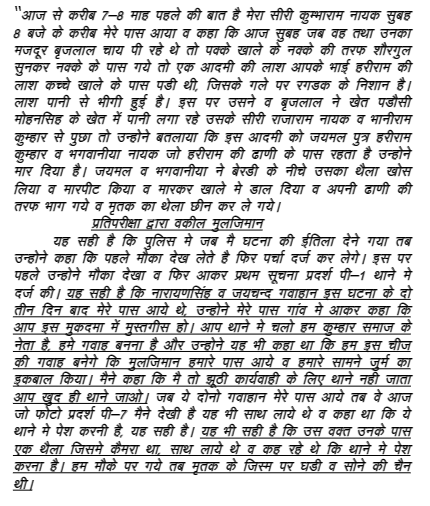
3. The brief facts as noted from the record of the learned trial court are that one Raja Ram lodged a verbal report on 22.09.1991 to SHO Police Station Dibi, District Hanumangarh on which FIR bearing No. 232/1991 was registered. The oral report, Exhibit P-1 is reproduced as under:-
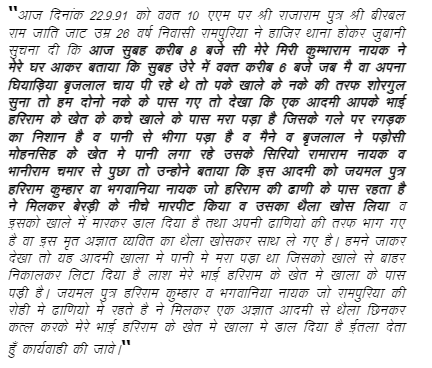
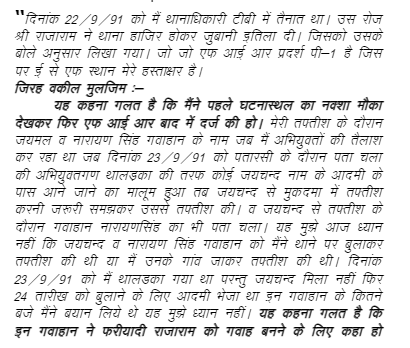
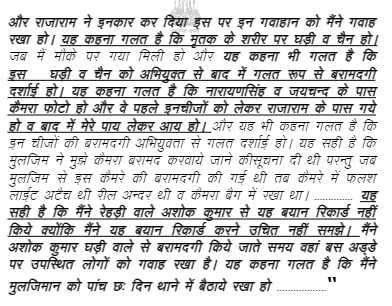
4. As per the oral report the complainant found the body of deceased in the agricultural field of Hari Ram. The FIR was registered against the named person i.e. the appellants herein. The police conducted the investigation and arrested accused- appellants herein and filed the charge-sheet against them. The prosecution to prove its case produced 16 witnesses and exhibited 40 documents in documentary evidence. In defence the statement of accused persons were recorded under Section 313 Cr.P.C. as well as of three defence witnesses. The learned trial court after considering the statement of all the witnesses, documents exhibited by the prosecution and statement of accused as recorded under Cr.P.C, and three of defence witnesses, passed the judgment dated 18.01.1996, impugned in the present appeal, whereby the accused-appellant were punished for offence under Section 302 r/w 34 IPC and 404 as mentioned in the above paras.
5. The learned counsel for the appellant Mr. RDSS Kharlia along with Ms. Kinjal Purohit, submitted that they have preferred the present appeal on the following grounds.
“1. Because, the learned trial court has erred in convicting and sentencing the appellants.
2. Because there is admittedly no direct evidence of the crime. Circumstances relied upon by the learned court below are not made out. Under these circumstances, the case for conviction is not made out.
3. Because, the Extra Judicial Confession relied upon by the learned trial court, is not a piece of evidence, which should have been relied upon. This is a totally fabricated evidence. Witnesses have been doubted and therefore, the evidence deserves to be discarded.
4. Because the P.W.1 Rajaram the first informant has clearly deposed that these witnesses have come to him and has stated that they wanted to help the prosecution. In the face of this witness their testimony could not have been relied.
5. Because the circumstances of last seen has been found to be established on the basis of the evidence of the father of the deceased. No identification parade was held. It is the admitted case that the witness had seen the accused for the first time when the accused allegedly went to his shop. Next time they were seen by him in the Court. This makes his evidence unreliable.
6. Because the Photo Graphs have been held to be of the spot, where the dead body was found. There was no spot near the dead body, which has the resemblance of the back ground of the photographs, the I.O. could have said so but there is nothing on record to suggest the same. Wrong reliance has be