1. Enforceability of policy assurances for renewable energy promotion and withdrawal of electricity duty exemption. (Para 1 , 2 , 3 , 4 , 5 , 6 )
 Back
Next 





2026 Supreme(Raj) 357
HIGH COURT OF JUDICATURE FOR RAJASTHAN AT JODHPUR
ARUN MONGA, SUNIL BENIWAL, JJ.
M/s Ultra Tech Cement Ltd. - Petitioner
Versus
Energy Department, Government Of Rajasthan - Respondent
D.B. Civil Writ Petition No. 1151 of 2023 Connected with D.B. Civil Writ Petition Nos - 12531 of 2021, 13492 of 2021, 13525 of 2021, 15565 of 2021, 13979 of 2022, 15593 of 2022, D.B. Civil Writ Petition Nos – 7298 of 2022, 9591 of 2022, 9593 of 2022, 9621 of 2022, 9633 of 2022, 9689 of 2022, 12614 of 2022, 13681 of 2022, 14422 of 2022, 15097 of 2022, 15337 of 2022, 17557 of 2022, 17691 of 2022, 19686 of 2022, 1964 of 2023, 2423 of 2023, 2688 of 2023, 2811 of 2023, 10590 of 2023, 10618 of 2023, 11135 of 2023, 18783 of 2023, 19436 of 2023, 4503 of 2024.
Decided On : 06-04-2026
Important Points
State promises in executive policies, if relied upon for investment, are enforceable via promissory estoppel. Such policies cannot be arbitrarily withdrawn retrospectively to divest accrued rights, and the State cannot use the absence of a statutory notification to evade a clear and unequivocal promise.
Subject
Administrative Law - Promissory Estoppel
Act Referred
Headnote
(A) Rajasthan Electricity (Duty) Act, 1962 - Section 3(3) - Electricity Act, 2003 - Sections 3, 7 and 9 - Constitution of India - Articles 14 and 21 - Exemption from electricity duty for captive solar power plants - Promissory estoppel and legitimate expectation - The State’s representation in a policy to grant fiscal incentives to induce investment in the renewable energy sector constitutes a binding promise when the investor alters their position to their detriment (Paras 13, 14) - Promotional policies, even if executive in nature, are enforceable in equity through the doctrine of promissory estoppel (Para 16) - The State cannot rely on its own failure to issue a statutory notification as a defense to defeat a promise consciously made in a policy (Para 15).
(B) Legitimate Expectation - Public authorities should not resile from expectations created through express representation, ensuring substantive and procedural fairness in governance (Para 14.1).
(C) Policy Amendments - While the State retains the power to modify economic policies in the larger public interest, such modifications cannot operate retrospectively to divest accrued or vested rights of those who acted upon the original representation (Paras 19, 20).
Facts of the case:
The State introduced a solar energy policy assuring exemption from electricity duty for seven years from the commercial operation date (COD) for captive solar plants to promote renewable energy. Relying on this representation, the petitioner made substantial capital investments to establish captive solar power projects. Subsequently, the State amended the policy, withdrawing the exemption and making it subject to government orders and notifications. The State contended that exemptions could only be granted through statutory notifications under the 1962 Act and that the executive policy lacked statutory force, and thus no estoppel could operate against the statute.
Findings of Court:
The court found that the policy was a concrete, time-bound fiscal representation intended to induce investment, satisfying all elements of promissory estoppel. The State's argument that a statutory notification was missing is untenable because the policy represented that such power would be exercised. Furthermore, the claim of financial constraints was a bald assertion lacking substantive material to override the vested rights of investors. The withdrawal was deemed manifestly arbitrary under Article 14 and counterproductive to climate commitments and sustainable development goals.
Issues: Whether a non-statutory executive policy promising fiscal incentives is enforceable against the State via promissory estoppel, and whether such incentives, once acted upon, can be withdrawn retrospectively by a policy amendment.
Ratio Decidendi: Promissory estoppel operates independently of statutory force; the State is bound by a clear and unequivocal promise when a party has relied upon it to their detriment. The State cannot use its own inaction in issuing statutory notifications to escape a policy commitment. Any change in policy intended to preserve executive flexibility must operate prospectively and cannot divest accrued rights of those who have already altered their position.
Result: The writ petition is disposed of with liberty to verify the exact commercial operations date of the solar projects and, thereafter, pass independent orders by granting the benefit of exemption from electricity duty for the limited period of seven years from the commercial operations date (COD) for projects commissioned prior to the policy amendment.
Legal Category Hierarchy
Advocates Appeared:
For the Petitioner:Mr. Vikas Balia, Sr. Advocate assisted by Mr. Mridul Chakravarty, Mr. Sharad Kothari, Mr. Lakshyajit Singh Badhwal, Mr. Sachin Saraswat, Mr. Shridhar Mehta, Mr. Abhishek Aggarwal for Mr. T.C. Sharma, Mr. Sunil Joshi, Mr. Kuldeep Bishnoi, Mr. Ankur Mathur, Mr. Kalpit Shishodia Mr. Chirag Soni, Mr. Samikrith Rao, Mr. Kunal Kaul, Mr. Abhishek Howt, Mr. Dinesh Kumar Bishnoi, Mr. Priyansh Arora, Mr. Gopal Sandu, Ms. Varsha Paliwal, Mr. Yashraj Singh Kanawat, Mr. Lakshya Bagadwat, Mr. Punit Choudhary, Mr. Manish Priyadarshi, Mr. Ayush Goyal, Mr. Vijay Bishnoi, Mr. Sachin Lohia
For the Respondent:Mr. Rajendra Prasad, Advocate General assisted by Mr. Anirudh S. Shekhawat, Mr. Dheerendra Singh Sodha, Mr. Anurag Jyani for Mr. Mahaveer Bishnoi, A.A.G., Mr. Harshwardhan Singh Chundawat, Mr. Arpit Samaria for Mr. Nathu Singh Rathore, A.A.G., Mr. Manvendra Singh, Mr. Bhavyadeep Singh
Table of Contents
2. State bound by promissory estoppel/legitimate expectation vs. State's exclusive power to levy/exempt duty via notification. (Para 7 , 8 )
3. Promissory estoppel applies; amendment cannot divest accrued rights for projects commissioned before amendment. (Para 9 , 10 , 11 , 12 , 13 , 14 , 15 , 16 , 17 , 18 , 19 )
4. State can alter policy but cannot retrospectively take away accrued rights under promissory estoppel. (Para 20 )
5. Petition disposed; petitioners entitled to exemption for projects commissioned before amendment for seven years from COD. (Para 20 , 21 , 22 , 23 , 24 , 25 , 26 , 27 , 28 , 29 , 30 , 31 , 33 , 34 , 35 )
6. Can promissory estoppel be invoked against the State for policy assurances made under an executive policy?
Yes, if a clear and unequivocal representation was made, intended to induce action, and the promisee acted upon it to their detriment, the State is bound unless overriding public interest justifies withdrawal. (Para 13 , 15 , 16 )
7. Can an executive policy granting a fiscal incentive override a statutory requirement for a notification?
No, but the State cannot rely on its own failure to issue a statutory notification to defeat a promise consciously made, as that would render policy assurances illusory and violate promissory estoppel. (Para 15 )
8. Can a policy amendment retrospectively withdraw a benefit that had already accrued based on the previous policy?
No, a change in policy cannot operate retrospectively to divest accrued or vested rights; it can only have prospective effect, preserving the rights of those who altered their position in reliance on the earlier representation. (Para 19 , 20 )
9. Is the State's plea of financial constraint a sufficient overriding public interest to justify withdrawing a policy assurance?
No, a bald assertion of fiscal burden without substantive material does not suffice to defeat vested rights and legitimate expectations, especially when policy targets remain unmet. (Para 17 )
JUDGMENT :
Arun Monga, J.
D.B. Civil Writ Petition No. 1151/2023.
1. The issue raised by petitioner before us is qua the enforceability of policy assurances made by the State in the context of renewable energy promotion (solar power), and the extent to which such assurances can be withdrawn, allegedly to the detriment of petitioners/investors who have acted upon them.
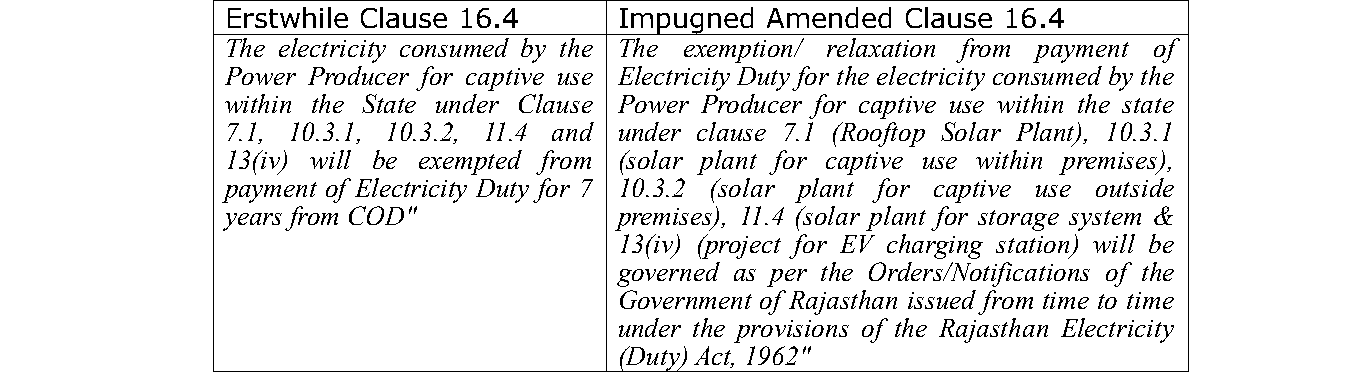
2. The State of Rajasthan, with a view to promote solar energy, introduced the Solar Policy, 2019, which, inter alia, assured exemption from payment of electricity duty for a period of seven years from the date of commissioning of solar power plants. Acting upon such representation, the petitioner made investments in establishing its captive solar power project.
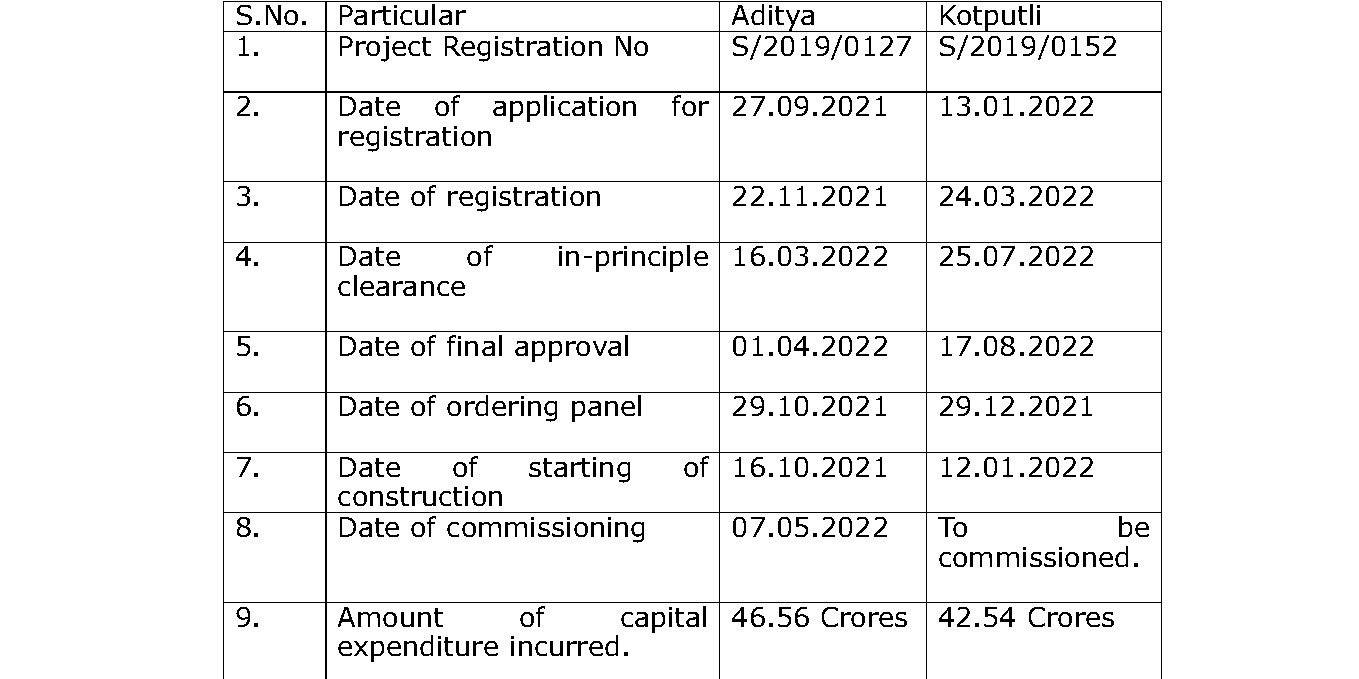
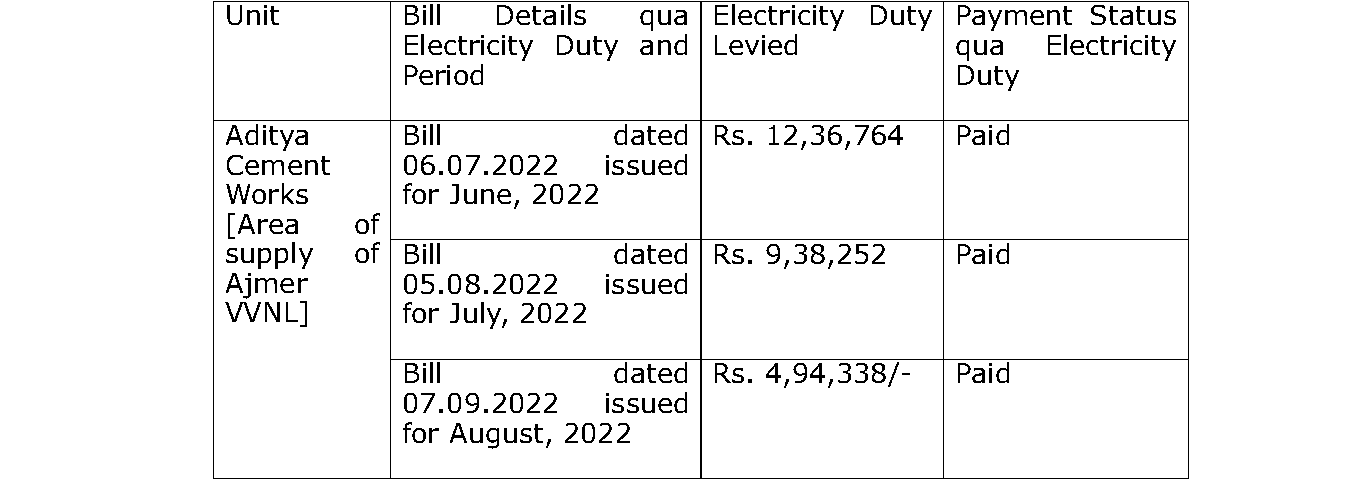
3. The Petitioner No. 1 company, UltraTech Cement Limited (“UltraTech”), operates two cement manufacturing plants in Rajasthan, namely Aditya Cement Works and Kotputli Cement Works, for which it has established captive solar power generation facilities after declaration of the State Solar policy.
4. The grievance of the petitioner arises from the subsequent action of the State, whereby the benefit of exemption was withdrawn by way of impugned amendment dated 10.05.2022 in the Solar policy, thereby subjecting such project to electricity duty. The petitioner’s case, inter alia, is anchored on promissory estoppel and legitimate expectation. More of it later.
CHRONOLOGY OF FACTS
5. Succinct factual narrative, shorn of unnecessary details, which, the petitioners state, led to their decision in setting up Solar power plants in Rajasthan, is as below :-
5.1. On 21.05.1962, the Rajasthan Electricity (Duty) Act, 1962 (“ED Act”) came into force. Section 3 thereof levies a duty on a consumer consuming electricity generated by itself, at such rate as may be notified by the State Government. Section 3(3) further empowers the State Government, where it is of the opinion that it is necessary or expedient in public interest, to reduce or remit electricity duty, inter alia, for consumers in the manufacturing industry or persons generating energy for their own consumption.
5.2. On 10.06.2003, the Electricity Act, 2003 came into force. The Act seeks to promote efficient and environmentally benign policies, as reflected in its Statement of Objects and Reasons, and incorporates several provisions aimed at encouraging efficient use of captive as well as renewable energy through various facilitative measures.
5.3. On 12.02.2005, the Government of India notified the National Electricity Policy under Section 3 of the Electricity Act. Clause 5.12 thereof envisages the need to promote electricity generation from non-conventional (renewable) sources through appropriate promotional measures.
5.4. On 06.01.2006 (as revised on 28.01.2016), the Government of India notified the Tariff Policy under Section 3 of the Electricity Act, which has a statutory force. Clause 6.4 of the said policy mandates that State Electricity Regulatory Commissions (“SERCs”) shall endeavour to promote renewable energy by prescribing a minimum percentage for procurement of power from such sources.
5.5. On 08.03.2006, the Government of Rajasthan issued a notification remitting electricity duty on consumption of electricity by a person generating such electricity for its own use.
5.6. In July 2012, the Government of Rajasthan issued the “Policy for Promoting Generation of Electricity from Wind, 2012” (“Wind Policy, 2012”). Clause 9.1 thereof provided that energy consumed by a power producer for captive use would be exempt from payment of electricity duty.
5.7. On 04.03.2014, the Government of Rajasthan issued a notification amending, inter alia, Clause 9.1 of the Wind Policy, 2012, to restrict the exemption to energy consumed for captive use within the State of Rajasthan.
5.8. On 18.10.2014, the Government of Rajasthan introduced the Rajasthan Investment Promotion Scheme, 2014 (“RIPS, 2014”), which provided, inter alia, that eligible manufacturing enterprises would be granted ex