



1. Murder appeal against conviction under Sections 302 & 302/34 IPC and Arms Act. (Para 1 , 3 )
 Back
Next 





2026 Supreme(Raj) 383
HIGH COURT OF JUDICATURE FOR RAJASTHAN, BENCH AT JAIPUR
MAHENDAR KUMAR GOYAL, ANIL KUMAR UPMAN, JJ.
Kallu @ Yogendra, Son of Shri Mool Chand – Appellant
Versus
State Of Rajasthan, Through Public Prosecutor – Respondent
D.B. Criminal Appeal (DB) No. 208 of 2021
Decided On : 27-05-2026
Important Points
Reliable ocular testimony and forensic corroboration override the absence of a detailed motive. Minor descriptive discrepancies regarding the crime scene do not discredit witnesses, and a sanction order formally exhibited without objection is valid even if the sanctioning authority is not examined.
Subject
Criminal Law - Murder and Arms Act
Act Referred
Headnote
(A) Indian Penal Code, 1860 - Sections 302, 34 and 120B - Arms Act, 1959 - Section 3/25 - Murder in furtherance of common intention - Reliability of eye-witnesses - Testimony of witnesses residing in the vicinity and providing consistent accounts is trustworthy, and mere relationship with the deceased cannot be a ground to reject evidence unless inconsistent (Para 17) - Omission of a specific term like "park" in a site plan is immaterial if an open area suitable for walking exists and is confirmed by the investigating officer (Paras 19, 20).
(B) Evidence Act - Test Identification Parade (TIP) - Where precautions like muffling faces and mixing accused with similar persons are taken, the procedure is valid - Bald assertions that accused were shown to witnesses before the TIP are insufficient to invalidate the identification without tangible evidence (Para 18).
(C) Arms Act - Sanction for prosecution - Once a sanction order is produced and formally exhibited without objection during trial, a subsequent plea that the sanctioning authority was not examined as a witness is unsustainable (Para 29).
(D) Criminal Jurisprudence - Motive - Motive is primarily significant in cases based on circumstantial evidence - In cases with reliable and cogent ocular testimony, failure to establish motive with precision does not demolish the prosecution case (Para 27).
Facts of the case:
The deceased was shot and killed by assailants on a motorcycle. The prosecution's case rested on the testimony of three eye-witnesses who observed the incident during a morning walk, medical evidence confirming death by firearm injuries, and a forensic report linking the bullets recovered from the body to the weapons seized from the accused. The trial court convicted the appellants for murder and offences under the Arms Act.
Findings of Court:
The court held that the ocular testimony of the eye-witnesses was consistent and reliable. The medical evidence and the ballistic report from the State Forensic Science Laboratory provided scientific corroboration, establishing a direct link between the accused's weapons and the crime. The court further found that the sanction for prosecution under the Arms Act was properly exhibited during trial.
Issues: Whether the ocular evidence was reliable despite a dispute over the descriptive characterization of the crime scene; whether the identification parade was legally sound; and whether the absence of a detailed motive or the non-examination of the sanctioning authority fatal to the conviction.
Ratio Decidendi: Reliable ocular testimony corroborated by forensic evidence outweighs the absence of a detailed motive. Minor descriptive discrepancies regarding the crime scene do not discredit witnesses if their presence is probable. A sanction order exhibited without objection is legally sufficient regardless of whether the issuing authority is examined.
Result: Appeal dismissed. Conviction and sentence affirmed.
Legal Category Hierarchy
- crime and sentencing
- practice and procedure
- evidence law
Advocates Appeared:
For the Appellant : Mr. Surendra Singh, Adv. with Mr. Anoop Kumar, Adv., Mr. Deepak Soni, Adv.
For the Respondents: Mr. Amit Kumar Punia, PP with Ms. Divyangana, Adv. & Ms. Neha Goyal, Adv.
For the Complainant : Mr. Parth Sharma, Adv. & Mr. Yatharth Agarwal, Adv. for Mr. Sudhir Jain, Adv.
For the Appellant : Mr. Surendra Singh, Adv. with Mr. Anoop Kumar, Adv., Mr. Deepak Soni, Adv.
For the Respondents: Mr. Amit Kumar Punia, PP with Ms. Divyangana, Adv. & Ms. Neha Goyal, Adv.
For the Complainant : Mr. Parth Sharma, Adv. & Mr. Yatharth Agarwal, Adv. for Mr. Sudhir Jain, Adv.
Table of Contents
2. Conviction based on unreliable eye-witness testimony, no park at scene, false implication. (Para 9 , 10 )
3. Eye-witness testimony consistent, credible; identification parade valid; medical and FSL evidence corroborates. (Para 17 , 18 , 20 , 22 , 23 , 24 )
4. Reliable ocular testimony can overcome absence of motive; motive not essential when direct evidence exists. (Para 27 )
5. Criminal appeal dismissed; trial court conviction and sentence affirmed. (Para 32 )
6. Can mere relationship with the deceased be a ground to reject eye-witness testimony?
No, mere relationship is not a ground to reject testimony unless contradictions or inconsistencies are established during cross-examination. (Para 17 )
7. Is the absence of a park in the site plan fatal to the prosecution case regarding presence of eye-witnesses?
No, the omission of the word 'park' in the site plan does not discredit the witnesses when an open area existed where locals walked. (Para 19 , 20 , 21 )
8. Does failure to establish motive override strong and trustworthy evidence of guilt?
No, where reliable ocular testimony exists, lack of motive does not demolish the prosecution case. (Para 27 )
9. Is a sanction order under the Arms Act invalid if the sanctioning authority is not examined?
No, once the sanction order is exhibited without objection, it is proved; the authority need not be examined unless prejudice is shown. (Para 29 )
JUDGMENT :
Anil Kumar Upman, J.
1. The instant Criminal Appeal has been filed by the accused- appellants under Section 374 of Cr.P.C. being aggrieved of the judgment dated 05.10.2021 passed by learned Additional Sessions Judge No.1, Tijara, District Alwar in Sessions Case No.85/2014 whereby they have been convicted for offences punishable under Sections 302 & 302/34 of IPC and Section 3/5 of Arms Act and sentenced as under :

2. Both sentences were ordered to be run concurrently.
3. The brief facts of the case are that the complainant, Baney Singh (PW-2), filed a report (Ex-P/2) stating that on 07.05.2014, between approximately 7:30 and 8:00 AM, his brother, Mahendra Tanwar, was returning home after dropping his nephew at the bus stop for school. During this time, Mahendra Tanwar was shot and killed by unknown assailants, who were standing near an ironing shop located in the Chowk of Sector 7. According to the complainant, there were three accused, one of whom appeared stout while the other two appeared to be childlike. They were reportedly riding a black Pulsar motorcycle without a number plate. On the basis of said report, an FIR No.162/2014 (Ex.P/51) was registered at the Police Station, Bhiwari Phase-III for offence punishable under Section 302/34 of IPC and investigation was commenced.
4. After thorough investigation, the police filed a charge-sheet against the accused-appellants before the concerned Court for the offences under Sections 302, 120B & 34 of IPC and Section 3/25 of Arms Act.
5. Thereafter, the case was committed for trial to the Court of Additional Sessions Judge No.1, Tijara, District Alwar (hereinafter referred to as the ‘learned trial Court’). Learned trial Court framed charges against the appellants under Sections 302 or 302/34 & 120B of IPC and Section 3/25 of Arms, which were denied and trial was claimed.
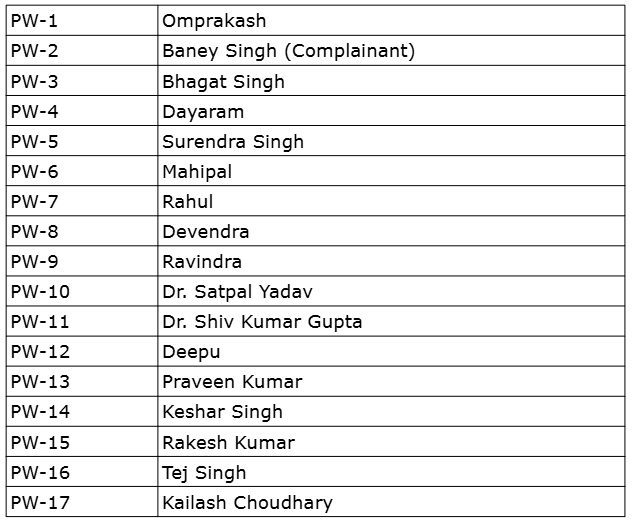
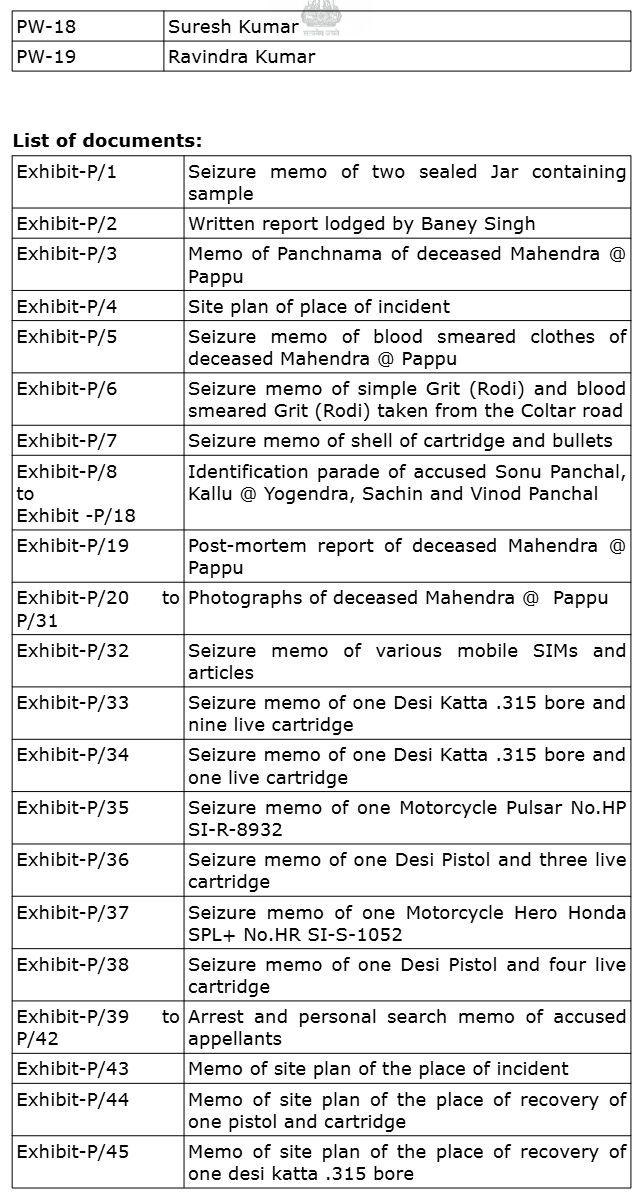
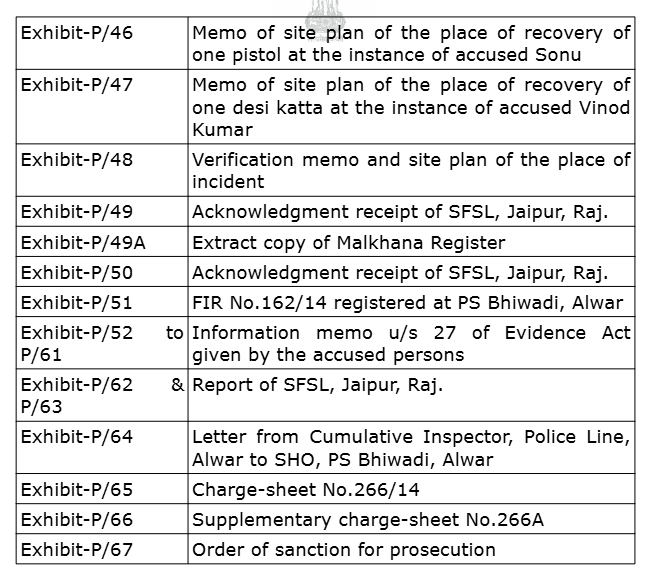
6. The prosecution in support of its case examined as many as 19 witnesses and got exhibited 67 documents. Details of which are reproduced as under:
List of witnesses:
7. The accused-appellants were examined under Section 313 Cr.P.C. wherein they denied the allegations levelled by the prosecution and stated that they had been falsely implicated in this case.
8. At the conclusion of the trial, the learned trial Court, vide impugned judgment dated 05.10.2021 found the accused- appellants guilty for offences under Sections 302 & 302/34 of IPC and Section 3/25 of Arms Act and as a consequence, convicted and sentenced them as mentioned above. Hence, this appeal.
9. Learned counsel appearing on behalf of the accused- appellants submitted that the learned trial Court failed to properly appreciate the evidence available on record and that the findings of conviction recorded against the accused-appellants are not supported by any proper or judicious assessment of the evidence adduced during trial. Rather, the conclusion arrived at by the trial Court seems to be based on surmises, conjectures, and assumptions unsupported by reliable and cogent evidence. Counsel submitted that the complainant is not an eye-witness of the incident and the so-called eye-witnesses of the case namely Rahul (PW-7), Devendra (PW-8) & Ravindra (PW-9) had deposed in their testimony that at the time of alleged incident, they were present in a park situated near the place of alleged incident. Counsel submitted that no park was situated near the place of alleged incident. The three so-called eye-witnesses are the relatives of the deceased and they gave false testimony just in order to implicate the appellants in the alleged crime. If these three eye-witnesses were present at the place of alleged incident, they would have participated in the panchnama proceedings, but they did not participate in the same. Thus, their testimony as well as their presence at the place of alleged incident is very doubtful and unreliable. The trial Court failed to take notice of the material inconsistencies, omission and improvements in the testimony of these eye-witnesses.












