



1. Recruitment — Selection process — Disqualification on medical grounds — Challenge to medical unfitness. (Para 1 , 2 , 3 , 4 )
 Back
Next 





2026 Supreme(Raj) 556
IN THE HIGH COURT OF JUDICATURE FOR RAJASTHAN AT JAIPUR
ANAND SHARMA, J.
Saurabh Singh Sanket S/o Tikam Singh – Appellant
Versus
The Union of India, through Home Secretary, New Delhi – Respondent
S.B. Civil Writ Petition Nos. 12986, 13250, 13699, 13886, 14137, 14389, 14390, 14599, 14604, 14838, 14895, 14896, 14897, 15047 of 2021, S.B. Civil Writ Petition Nos. 1005, 15684 of 2022, S.B. Civil Writ Petition No. 14693 of 2023, S.B. Civil Writ Petition Nos. 289, 670, 1110, 1482 of 2024
Decided On : 12-03-2026
Important Points
Where inconsistent findings exist between a detailed medical examination and a review medical examination for recruitment to uniformed services, the court may direct a fresh examination by a specialized medical board to ensure fairness, despite rules declaring the review board's decision final.
Subject
Service Law - Recruitment
Act Referred
Headnote
(A) Constitution of India - Article 14 - Recruitment Process - Medical Fitness - Detailed Medical Examination (DME) and Review Medical Examination (RME) - Inconsistency in findings - Interference with expert medical opinion - Where the findings of the initial medical examination and the subsequent review medical examination are inconsistent and contradictory, and are further challenged by independent medical reports, the court may direct a fresh examination by a specialized medical board to ensure fairness, even if the recruitment rules stipulate that the review medical board's decision is final. (Paras 10, 12)
(B) Medical Standards - Specialized vs. Civil - While medical standards for uniformed forces are more stringent than those for civil posts, extreme inconsistencies in the findings of specialized boards may justify a third independent evaluation to resolve uncertainty. (Paras 8, 11)
Facts of the case:
Petitioners applied for recruitment to posts in uniformed services. After clearing written and physical tests, they were declared medically unfit in the detailed medical examination and subsequently in the review medical examination. It was noted that the reasons for unfitness provided in the review examination differed from those in the initial examination. Furthermore, independent certifications from government hospitals indicated the petitioners were fit. The respondents contended that the review medical board's decision was final as per the recruitment notification and that the standards for uniformed services are higher than civil standards.
Findings of Court:
The court observed a substantial variation and inconsistency between the findings of the detailed medical examination and the review medical examination. This inconsistency, coupled with contradictory reports from civil hospitals, created uncertainty and doubt regarding the reliability of the medical boards' conclusions.
Issues: Whether the court can interfere with the finality of a Review Medical Board's decision when there are contradictory findings between the initial and review examinations and contrary opinions from independent medical specialists.
Ratio Decidendi: While the court generally exercises restraint in interfering with expert medical opinions, evident inconsistencies in the reasons provided for medical unfitness across different stages of examination, along with contrary evidence from other government medical facilities, warrant a fresh, comprehensive examination by a superior specialized medical board to ensure fairness and dispel doubt.
Result: Writ petitions disposed of with a direction to conduct a fresh medical examination by a specialized medical board at a designated military hospital, whose findings shall be final and binding.
Legal Category Hierarchy
Advocates Appeared:
For the Appellants : Tribhuvan Narayan Singh, Vikash Meena, Kiran Meena, Bajrang Sepat, Komal Kumari Giri, Abhimanyu Yaduvanshi, Heera Lal Gothwal, Akshay Dutt Sharma, Dinesh Yadav
For the Respondents: Ashish Kumar, Devesh Yadav, R.D. Rastogi
For the Appellants : Tribhuvan Narayan Singh, Vikash Meena, Kiran Meena, Bajrang Sepat, Komal Kumari Giri, Abhimanyu Yaduvanshi, Heera Lal Gothwal, Akshay Dutt Sharma, Dinesh Yadav
For the Respondents: Ashish Kumar, Devesh Yadav, R.D. Rastogi
Table of Contents
2. Petitioners: medical findings arbitrary, inconsistent. Respondents: medical findings final, binding; no further appeal permissible. (Para 5 , 6 , 7 , 8 )
3. Material inconsistencies between DME and RME findings create doubt; Court directs fresh examination by independent board. (Para 10 , 11 , 12 )
4. When medical findings are inconsistent and cast doubt, Court may order fresh examination by an independent Board. (Para 12 )
5. Writ petitions disposed — Respondents to arrange fresh medical examination at Army Hospital, New Delhi; report binding. (Para 13 , 14 , 15 )
6. Can a court interfere with expert medical opinions of a Review Medical Board in recruitment matters?
Ordinarily courts refrain, but if findings are inconsistent and create uncertainty, a court may direct a fresh examination by an independent board. (Para 10 , 11 , 12 )
7. Is the decision of the Review Medical Board final and binding in recruitment processes?
The advertisement stipulates finality, but this does not preclude judicial intervention when findings are contradictory or doubtful. (Para 7 , 12 )
JUDGMENT :
ANAND SHARMA, J.
1. All the aforesaid writ petitions arise out of substantially identical factual matrix, involving common questions for consideration, similar grievance and an identical cause of action, hence, all the writ petitions were analogously heard together. With the consent of learned counsel for the parties, for the sake of convenience and to avoid repetition of facts, the present batch of writ petitions is being decided by this common judgment, treating S.B. Civil Writ Petition No. 14897/2021 (Saurabh Singh Sanket vs. The Union of India & Others) as the lead case and the facts pleaded therein are being taken as the representative facts for adjudication of the issues involved.
2. The facts, in brief, are that the Staff Selection Commission issued a notification for recruitment to the posts of Sub-Inspector in Delhi Police, CAPFs and Assistant Sub-Inspector in CISF Examination, 2019, pursuant to which the petitioner, being fully eligible, applied online. The selection process comprised multiple stages including Paper-I, Physical Standard Test (PST)/Physical Endurance Test (PET), Paper-II and Detailed Medical Examination (DME), all of which were mandatory. The petitioner successfully cleared the written examinations as well as the physical tests and was consequently shortlisted for the Detailed Medical Examination. It is further averred that as per the applicable procedure, a candidate declared unfit in DME is entitled to prefer an appeal for Review Medical Examination (RME) before a Review Medical Board in terms of Office Memorandum dated 31.05.2021.
3. It is the case of the petitioners in all the petitions that upon undergoing DME, they were declared medically unfit on account of different and multiple deficiencies. Aggrieved thereby, the petitioners exercised their right to appeal and underwent Review Medical Examination at GC-I, CRPF, Ajmer, wherein also the petitioners were again held medical unfit by showing different reasons than the reasons shown during DME. As a consequence of being declared medically unfit in both examinations, the petitioners became ineligible for further consideration in the recruitment process, despite having cleared all earlier stages.
4. The reasons assigned for declaring the respective petitioners medically unfit in the Detailed Medical Examination (DME) as well as in the Review Medical Examination (RME) vary from case to case and have been specifically indicated in the records. For the sake of clarity and ready reference, the same are being compiled and set out in detail in the following tabular statement:
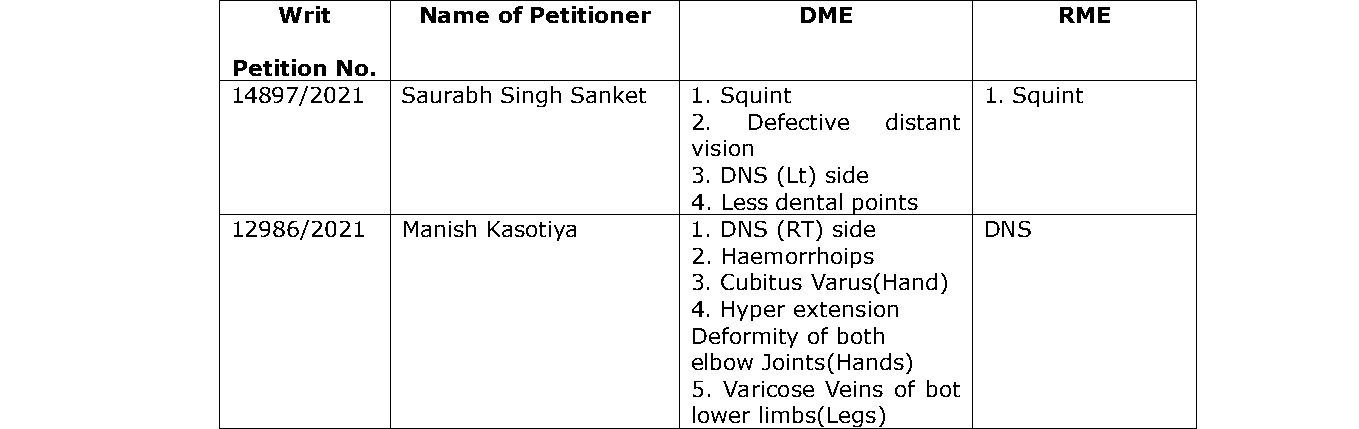
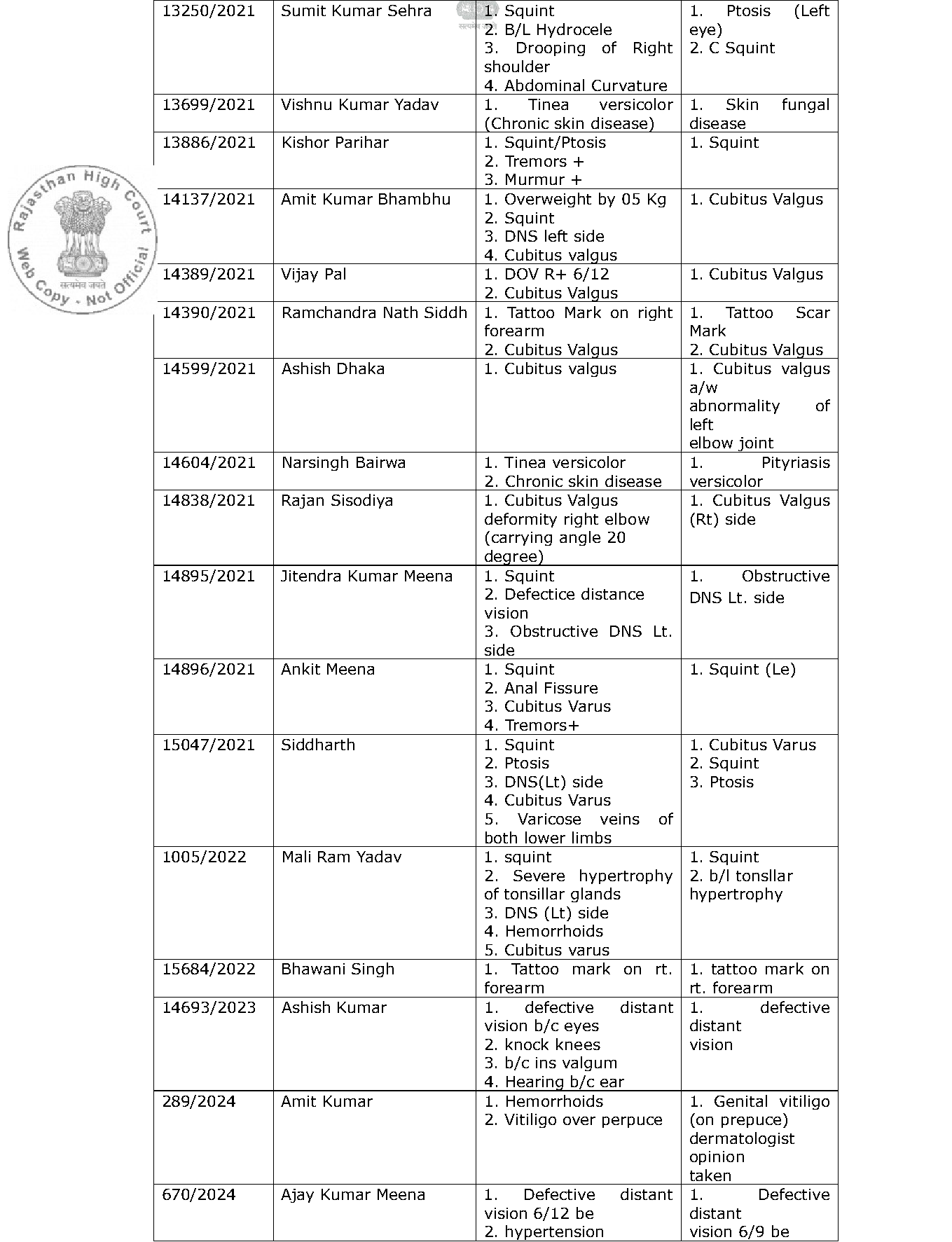

5. The petitioner in S.B. Civil Writ Petition No. 14897/2021 has further pleaded that subsequent to his rejection, he got himself medically examined at Sawai Man Singh Hospital, Jaipur, which is a reputed Government Medical Hospital, where, upon examination by a specialist in the Department of Ophthalmology, it was opined that the petitioner did not suffer from squint and was medically fit for the post in question. The petitioner has also relied upon opinions of other specialists, who similarly found no evidence of squint. It is contended that despite such contrary medical opinions, the respondents proceeded to declare the result and scheduled document verification, thereby excluding the petitioner from further participation. Similar contentions have been raised by the petitioners in other connected writ petitions.
6. Being aggrieved, the petitioners have approached this Court challenging the memorandum of unfitness issued in DME and the result of RME. Learned Counsels for the petitioners argued that action of the respondents is arbitrary, unjustified and contrary to the medical evidence. It is asserted that there exists a clear variance between the findings of the respondents’ medical boards and those of independent government specialists and that no detailed clinical findings or confirmatory diagnostic reports were supplied to substantiate the conclusion of unfitness.
7. In repl












