


1. Appeal against conviction for kidnapping, aggravated penetrative sexual assault, and murder of a minor girl. (Para 1 , 2 , 4 , 5 , 6 , 7 , 8 , 9 , 10 , 11 )
 Back
Next 





2026 Supreme(Raj) 1039
HIGH COURT OF JUDICATURE FOR RAJASTHAN AT JODHPUR
VINIT KUMAR MATHUR, CHANDRA SHEKHAR SHARMA, JJ.
State Of Rajasthan, Through Pp - Petitioner
Versus
Ramesh Kumar Dhakad S/o Nanuram Dhakad - Respondent
D.B. Murder Reference No. 2 of 2023, D.B. Criminal Appeal (DB) No. 87 of 2023
Decided On : 06-08-2026
Important Points
The court affirmed conviction based on a complete chain of circumstantial and scientific evidence, but commuted the death sentence to life imprisonment by balancing the crime's brutality against mitigating factors under the "rarest of rare" doctrine.
Subject
Criminal Law - Homicide and Sexual Offences
Act Referred
CRIMINAL PROCEDURE CODE: S.164, S.313, S.366, S.374(2)
INDIAN PENAL CODE: S.201, S.302, S.323, S.363, S.376(a)
SCHEDULED CASTES AND SCHEDULED TRIBES PREVENTION OF ATROCITIES ACT: S.3(1)(w)
PROTECTION OF CHILDREN FROM SEXUAL OFFENCES ACT: S.3(d), S.4, S.5(m), S.6
JUVENILE JUSTICE CARE AND PROTECTION OF CHILDREN ACT: S.84
EVIDENCE ACT: S.27
Headnote
(A) Indian Penal Code, 1860 - Sections 363, 302 and 201 - Protection of Children from Sexual Offences Act, 2012 - Sections 3(d)/4 and 5(m)/6 - Scheduled Castes and Scheduled Tribes (Prevention of Atrocities) Act, 1989 - Section 3(2)(v) - Juvenile Justice (Care and Protection of Children) Act, 2015 - Section 84 - Code of Criminal Procedure, 1973 - Sections 366 and 374(2) - Conviction for kidnapping, murder, and causing disappearance of evidence - Evaluation of circumstantial evidence - "Last seen" circumstance established by consistent witness testimonies - Medical evidence confirming death by manual strangulation and presence of ante-mortem bite marks - Scientific evidence including DNA profiling matching biological samples of the accused and the deceased - Discovery of the body following a disclosure statement under Section 27 of the Indian Evidence Act - Chain of circumstances found to be complete, conclusive, and consistent only with the hypothesis of guilt. (Paras 27-56)
(B) Sentencing - Death Penalty - "Rarest of Rare" doctrine - Balancing of aggravating and mitigating circumstances - Aggravating factors: Extreme brutality, vulnerability of the child victim, and the nature of the sexual assault - Mitigating factors: Rural socio-economic background, illiteracy, absence of prior criminal antecedents, family dependencies (aged parents and minor children), and satisfactory conduct during incarceration - Death penalty as an exception and life imprisonment as the rule - Where the alternative of life imprisonment is not unquestionably foreclosed, the death sentence should be commuted. (Paras 63-78)
Facts of the case:
A three-year-old girl went missing during a wedding ceremony. The accused was alleged to have kidnapped the child, subjected her to penetrative sexual assault, strangulated her, and disposed of the body in a well. It was further alleged that the accused had previously targeted another minor child. The prosecution's case rested on circumstantial evidence, including testimonies of witnesses who saw the accused with the child, medical reports indicating strangulation and bite marks, and DNA evidence linking the accused to the victim.
Findings of Court:
The court upheld the conviction, finding that the prosecution proved every incriminating circumstance beyond reasonable doubt. The "last seen" theory was corroborated by witnesses, and the FSL report provided scientific confirmation of the sexual assault. The discovery of the body based on the accused's disclosure further solidified the chain of evidence.
Issues: Whether the circumstantial evidence established a complete and unbroken chain pointing exclusively to the guilt of the accused and whether the crime fell within the "rarest of rare" category necessitating the death penalty.
Ratio Decidendi: The court reasoned that while the crime was heinous and brutal, the death penalty must be reserved for cases where life imprisonment is unquestionably inadequate. By balancing the aggravating nature of the offense against the accused's personal circumstances—such as his rural background, lack of previous convictions, and family responsibilities—the court concluded that the case did not satisfy the stringent parameters of the "rarest of rare" test.
Result: Appeal partly allowed; conviction affirmed, but death sentence commuted to imprisonment for life for the remainder of natural life with a fine of Rs. 50,000/-.
Legal Category Hierarchy
-
crime and sentencing
- offences against the person
- offences against children
- offences against public justice
- sentencing
- scheduled castes and scheduled tribes (prevention of atrocities) act
- practice and procedure
Advocates Appeared:
For the Petitioner: Mr. Deepak Choudhary, GA-cum-AAG with Mr. Kuldeep Singh Kumpawat
For the Respondent: Mr. Kaushal Gautam
Table of Contents
2. Appellant argued circumstantial evidence was insufficient and prosecution case was based on fabricated and unreliable evidence. (Para 12 , 13 , 14 , 15 , 16 , 17 , 18 , 19 , 20 , 21 , 22 , 23 , 24 )
3. The chain of circumstantial evidence, including last seen, DNA, and medical evidence, was complete and pointed unerringly to guilt. (Para 26 , 27 , 28 , 29 , 30 , 31 , 32 , 33 , 34 , 35 , 36 , 37 , 38 , 39 , 40 , 41 , 42 , 43 , 44 , 45 , 46 , 47 , 48 , 49 , 50 , 51 , 52 , 53 , 54 , 55 , 56 , 57 )
4. In circumstantial evidence cases, the chain must be complete and exclude every hypothesis of innocence to sustain conviction. (Para 55 , 56 )
5. Conviction affirmed; death sentence commuted to life imprisonment for natural life after applying rarest of rare doctrine. (Para 57 , 58 , 59 , 60 , 61 , 62 , 63 , 64 , 65 , 66 , 67 , 68 , 69 , 70 , 71 , 72 , 73 , 74 , 75 , 76 , 77 , 78 , 79 , 80 , 81 )
6. What are the five golden principles for conviction based on circumstantial evidence?
The five principles (Panchsheel) are: circumstances must be fully established, consistent only with guilt, conclusive, exclude all other hypotheses, and form a complete chain. (Para 55 )
7. When can a death sentence be imposed as the rarest of rare cases?
Death penalty is only for rarest of rare cases when life imprisonment is unquestionably inadequate, and after balancing aggravating and mitigating circumstances. (Para 60 , 63 , 67 , 68 , 70 , 71 , 76 , 77 )
8. What factors are considered as mitigating circumstances in a death sentence review?
Mitigating factors include no criminal antecedents, young age, family responsibilities, socio-economic background, absence of mental illness, and good conduct during incarceration. (Para 72 , 73 , 74 , 75 , 76 )
9. How is a last seen circumstance evaluated in a circumstantial evidence case?
The last seen circumstance must be established by reliable, cogent, and consistent witness testimony, and forms a strong link in the chain of evidence pointing to guilt. (Para 27 , 28 , 29 , 30 , 31 , 32 , 33 )
10. What is the evidentiary value of a DNA report in a criminal trial?
A DNA report provides compelling scientific corroboration; matching DNA profiles from the accused and victim conclusively establishes physical contact and presence at the crime. (Para 40 , 48 , 49 , 50 , 51 , 52 )
JUDGMENT :
VINIT KUMAR MATHUR, J.
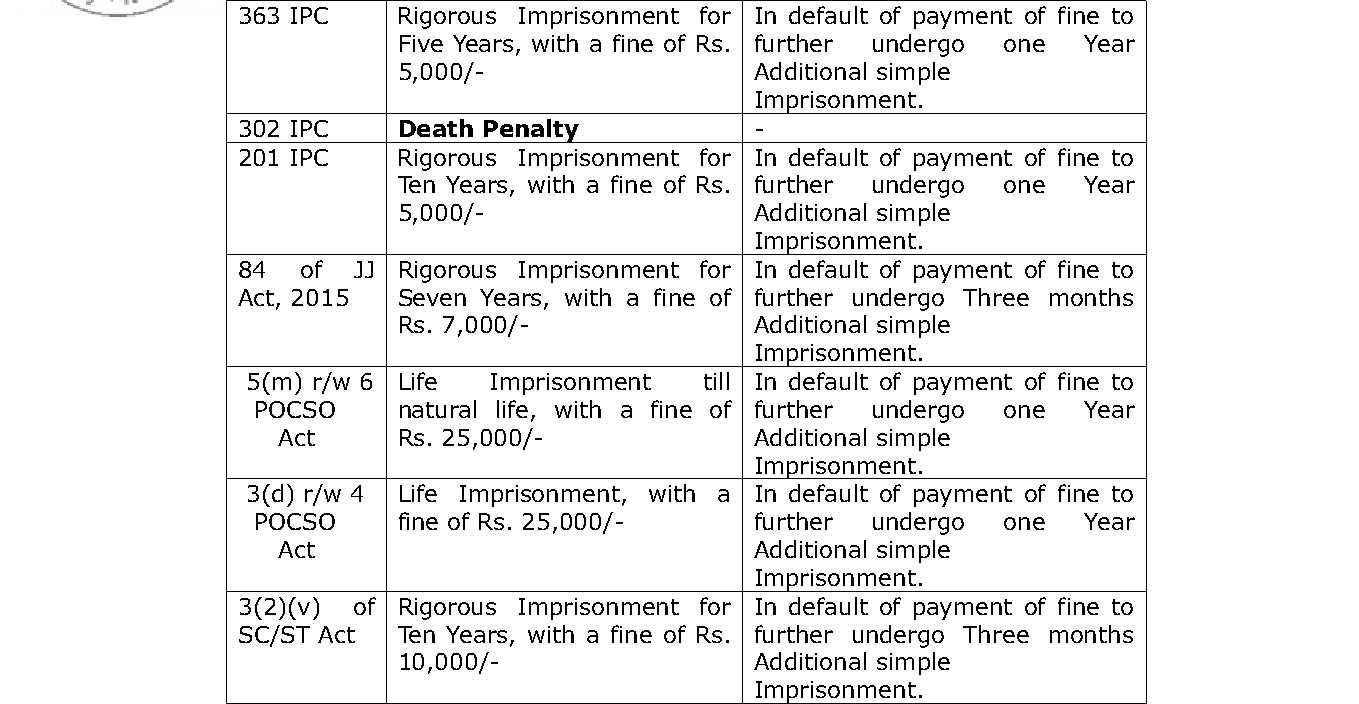
1. By the impugned judgment dated 29.03.2023 passed by the learned Special Judge, Protection of Children from Sexual Offences Act Cases No.1, Chittorgarh, District Chittorgarh (hereinafter referred to as "the learned Trial Court") in Sessions Case No. 42/2022, the accused-appellant Ramesh Kumar S/o Shri Nanuram Dhakad, was convicted and sentenced in the following manner:–
2. Death Reference No. 02/2023 has been submitted by the learned Trial Court under Section 366 of the Code of Criminal Procedure, 1973, seeking confirmation of the sentence of death awarded to the accused-appellant-Ramesh Kumar. The accused- appellant have also preferred D.B. Criminal Appeal No. 87/2023 under Section 374 (2) of the Code of Criminal Procedure, 1973, assailing the legality and correctness of the judgment of conviction and order of sentence dated 29.03.2023 passed by the learned Special Judge, Protection of Children from Sexual Offences Act Cases No.1, Chittorgarh, District Chittorgarh in Sessions Case No. 42/2022. Since both the death reference and the criminal appeal arise out of the same judgment and involve common questions of fact and law, they are being decided by this common judgment.
3. The Hon’ble Supreme Court in the case of Nipun Saxena & Anr. Vs. Union of India & Ors., (2019) 2 SCC 703, and further reiterated in Birbal Kumar Nishad Vs. State of Chhattisgarh (SLP (Crl.) No. 4540/2021, decided on 30.06.2021), emphasized the mandatory requirement of protecting the identity of victims of sexual offences, this Court deems it appropriate to withhold the real name and identity of the victim. Accordingly, for the purpose of maintaining anonymity, the deceased (Girl) has been referred to as the “H” and the victim (Boy) has been referred to as “U”.
Factual Aspects :
4. Facts relevant for adjudication of the present case are that, on April 22, 2022, the complainant Jamnalal (PW-2) submitted a written report (Exhibit P.3) at Police Station Bassi, District Chittorgarh. In the said report, it was stated that on April 21, 2022, his family members had gathered at village Laxmipura to attend the wedding of his aunt’s daughters. At about 3:00 PM, the complainant was sleeping at the residence of one Suresh, and his three-year-old daughter, "H" (deceased), was sleeping beside him. When he woke up at around 5:00 PM, he found his daughter missing. Upon making inquiries, witnesses Ratanlal and Rajulal informed him that they had seen "H" walking towards the river along with the accused-Ramesh Dhakad. When the complainant confronted the accused Ramesh Dhakad, the accused initially gave misleading information, stating that a young girl was sleeping near a village well. The complainant accordingly went to search the well belonging to Ghisalal Dhakad, but the child was not found there. Upon further questioning, the accused confessed that he had thrown the child into the well. The police were immediately notified, and on April 22, 2022, the dead body of the deceased "H" was recovered from the well. It was alleged that the accused Ramesh Dhakad committed rape on the minor victim "H", inflicted multiple injuries on her body, and threw her into the well to cause her death. Furthermore, the report mentioned a prior act by the accused, alleging that he had previously bitten the private part (penis) of another child, "U", aged about two years, who is the son of Suresh Meena.
5. On the basis of the aforesaid written report, FIR No. 68/2022 was registered at Police Station Bassi, District Chittorgarh for the offences punishable under sections 363,376-A, 302, 201, and 323 of the Indian Penal Code, Under Sections 3(1)(w), 3(2)(v) of the Scheduled Castes and Scheduled Tribes (Prevention of Atrocities) Act, 1989, under sections 3/(D)4, 5(M)/6 of the Protection of Children from Sexual Offences Act, 2012 and Section 84 of the Juvenile Justice (Care and Protection of Children) Act. The investigation was thereupon commenced.









