


 Back
Back





2025 Supreme(HP) 1289
IN THE HIGH COURT OF HIMACHAL PRADESH, SHIMLA
RAKESH KAINTHLA, J.
Basso Devi - Petitioner
Versus
State of H.P. – Respondent
Cr. Revision No. 138 of 2015
Decided On : 18-09-2025
For the Petitioner:Mr. Sanjeev Kumar Suri, Advocate.
For the Respondent:Mr. Lokender Kutlehria, Additional Advocate General.
Cognizance of Section 186 IPC requires public servant's written complaint per CrPC Section 195; impermissible to split same-transaction Section 189 prosecution, vitiating entire trial on police report alone.
Headnote:(A) Code of Criminal Procedure, 1973 - Section 195(1)(a) - Indian Penal Code, 1860 - Sections 186, 189 - Cognizance - No Court shall take cognizance of offence punishable under Section 186 except upon complaint in writing by public servant concerned or administratively subordinate public servant - Police complaint impermissible - Where offences under Sections 186 and 189 committed in course of same transaction, impermissible to split offences and take cognizance of latter - Entire trial vitiated due to jurisdictional error. (Paras 19-25)
(B) Criminal Procedure Code - Sections 397, 401 - Revisional jurisdiction - Limited supervisory jurisdiction to rectify patent defects, errors of jurisdiction or law - Not to reappreciate evidence or act as appellate court unless gross perversity, illegality or miscarriage of justice. (Paras 14-18)
Facts of the case:
Public servant informant tasked with executing warrant of attachment approached residence of judgment-debtor; accused present obstructed execution, abused and threatened informant preventing discharge of duty - Report led to police investigation and complaint under Sections 186, 189 - Trial court convicted, appellate court upheld - Revision challenging lack of written complaint from public servant.
Findings of Court:
Judgments of conviction and sentence set aside; accused discharged of offences.
Issues: Whether cognizance could be taken on police complaint for offences under Sections 186, 189 without written complaint by public servant; whether offences in same transaction separable to evade Section 195 bar.
Ratio Decidendi: Mandatory bar under Section 195(1)(a) CrPC for Section 186 extends to Section 189 when part of same transaction; no splitting of composite police challan permissible; absence of required complaint renders cognizance and trial void ab initio, constituting jurisdictional defect warranting interference in revision.
Result: Revision petition allowed.
| Table of Content |
|---|
| 1. accused obstructed public servant executing attachment warrant. (Para 1 , 2 , 3 , 4 , 5 , 6) |
| 2. lower courts convicted accused under sections 186, 189 ipc. (Para 7 , 9) |
| 3. debate on cognizance validity for sections 186, 189 ipc. (Para 10 , 11 , 12) |
| 4. revisional jurisdiction limited to jurisdictional errors or perversity. (Para 13 , 14 , 15 , 16 , 17 , 18) |
| 5. section 195 crpc bars cognizance of s.186; no splitting with s.189. (Para 19 , 20 , 21 , 22 , 23 , 24 , 25) |
| 6. revision allowed; conviction set aside for procedural defect. (Para 26 , 27 , 28 , 29) |
JUDGMENT :
Rakesh Kainthla, J.
The present revision is directed against the judgment dated 28.02.2015, passed by learned Additional Sessions Judge-III, Kangra at Dharamshala, Circuit Court at Baijnath, District Kangra, H.P. (learned Appellate Court) whereby the judgment of conviction dated 26.08.2008 and order of sentence dated 27.08.2008, passed by learned Judicial Magistrate First Class, Baijnath, District Kangra, H.P. (learned Trial Court) were upheld (Parties shall hereinafter be referred to in the same manner as they were arrayed before the learned Trial Court for convenience.)
2. Briefly stated, the facts giving rise to the present petition are that the police presented a complaint before the learned Trial Court for the commission of an offence punishable under Section 186 of the Indian Penal Code (IPC). It was asserted that informant Dalip Singh (PW-1) was handed over a warrant of attachment. He, alongwith Kusum Lata (PW-3) went to the house of Bihari Lal, judgment-debtor. At that time, Basso Devi (the present accused) was present at her residence. The informant inquired the accused about Bihari Lal, and she replied that Bihari Lal had gone to work. The informant apprised the accused about the warrants of attachment, and the accused dared the informant to attach the property. She abused him and threatened to beat him with a shoe. Consequently, the warrant could not be executed due to the conduct of the accused.
3. The informant made a report (Ext.PW5/B) to the learned Civil Judge, Senior Division, Baijnath, who held that the matter required investigation by the police. HC Sampuran Singh (PW-4) conducted the investigation. He recorded the statements of witnesses as per their version and filed a complaint before the Court.
4. Learned Trial Court found sufficient grounds to summon the accused. When the accused appeared, a notice of accusation was put to her for the commission of offences punishable under Sections 186 and 189 of the IPC. She pleaded not guilty and claimed trial.
5. The prosecution examined five witnesses to prove its case. Dalip Singh (PW-1) is the informant, Dalip Kumar (PW-2) and Kusum Lata (PW-3) are the eyewitnesses, Suresh Bhardwaj (PW-4) is the Additional Ahlmad, who prepared the report, and Sampuran Singh (PW-4) conducted the investigation.
6. The accused, in his statement recorded under Section 313 of Cr.P.C., admitted that the proceedings were pending against her husband for the recovery of the money. She admitted that the Court had issued the warrant of attachment of moveable property. She admitted that she had told the informant that her husband had gone to work. She denied the rest of the prosecution’s case. She stated that her husband had supported the Pardhan’s rival candidate, the witnesses belong to the same department, and she had met the informant outside her home. She did not produce any defence evidence.
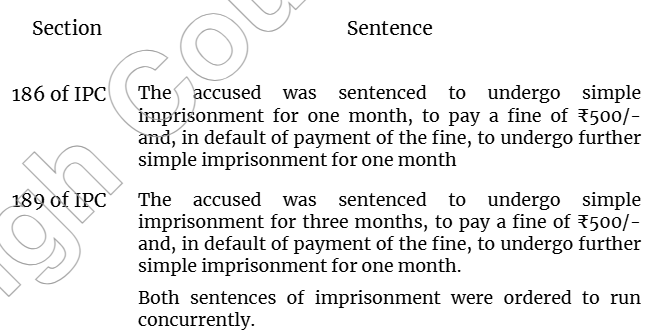
7. Learned Trial Court held that the informant’s testimony was duly supported by independent witnesses. Their statements established that the accused had obstructed a public official in the discharge of his official duty and had abused him. Hence, the accused was convicted for the commission of offences punishable under Sections 186 and 189 of the IPC and was sentenced as follows:
8 Being aggrieved by the judgment and order passed by the learned Trial Court, the accused filed an appeal, which was decided by the learned Appellate Court









