
 Back
Back





IN THE HIGH COURT OF JHARKHAND AT RANCHI
SUJIT NARAYAN PRASAD, ARUN KUMAR RAI, JJ.
Shyam Sundar Mahato – Appellant
Versus
Union of India – Respondent
L.P.A. No. 42 of 2023
Decided on : 15-04-2024
[LIMITATION] - [DEPARTMENTAL DISCIPLINE] - [Article 226 of the Constitution of India, Union of India and Others Vs Managobinda Samantaray 2022 SCC OnLine SC 284, Director General, RPF and Ors. Vs. Ch. Sai Babu, (2003) 4 SCC 331] - [The court discussed the discretionary power of the disciplinary authority in imposing punishment for misconduct, emphasizing that judicial review is limited to cases where the punishment is grossly disproportionate to the offense. The court highlighted the importance of maintaining discipline within the forces and the need for a reasonable approach to punishment, ultimately affirming the disciplinary authority's decision as appropriate given the circumstances.]
Fact of the Case:
The appellant, while on duty, lost a magazine containing live ammunition due to negligence while driving away coal thieves. Following an inquiry, he was punished with a reduction in pay for two years. The appellant challenged the punishment, claiming it was excessive given his 15 years of unblemished service.
Finding of the Court:
The court found that the disciplinary authority acted within its rights and that the punishment was not excessive in light of the serious nature of the charge. The court upheld the decision of the learned Single Judge, stating that the punishment was commensurate with the misconduct.
Issues: Whether the punishment imposed on the appellant was excessive and whether the court should interfere with the disciplinary authority's decision.
Ratio Decidendi: The court reiterated that the quantum of punishment is within the discretion of the disciplinary authority and can only be interfered with if it is grossly disproportionate to the misconduct. The court emphasized the need for discipline in the forces and the importance of the authority's discretion in such matters.
Final Decision: The appeal was dismissed, affirming the disciplinary authority's decision and the learned Single Judge's order.
JUDGMENT :
I.A. No.1049 of 2023
1) Having heard the learned counsels for the parties and being satisfied with the grounds shown in the limitation petition, the delay of 12 days in filing the appeal is condoned.
2) Accordingly, I.A. No.1049 of 2023 stands allowed and disposed of.
L.P.A. No. 42 of 2023
Prayer
3) This intra-court appeal is directed against the order dated 06.12.2022 passed by the learned Single Judge in W.P. (S) No. 660 of 2021, whereby and whereunder the writ petition has been dismissed by declining to interfere with the order dated 15.10.2019 passed by the Commandant-cum-Disciplinary Authority, whereby the Disciplinary Authority imposed punishment of reduction of pay by two stages from Rs.33,300/-to 31,400/-for a period of two years with a direction that during the period of reduction the appellant will not earn increment of pay and that on expiry of this period the reduction will have effect on postponing his future increment of pay. Further, the appellate order dated 19.01.2020 as also the revisional order dated 26.05.2020 has also been sought to be quashed by which the order dated 15.10.2019 passed by the Disciplinary Authority has been affirmed.
Facts
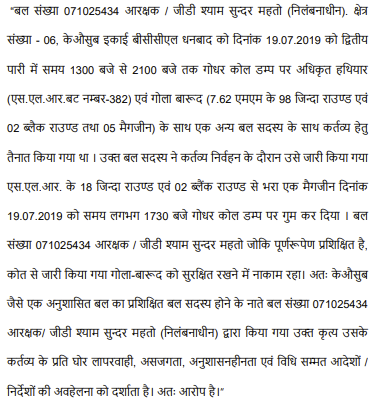
4) The facts leading to initiation of the departmental proceeding and the impugned punishment are that the appellant while discharging his duties at BCCL Area No.6, Dhanbad on 19.07.2019 in the 2nd shift, he was provided with 7.62 M.M. SLR Butt No.382 with 100 round 7.62 M.M. (98 live and 02 blank round) and 05 magazine.
5) It is further evident that in course of the duty at 17:15 hours when some women and children came to steal coal, he drove them away from the coal dump and during the course of drive away, from the SLR of the appellant, one magazine with 18 live round and 02 blank round fell down somewhere in that area. The aforesaid fact came to his knowledge when the appellant physically checked his SLR.
6) He immediately informed the Shift In-charge, but considering the said lapses of the appellant, the departmental proceeding has been initiated by framing the regular charge of negligence in discharging the duties without any sincerity.
7) The appellant had appeared before the Enquiring Officer. He has availed the opportunity. The Enquiring Officer had found the charge proved. The enquiry report was referred before the Disciplinary Authority who on acceptance of the enquiry report has passed an order on 15.10.2019 whereby imposing punishment of reduction of pay by two stages from Rs.33,300/-to 31,400/-for a period of two years with a direction that during the period of reduction the appellant will not earn increment of pay and that on expiry of this period the reduction will have effect on postponing his future increment of pay.
8) The appellant against the said order preferred an appeal as also revision which were dismissed vide orders dated 19.01.2020 and 26.05.2020 respectively.
9) Being aggrieved by the said orders, the appellant preferred W.P. (S) No.660 of 2021, however, the learned Single Judge considering the nature of allegation has declined to interfere with the order of punishment by dismissing the writ petition.
10) Before the learned Single Judge, the issue of punishment said to be not in consonance with the charge was also raised, but even the same has not been found proper to be considered so as to interfere with the order of punishment on the ground of punishment being excessive.
Submission of the learned counsel for the appellant
11) Mr. Saibal Mitra, learned counsel appearing for the appellant, has submitted in the course of the argument that he is only raising the sole propriety of the order whereby and whereunder the learned Single Judge has not interfered with the quantum of punishment.
12) The learned counsel has further submitted that the appellant has already put in 15 years of service which was unblemished and without any complaint from any quarter and whatever incidence took place based upon which the memorandum of charge has been issued, the sam
The court established that judicial review of disciplinary actions is limited to cases of gross disproportionality in punishment, reinforcing the authority's discretion in maintaining discipline with....

The punishment of reduction in pay scale under Rule 34(v) of the CISF Rules, 2001 can be for more than one stage, and the principle of parity in punishment applies only to identical charges.

Judicial review of disciplinary punishment is limited to cases where the penalty is shockingly disproportionate or perverse. Parity in punishment is not absolute; it must account for the delinquent's....

Disparity in punishment among co-delinquents is justified based on the severity of misconduct and position of authority, adhering to Article 14's principles of equality and non-discrimination.

Disciplinary actions must follow principles of natural justice, and punishment should only be altered if found shockingly disproportionate; lack of proof for a charge does not justify changing penalt....

The main legal point established in the judgment is the limited scope of interference in disciplinary proceedings, emphasizing the need for evidence-based findings and the principles of proportionali....



An indispensable Tool for Legal Professionals, Endorsed by Various High Court and Judicial Officers
Please visit our Training & Support
Center or Contact Us for assistance

Scan Me!
India’s Legal research and Law Firm App, Download now!


For Daily Legal Updates, Join us on :



 Back to top


