
 Back
Back





IN THE HIGH COURT OF JHARKHAND AT RANCHI
SUJIT NARAYAN PRASAD, NAVNEET KUMAR, JJ.
Dilip Kumar Sahu, son of Late Narayan Sahu - Appellant
Versus
The State Jharkhand - Respondent
L.P.A No. 510 of 2024
Decided on : 08-01-2025
(A) Constitution of India - Article 226 - Delay and laches - The appellant challenged the orders of disciplinary authority and appellate authority after a significant delay of 12 years, which was a key factor in the dismissal of the writ petition by the learned Single Judge. The court emphasized that while delay and laches apply, they should not be rigidly enforced when the cause of action is recurring, particularly in pension-related matters. The court found that the charges against the appellant were not substantiated, particularly the charge of misconduct related to duties not assigned to him. (Paras 1, 8, 16, 54, 112)
(B) Judicial Review - The High Court’s scope in disciplinary matters is limited to checking for procedural compliance, natural justice, and the reasonableness of findings. The court can intervene if findings are arbitrary or unsupported by evidence. (Paras 27, 88)
(C) Recurring Cause of Action - The court recognized that pension-related grievances constitute a recurring cause of action, thus allowing for the possibility of relief despite delays. (Paras 53, 112)
(D) Misconduct - The court clarified that misconduct must be based on assigned duties, and if no such duty exists, charges cannot be sustained. (Paras 84, 110)
ORDER :
Sujit Narayan Prasad, J.
Prayer:
1. The instant intra-court appeal, under Clause 10 of the Letters Patent, is directed against order/judgment dated 16.08.2024 passed by learned Single Judge in W.P.(S) No. 4477 of 2019 whereby and whereunder without deliberating the issues on merit the learned Single Judge has dismissed the writ petition by refusing to interfere with the order passed by the disciplinary authority dated 22.09.1997 and appellate order dated 05.06.2006 solely on the ground of delay and laches, since the writ petition was filed after a lapse of about 12 years of passing of impugned order.
Brief facts of the case
2. Brief facts of the case, as per the pleadings made in the writ petition, which is required for adjudication of lis, reads as under:
3. The petitioner was appointed on the post of Village Level Worker [VLW], now designated as 'Jan Sewak', on 20.10.1986. While working as such in the district of Raidih, Gumla, he was served with a charge-sheet issued by respondent no. 3 on 18.12.1990, on the allegation of dereliction of duty and irregularities in Government work, misleading the higher authorities and violation of Government Rules, to which he replied vide letter dated 06.01.1991 before the enquiry officer denying the allegation leveled against him.
4. After enquiry, vide letter dated 03.04.1991, the enquiry officer-cum-Sub Divisional Officer, Gumla submitted enquiry report to the Director, Accounts, Administration and Self-Employment Programme, Gumla holding the charges not proved against the appellant. However, disagreeing with the enquiry report, the respondent no. 3 asked respondent no. 4 to re-enquire the matter, in turn, the respondent no. 4 submitted the report holding charge nos. 1 and 2 not proved whereas in respect of charge no. 3, the appellant was asked to be vigilant.
5. Thereafter, vide office order dated 13.02.1992, the respondent no. 4 imposed a punishment of withholding of five annual increments and salary for the period of suspension, against which, the appellant preferred departmental appeal, which was dismissed vide order dated 07.09.1993.
6. Being aggrieved with the order passed by the disciplinary authority as well as the appellate authority, the appellant invoked the writ jurisdiction of this Court by filing CWJC No. 1953 of 1994(R), which was dismissed vide order dated 17.05.1995, against which the appellant preferred intra-court appeal, being LPA. No. 288 of 1995(R), which was allowed vide order dated 10.07.1996 and the matter was remitted to the disciplinary authority asking him to start the proceeding afresh from the stage of enquiry report after providing opportunity of being heard to the appellant and to pass a reasoned order.
7. Accordingly, the respondent no. 3 modified the order of punishment vide order dated 22.09.1997 and reduced the same by withholding two annual increments and salary during the period of suspension, against which the writ petitioner-appellant preferred departmental appeal which was dismissed vide order dated 05.06.2006.
8. The writ petitioner-appellant being aggrieved with the order passed by the disciplinary authority dated 22.09.1997 and appellate order dated 05.06.2006 again invoked the writ jurisdiction of this Court conferred under Article 226 of the Constitution of India by filing writ petition being W.P. (S) No. 4477 of 2019, which was dismissed solely on the ground of delay and laches without deliberating the issues on merit, against which the instant intra-court appeal has been preferred.
9. It is evident from the aforesaid factual aspect that the appellant, who is a Village Level Worker [VLW] was served with a charge-sheet on the allegation, inter alia, (i).dereliction of duty and irregularities in Government work; (ii).misleading the higher authorities and (iii).violation of Government Rules. For ready reference, the charge, which is in Hindi, is quoted as under:
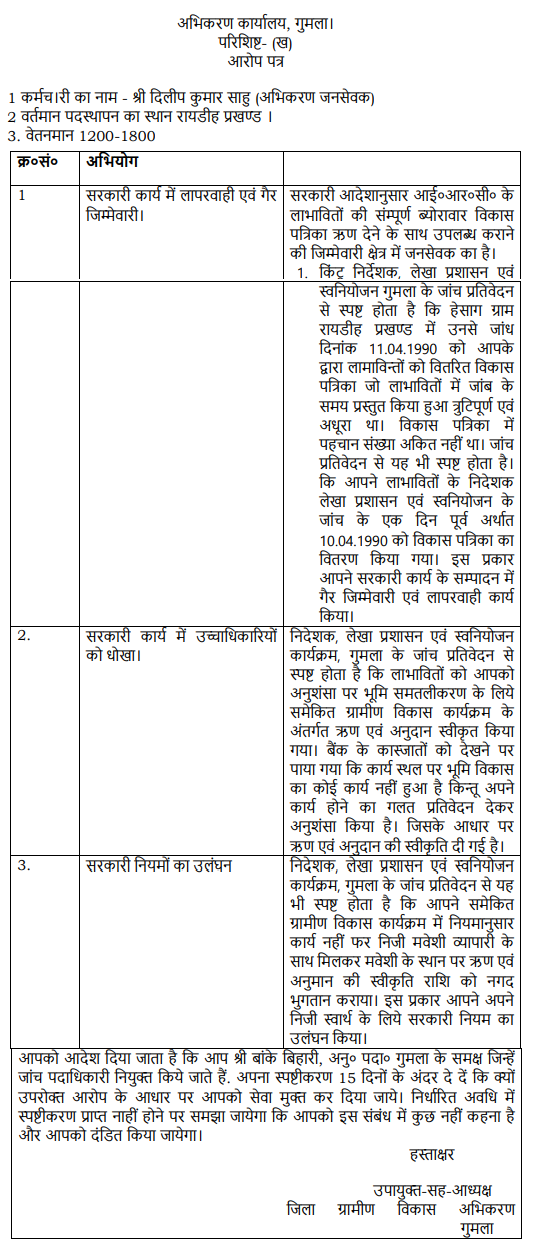
10. The enquiry officer-cum-Sub Divisional Officer, Gumla found the charges leveled agai
The principle of delay and laches is flexible in cases involving recurring causes of action, particularly in pension matters, and charges of misconduct must be substantiated by assigned duties.

The court emphasized the importance of timely filing of appeals and writ petitions, the inability of successive representations to condone delay, and the limited scope of judicial review in disciplin....

The main legal point established in the judgment is that delay in disciplinary proceedings, violation of natural justice, non-compliance with regulations, lack of reasoning in the order imposing puni....


The court emphasized the necessity of adhering to principles of natural justice in disciplinary inquiries, asserting that findings must be supported by adequate evidence and fair procedures.


Point of law: doctrine of laches in courts of equity is not an arbitrary or technical doctrine. Where it would be practically unjust to give a remedy either because the party has, by his conduct done....

Disciplinary proceedings initiated by an authority subordinate to the appointing authority do not violate Article 311; the standard for punishment must align with proven misconduct.



An indispensable Tool for Legal Professionals, Endorsed by Various High Court and Judicial Officers
Please visit our Training & Support
Center or Contact Us for assistance

Scan Me!
India’s Legal research and Law Firm App, Download now!


For Daily Legal Updates, Join us on :



 Back to top


