
 Back
Back





IN THE HIGH COURT OF JHARKHAND AT RANCHI
ANUBHA RAWAT CHOUDHARY, J.
Bishwanath Prasad, son of Late Nathuni Chaudhuri – Appellant
Versus
Dwarika Prasad Bhagat @ Dwarka Prasad Bhagat, son of Late Nathuni Chaudhuri – Respondent
S.A. No. 14 of 1995 (R)
Decided on : 29-01-2026
| Table of Content |
|---|
| 1. second appeal challenges partition decree reversal. (Para 1 , 2 , 3 , 4) |
| 2. adoption invalid; property thrown into joint family. (Para 5) |
| 3. valid adoption; partition barred; appeal abated. (Para 6) |
| 4. adoption invalid per prior suit; no abatement. (Para 7) |
| 5. joint family contested prior suit; equal shares. (Para 8) |
| 6. exclusive ownership post-adoption; permissive possession. (Para 9) |
| 7. trial court decrees half share for plaintiff. (Para 10 , 11 , 12) |
| 8. appellate court rejects agreement; no joint title. (Para 13 , 14) |
| 9. no abatement; estate sufficiently represented. (Para 15 , 16 , 17 , 18 , 19 , 20 , 21 , 22) |
| 10. adoption severs joint family ties. (Para 23 , 24 , 25 , 26 , 32 , 34 , 35) |
| 11. forged agreement; permissive possession; no unity. (Para 27 , 28 , 29 , 30 , 31 , 33 , 36) |
| 12. no joint family; plaintiff gets no share. (Para 37 , 38 , 39) |
ANUBHA RAWAT CHOUDHARY, J.
1. This second appeal has been filed against the judgment and decree dated 02.12.1994 (decree signed on 13.12.1994) passed by the learned 2nd Additional District Judge, Giridih in Title Appeal No.24 of 1991 reversing the judgment and decree dated 10.05.1991 (decree signed on 27.05.1991) passed by the learned Sub-Judge-III, Giridih in Partition Suit No. 15 of 1989/08 of 1990.
2. The judgment and decree passed by the learned trial court has been reversed by the learned 1st appellate court and consequently, the plaintiff is the appellant before this Court.
3. This appeal was admitted for hearing vide order dated 21.11.1995 on the following substantial questions of law: -
(i) Whether even after adoption of the defendant by Man Kumari, Nathuni Chaudhuri and his two sons, namely, the plaintiff and the defendant continued to be in occupation of the suit premises as members of the Joint Hindu Family?
(ii) Whether the plaintiff is entitled to any share in the suit property?
4. The partition suit was filed by the sole plaintiff-Bishwanath Prasad seeking partition and half share of Schedule B property.
5. Arguments of the appellants (plaintiff)
A. The learned counsel for the appellants has placed the trial court’s judgment and has given the factual background of the case. He submits that the facts of the plaintiff and defendant case are reflecting from the trial court’s judgment.
B. Foundational facts have been submitted as under: -
a. It has been submitted that Man Kumari and Khoshal Kumari were full sisters.
b. Man Kumari was married to Kali Charan Bhagat;
c. Khoshal Kumari was married to Bhagwat Prasad Bhagat;
d. Kali Charan Bhagat had two wives, namely, Man Kumari and one more, but the name of another wife has not been mentioned. However, the descendants through another wife have been mentioned;
e. Another wife had a daughter, namely, Jamuna Devi, who in turn had 7 daughters including one Sabitri Devi;
f. Sabitri Devi was married to Nathuni Choudhary, who had two sons, namely, Dwarika Prasad and Bishwanath Prasad;
g. Bishwanath Prasad is the plaintiff of the case;
h. Dwarika Prasad is the defendant of the case.
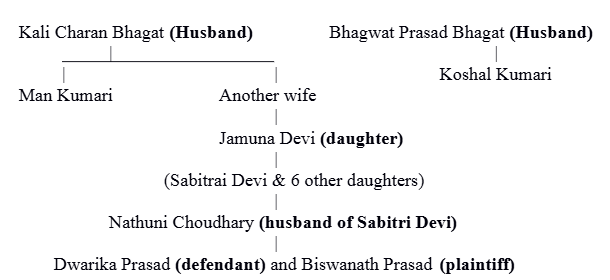
C. The plaintiff-Bishwanath Prasad had filed the partition suit with respect to Schedule-B property and the plaintiff claimed ½ share of the property. Man Kumari was the owner of Schedule-B property.
D. Further facts in connection with the defendant Dwarika Prasad is that Man Kumari had adopted Dwarika Prasad by registered deed of adoption way back in the year 1944. The adoption deed was challenged by Bhagwat Prasad Bhagat, husband of Koshal Kumari in Title Suit No. 18/1947, whereby the deed of adoption was set-aside. However, the same was subject matter of appeal in First Appeal No. 11/1949, which ended in a compromise. Consequently, the defendant claimed that he was the exclusive owner of the Schedule-B property by virtue of the fact that Man Kumari had adopted the defendant, and therefore, the property could not be subject matter of partition.
E. Learned counsel for the appellants has referred to paragraphs 13 and 14 of the plaint to submit that the adoption was ne
Valid adoption severs biological family ties completely; unchallenged adoption makes acquired property exclusive to adopted son, barring biological brother's partition claim absent timely challenge.

Adoption – Ceremony of adoption may vary depending upon circumstances of each case, but for a valid adoption there has to be ceremony of giving and taking of child in adoption.

The court established that valid adoption requires proof of giving and taking by biological and adoptive parents, which was not demonstrated, leading to equal shares among heirs.

For a valid adoption under the Hindu Adoption and Maintenance Act, the biological parents must give the child in adoption, and the adoptive parents must take the child, which was not proven in this c....

The court upheld that a registered adoption presumes validity unless disproved, affirming married daughters' inheritance rights under Hindu law.
Point of law: A perfectly valid adoption deed can be made without an adoption deed and any status which the adopted son gets by virtue of adoption is due to the proper ceremonies being performed and ....



An indispensable Tool for Legal Professionals, Endorsed by Various High Court and Judicial Officers
Please visit our Training & Support
Center or Contact Us for assistance

Scan Me!
India’s Legal research and Law Firm App, Download now!


For Daily Legal Updates, Join us on :



 Back to top


