
 Back
Back





IN THE HIGH COURT OF JHARKHAND AT RANCHI
ANANDA SEN, J.
Jaibind Kumar son of late Kishori Singh – Appellant
Versus
The State of Jharkhand through the Principal Secretary, Department of Personnel, Administrative Reforms and Rajbhasha, Government of Jharkhand
W.P.(S) No. 4879 of 2022
Decided On : 18-08-2025
| Table of Content |
|---|
| 1. factual overview of the petitioner's grievances and previous legal milestones. (Para 1 , 5) |
| 2. initial contention of parties regarding natural justice and perceived abuse of legal process. (Para 2 , 3 , 4) |
| 3. application of finality; evidence that issues of natural justice were previously adjudicated. (Para 6 , 7 , 8 , 9 , 10 , 11 , 14 , 15) |
| 4. application of res judicata and the doctrine against abuse of process in repetitive litigation. (Para 12 , 13 , 16 , 17 , 18 , 19) |
| 5. final dismissal order with punitive costs for vexatious litigation. (Para 20 , 21) |
JUDGMENT :
By filing this writ petition under Article 226 of the Constitution of India, petitioner herein has prayed for the reliefs, which is quoted hereunder: -
(i) Issue a writ of certiorari or other appropriate writ for setting aside/ quashing of the entire departmental proceedings (Annexure 1) conducted by respondent No.3 (the enquiry officer) in D.P. No.05/12 against the petitioner.
(ii) For setting aside/quashing of Memo No.26/22 (c) dated 18.07.22 issued by Principal District Judge Lohardaga (Annexure-20) whereby and where under the petitioner’s representation dated 07.07.2022 in D.P. No.05/12 for remitting the matter back to the enquiry officer for conducting further enquiry against the petitioner at the stage where defect is crept in and conclude the same by taking a fresh decision has been rejected.
(iii) Issue a writ of mandamus or any other appropriate writ or order or direction to respondent No.2 to remit the matter back to respondent no.3 to hold Denovo enquiry/ afresh enquiry or further enquiry against the petitioner in D.P. no.05/12 from the stage where it stood vitiated.
2. Learned counsel for the petitioner submits that the petitioner was not being allowed to participate in the Departmental Proceeding, thus, there is a gross violation of principles of natural justice. He contends that the petitioner was suffering from ailments as a result of which he could not participate in the proceeding and even his lawyer was not allowed to attend the Departmental Proceeding. Learned counsel also contends that only after obtaining the certified copies of the order sheets of the Departmental Proceeding, he could come to know about the illegality in conducting the Departmental Proceeding. He further contends that the essential documents were also not supplied to the petitioner. Learned counsel for the petitioner in support of his contention on the point of violation of principles of natural justice has relied upon various judgments of the Hon’ble Supreme Court and this Court, which shall be dealt at a later part of this judgment including their relevancy considering the facts of this case.
3. Learned counsel appearing for the respondents-State argued that the plea, which the petitioner is taking in this writ petition has already been considered in earlier rounds of litigation up to the Hon’ble Supreme Court, inasmuch as the petitioner had approached this Court in the Writ Petition, Letters Patent Appeal and Civil Review Application as also before the Hon’ble Supreme Court twice taking the same grounds each and every time. Learned counsel for the respondent-State, by relying upon the judgment of the Hon’ble Supreme Court in the case of M. Nagabhushana versus State of Karnataka and Others reported in (2011) 3 SCC 408, submits that it is not only a case of res judicata and constructive res judicata, but the petitioner has also made himself liable for exemplary cost for willful abuse of the process of the Court and law.
4. From a simple perusal of the prayers made in the writ petition and from the submissions made on behalf of the parties, it gives an impression that the prayer is simple and is of some substance, but from the facts of this case and the facts, which led to filing of this writ petition will clearly suggest that how the process of law has been misused, rather abused by the petitioner.
FACTS LEADING TO THIS WRIT PETITION
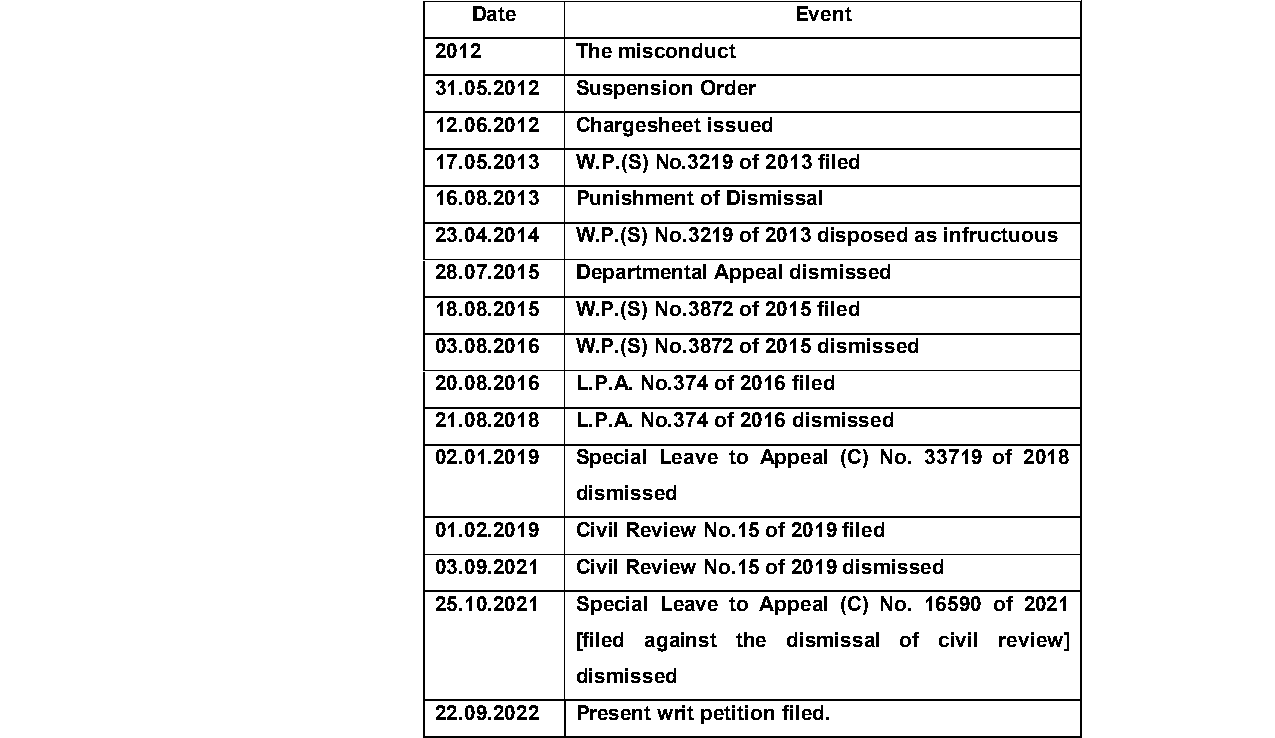
5. It is not necessary to give deta
AI


Point of law : Service - Department may not be permitted to proceed further at this length of time especially in the context that, all these nine petitioners have been acquitted in the criminal case,....


The main legal point established in the judgment is the violation of the principles of natural justice in the departmental inquiry, leading to the quashing of the impugned order and the reinstatement....
The court established that in departmental inquiries, adherence to principles of natural justice is paramount, and failure to provide a fair opportunity to defend oneself can render the inquiry and s....



An indispensable Tool for Legal Professionals, Endorsed by Various High Court and Judicial Officers
Please visit our Training & Support
Center or Contact Us for assistance

Scan Me!
India’s Legal research and Law Firm App, Download now!


For Daily Legal Updates, Join us on :



 Back to top


