
 Back
Back





IN THE HIGH COURT OF JUDICATURE AT MADRAS
THE HON'BLE MR. JUSTICE V. LAKSHMINARAYAN, J.
Thiru Kumara Rathina Veera Udaiyar, (Died) and Ors. - Petitioners
Versus
The District Revenue Officer, (Land Reforms), Chepauk, Chennai-5 and Anr. – Respondents
C.R.P(PD). No.1927 of 2003 and C.M.P.No.14272 of 2003 and W.P No.11951 of 2003
Decided On : 20-10-2023
LAND REFORMS - Partition and Stridhana Rights - Tamil Nadu Land Reforms Special (Fixation of Ceiling on Land) Act, 1961, Sections 3(14), 10(1), 10(5), 11, 22, 83 - The court interpreted the provisions of the Tamil Nadu Land Reforms Act, particularly regarding the definition of 'family' and the treatment of Stridhana. It concluded that the partition deed executed prior to the Act's commencement could not be disregarded, and the shares allotted to daughters as Stridhana should not be included in the father's holdings. The court emphasized the right of a joint family to designate property as Stridhana for daughters, which influenced its decision to set aside the order that incorrectly classified these holdings.
Fact of the Case:
The case involves a civil revision petition against an order regarding the classification of land holdings under the Tamil Nadu Land Reforms Act. The property in question was originally part of a joint family estate, and a partition deed executed in 1959 allocated shares to the daughters as Stridhana. The issue arose when the authorities attempted to include these shares in the father's holdings, contrary to the provisions of the Act.
Finding of the Court:
The court found that the partition deed was valid and that the shares allotted to the daughters as Stridhana should not be included in the father's holdings. It held that the daughters' rights to Stridhana were established prior to the enactment of the Land Reforms Act, and thus, the authorities' classification was incorrect.
Issues: Whether the shares allotted to the daughters in the partition deed could be included in the father's holdings under the Tamil Nadu Land Reforms Act, and whether the partition deed executed before the Act's commencement was valid.
Ratio Decidendi: The court established that a joint family can designate property as Stridhana for daughters, and such provisions made prior to the enactment of the Land Reforms Act cannot be disregarded. The definition of 'family' under the Act excludes married daughters' shares from being classified as part of the father's holdings.
Final Decision: The court partly allowed the civil revision petition, setting aside the order that treated the daughters' Stridhana properties as holdings of their father, while upholding the finding regarding the validity of the Will left by Kuppusamy Gounder.
ORDER :
(V. Lakshminarayan, J.)
(Prayer : Civil Revision Petition filed under Section 83 of The Tamil Nadu Land Reforms Special (Fixation of Ceiling on Land) Act, 1961 against an order in L.T.C.M.A.No.6/98 dated 21.01.1999 passed by the 1st Respondent.)
This Civil Revision petition arises against an order passed by the District Revenue Officer (Land Reforms), Chepauk in his proceedings in L.T.C.M.A.No.6/98, dated 21.01.1999.
2. Originally this revision was presented before the Tamil Nadu Land Reforms Special Appellate Tribunal at Chennai. This was in exercise of the powers vested in the said Tribunal under Section 83 of the Tamil Nadu Land Reforms (Fixation of ceiling on land) Act, 1961 (hereinafter referred to as “the Act”). The Special Appellate Tribunal was abolished and the revisions which were pending before the said Tribunal were transferred to this Court. Accordingly, the revision which was received as SRP.No.36 of 2001 was renumbered before this Court as CRP(PD).No.1927/2003.
3. Pending the revision, the Government passed an order in G.O.Ms.No.551, Revenue, LR-I.(2) Department dated 07.12.2001. This was issued, since no interim orders were passed in SRP.No.36/2001. The Government Order being a consequent proceeding of the orders impugned in the revision, out of an abundant of caution, W.P.No.11951 of 2003 has been filed. Since the result in W.P.No.11951 of 2003 is dependant on the orders to be passed in CRP(PD).No.1927 of 2003, the said revision is treated as the lead case.
History of the case:
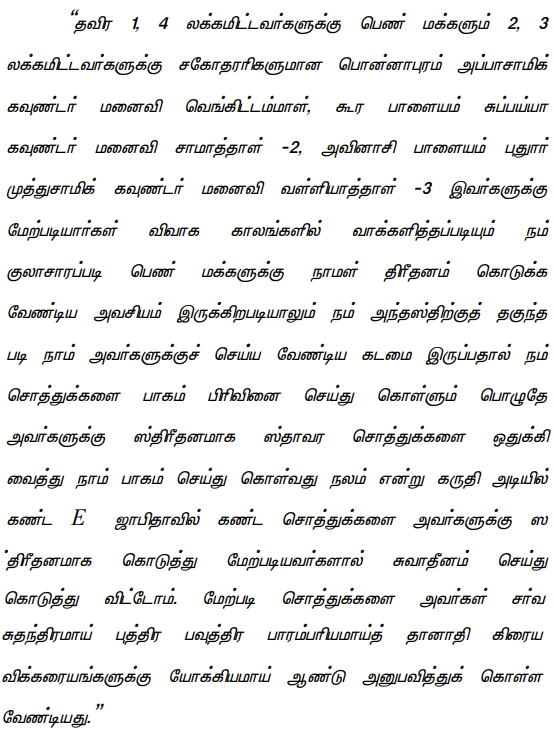
4. The property originally belonged to the joint family property of one Kuppusamy Gounder. The said Kuppusamy Gounder had one wife, two sons and three daughters. Kuppusamy Gounder, his sons and wife entered into a partition deed on 19.03.1959. As per the partition deed, A schedule fell to the share of Kuppusamy Gounder, B schedule fell to the share of his first son Kumara Rathina Veera Udaiyar, C schedule fell to the share of Ganesh @ Periyasamy/his second son, D schedule property was given to the maintenance of Muthammal, his wife/ the mother of his children and E schedule property fell to the share of his three married daughters namely Venkitammal, Samathal and Valliathal.
5. To complete the narration, Kuppusamy Gounder left behind a Will, whereunder, A schedule was given to Muthammal, his wife and B schedule property was given to Nataraja Gounder, Kuppusamy Gounder and Saminatha Gounder. The B schedule property as per the partition deed dated 19.03.1959 which was taken by Kumara Rathina Veera Udaiyar was partitioned again in the year 1969 between Kumara Rathina Veera Udaiyar and his son Balasubramaniam @ Periayana Nenaudayar. In a 1969 partition between the aforesaid persons, a portion of the properties which fell to Kumara Rathina Veera Udaiyar, was settled in the year 1970 in favour of his daughter Nallammal and the remaining extent was being enjoyed by his wife.
6. The issue in this revision is whether the shares which fell to the daughters as per the partition deed dated 19.03.1959 could be included in the shares of the father Kuppusamy Gounder.
7. The proceedings were originally initiated against S.V.Kuppusamy Gounder. A draft Notification was published under Section 10(1) of the Act on 02.04.1969. Since the said Kuppusamy Gounder had passed away in the year 1965, objections were filed by his wife Muthammal. Consequent to the draft Notification under Section 10(1) of the Act, an order was passed under Section 10(5) of the Act on 30.09.1970. Challenging the same, Muthammal preferred an appeal before the Principal Subordinate Judge at Coimbatore who was then the Land Tribunal. This appeal was taken on file as L.T.A.No.815 of 1971. The Land Tribunal allowed the appeal in and by way of its order dated 27.07.1972, wherein, it set aside the order passed under Section 10(5) of the Act and remanded the matter for fresh disposal.
8. On remand, the Assistant Commissioner (Land Reforms), Erode, issued a fresh Notification on 06.02.199
AI
A joint family can validly designate property as Stridhana for daughters, and such property cannot be included in the holdings of the father under the Tamil Nadu Land Reforms Act.


The court affirmed the joint family status and the trial court's ruling on partition, rejecting claims of prior oral partition due to insufficient evidence.

The burden of proof in establishing joint family property and partition lies with the party alleging its existence. The court also emphasized the entitlement of daughters to share in joint Hindu fami....



An indispensable Tool for Legal Professionals, Endorsed by Various High Court and Judicial Officers
Please visit our Training & Support
Center or Contact Us for assistance

Scan Me!
India’s Legal research and Law Firm App, Download now!


For Daily Legal Updates, Join us on :



 Back to top


