IN THE HIGH COURT OF JUDICATURE AT MADRAS
THE HON'BLE MR. JUSTICE G. ARUL MURUGAN, J.
K. Malarkodi and Ors. – Appellants
Versus
Vanitha and Ors. - Respondents
AS.No.925 of 2010 and MP.No.1 of 2010
Decided On : 29-11-2023
WILL - Partition and Succession - Indian Succession Act, Section 63; Hindu Succession Act, Section 8; Life Insurance Act, Section 39 - The court analyzed the validity of a will executed by the deceased, focusing on the requirements of execution and attestation under Section 63 of the Indian Succession Act. It found that the will was surrounded by suspicious circumstances and was not proven as required by law. The court also interpreted the nominee's role under the Life Insurance Act, concluding that the nominee holds the benefits in trust for all legal heirs, thus affirming the plaintiffs' rights to a share in the deceased's estate under the Hindu Succession Act.
Fact of the Case:
The plaintiffs, children of Kannan from his first marriage, filed a suit for partition of properties and death benefits after Kannan's death. The first defendant, Kannan's second wife, claimed sole rights based on a will and nomination for death benefits. The trial court granted the plaintiffs a share in certain properties but dismissed claims related to others, leading to an appeal by the defendants.
Finding of the Court:
The court upheld the trial court's decision, rejecting the validity of the will due to insufficient proof and suspicious circumstances. It ruled that the first defendant, as a nominee, could not claim the entire death benefits and must distribute them among all legal heirs.
Issues: 1. Is the will dated July 09, 2003 enforceable against the plaintiffs? 2. Are the plaintiffs entitled to a share in the suit properties? 3. Can the first defendant retain the entire death benefits as a nominee?
Ratio Decidendi: The court emphasized that a will must be proven in accordance with Section 63 of the Indian Succession Act, and mere registration does not suffice. It also clarified that a nominee under the Life Insurance Act holds the benefits in trust for the legal heirs, not as an absolute owner.
Final Decision: The appeal was dismissed, affirming the trial court's decree that the plaintiffs are entitled to a 1/8th share in items 1, 2, and 4 of the suit properties, and that the first defendant must distribute the death benefits among all legal heirs.
JUDGMENT :
(G. Arul Murugan, J.) :
(Prayer: Appeal is filed under Section 96 of the Civil Procedure Code, against the judgment and decree dated 29.06.2010 by the learned Additional District Judge (Fast Track Court), Ranipet and made in O.S. No.3 of 2009.)
This Appeal is filed challenging the judgment and decree dated 29.06.2010 in OS.No.3 of 2009 by the Additional District Court, Fast Track Court, Ranipet decreeing the suit in favour of the plaintiffs granting 1/8 share each or 4/8 share together in respect of items 1, 2 and 4 of the suit properties and dismissing the suit as against the item 3 of the suit property.
2. For the sake of convenience, the parties are referred to as per their rankings before the Trial Court.
3. The Plaintiffs are the sons and daughters born through first wife of their father Kannan. Plaintiffs father divorced his first wife Alamelu and married the first defendant Malarkodi. The defendants 2 to 4 are the children born through the first defendant.
4. It is the case of the plaintiff that their father was working as the Office Assistant in the Office of the fifth defendant/LIC and died in harness, leaving behind the Plaintiffs and the defendants 1 to 4 as his legal heirs.
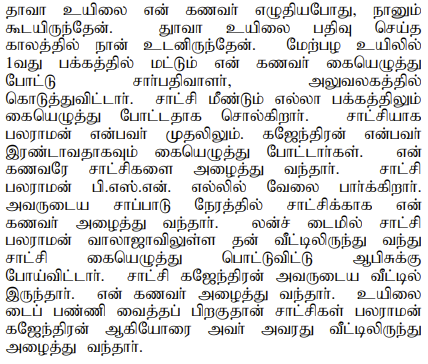
5. After the death of their father Plaintiffs and Defendants 1 to 4 are entitled to succeed both the death benefits payable from the 5th defendant and also the immovable properties owned by late Kannan. The Plaintiffs and the defendants, jointly are in possession of all the immovable properties. It is the further case of the Plaintiffs that the 1st defendant, suppressing the presence of the plaintiffs, made a claim and received the entire death benefits of Rs.14,01,657/-. Since the 5th defendant has paid the entire amount to the 1st defendant despite the objections of the plaintiffs, the 5th defendant has been impleaded in the suit.
6. According to the plaintiffs, the immovable properties mentioned in items 1 and 2 of the suit are the absolute properties of said Kannan. In addition, the 1st defendant has also purchased the house property mentioned in Item 3 of the suit schedule. Thus, according to the plaintiffs, they are entitled to a 4/8th share in all four items of the suit properties.
7. The plaintiffs issued a legal notice dated 21.02.2008, calling upon the defendant for an amicable partition by dividing the schedule property into eight equal shares and allotting 1/4th share to defendants 1 to 4. After receiving the notice, the defendants 1 to 4 replied on 04.03.2008, admitting the plaintiff's share in the suit properties and sought time for partition. However, defendants 1 to 4 remained silent after issuing the reply notice, and therefore the plaintiffs were compelled to file suit for partition and seek separate possession of their share in the suit properties.
8. The defendants 2 to 4 are minors represented by the first defendant's mother. The first defendant has filed a written statement opposing the relief. According to the first defendant, her husband Kannan legally divorced his wife Alamelu long ago. At that time, the first wife demanded and got permanent alimony for her and her children and she promised that she will not make any other claims in the future. The 1st defendant claims that even after Kannan married her and they had 3 children, still the plaintiffs were taken care of and sufficiently provided for. According to the first defendant, deceased Kannan nominated her as nominee in the 5th respondent office to receive the terminal benefits that could be paid to them. As per the the nomination, the 5th defendant has paid the entire death benefits of deceased Kannan to her, as per the nomination.
9. In view of the nomination made by the deceased Kannan in favour of the first defendant, the plaintiffs are not entitled to make any claim in so far as the item 4 of the suit property is concerned. In respect of the item 3 of the suit property, the same does not belong to first defendant nor the deceased Kannan. Therefore, the
Mageshkumar (Dead) By Lrs. Vs. Vinod Kumnar and Others reported in 2012 (4) SCC 387
AI
A will must be executed and attested as per legal requirements to be valid, and a nominee under the Life Insurance Act does not have absolute rights over the benefits but holds them in trust for the ....
Nomination in insurance does not confer absolute rights over terminal benefits, which pertain to legal heirs under succession laws.
The main legal point established in the judgment is that nomination under Section 39 of the Insurance Act, 1938 does not confer any beneficial interest on the nominee, and the amount payable under th....
A nominee does not inherit the estate of the deceased and must distribute amounts to legal heirs according to succession laws.
Nomination does not confer ownership rights; legal heirs retain entitlement to the deceased's estate under succession laws.
Nominees do not inherit the estate of the deceased; they must distribute amounts to legal heirs according to succession laws.
The court affirmed the validity of a Will executed under proper procedures, ruling that mere relationships or opportunities do not imply undue influence unless proven with clear evidence.
The court affirmed the validity of a Will and upheld its execution despite claims of suspicion, indicating that the exclusion of a child does not inherently nullify a Will.
The classification of properties as joint family or self-acquired depends on the presence of a joint family nucleus; discrepancies in the execution of the Will sow doubt on its validity due to mental....
Login now and unlock free premium legal research
Login to SupremeToday AI and access free legal analysis, AI highlights, and smart tools.
Login
now!
India’s Legal research and Law Firm App, Download now!

Copyright © 2023 Vikas Info Solution Pvt Ltd. All Rights Reserved.