
 Back
Back





IN THE HIGH COURT OF JUDICATURE AT MADRAS
THE HONOURABLE MR. JUSTICE S.S.SUNDAR, THE HONOURABLE MR. JUSTICE SUNDER MOHAN
K.Malligeswari – Appellant
Versus
The State – Respondent
Crl.A.No. 510 of 2018
Decided on : 22-12-2023
CRIMINAL LAW - MURDER AND CONSPIRACY - IPC SECTIONS 148, 447, 302 - The court discussed Sections 148 (rioting, armed with deadly weapon), 447 (criminal trespass), and 302 (punishment for murder) of the Indian Penal Code. It interpreted these sections in the context of unlawful assembly and the necessity of establishing motive and intent behind the actions of the accused. The court emphasized the need for reliable evidence to support convictions under these sections, ultimately leading to the conclusion that the prosecution failed to prove its case beyond reasonable doubt.
Fact of the Case:
The appellants, A1 to A7, were convicted for the murder of Venkatachalam, stemming from a long-standing land dispute over irrigation rights. On 29.10.2015, the accused allegedly formed an unlawful assembly, trespassed onto the deceased's land, and assaulted him, leading to his death. The prosecution's case relied heavily on the testimonies of the deceased's wife and mother, who claimed to have witnessed the incident.
Finding of the Court:
The court found significant discrepancies in the testimonies of the key witnesses, particularly regarding the motive for the crime and the sequence of events. It noted that the evidence presented was not sufficient to establish a clear motive for the accused to commit murder, and the reliability of the eyewitness accounts was questionable. The court concluded that the prosecution had not proven its case beyond a reasonable doubt.
Issues: 1. Whether the motive for the accused to commit the crime was established? 2. Whether the crime occurred as reported by the eyewitnesses? 3. Whether the evidence provided by the prosecution was trustworthy and sufficient to support a conviction?
Ratio Decidendi: The court held that the prosecution failed to establish a clear motive for the accused, and the testimonies of the eyewitnesses were inconsistent and unreliable. The absence of corroborative evidence and the significant delay in lodging the FIR further undermined the prosecution's case. The court emphasized that convictions must be based on credible evidence, and in this case, the evidence did not meet that standard.
Final Decision: The appeal was allowed, the conviction and sentence imposed on the appellants were set aside, and they were acquitted of all charges.
JUDGMENT :
S.S.SUNDAR, J.
Prayer:- Criminal Appeal filed under Section 374[2] of Cr.P.C., to call for the records relating to the proceedings dated 13.07.2018 in SC.NO.267/2016 on the file of the learned III Additional Sessions Judge, Salem, allow the appeal and set aside the order.
The above appeal is preferred by the appellants who are arrayed as A1 to A7 challenging the judgment dated 13.07.2018 in SC.No.267/2016 by the learned III Additional District and Sessions Judge, Salem, whereby the appellants stood convicted and sentenced as follows:-
| Rank of the Accused | Conviction under Section | Sentence Awarded |
| A1 to A7 | 148, 447 and 302 IPC | Each of the accused to undergo 3 years rigorous imprisonment and to pay a fine of Rs.1000/- each, in default, to undergo 3 months rigorous imprisonment for the offence under Section 148 IPC Each of the accused to undergo 3 months rigorous imprisonment and to pay a fine of Rs.500/- each, for the offence under Section 447 IPC Each of the accused to undergo life imprisonment and to pay a fine of Rs.1000/- each, in default, to undergo 6 months rigorous imprisonment for the offence under Section 302 IPC |
The sentences were ordered to run concurrently.
2. The case of the prosecution in a nutshell, is as follows:-
(a) The 1st accused Malligeswari is the adjacent land owner of the deceased Venkatachalam and the land of the deceased lies in between the lands of A1. There existed a dispute between the families of A1 and the deceased in taking water from the common well which is situated in S.NO.119/4 to the land in S.No.119/6 by digging a canal. The enmity existed between them for more than a decade and it grown day by day. A2 is the son of A1 ; A3 is the daughter of A1, A4 is the husband of A3 ; A5 and A6 are the in-laws of A2 and A7 is the wife of A2.
(b) On 29.10.2015 at about 11.30 p.m., the accused formed themselves into an unlawful assembly, with a common object of causing damage to the dripping irrigation pipelines running through the lands of the deceased at Merkku Kattukottai, Thenkumarai, situated within the limits of the respondent police and they trespassed into the lands of the deceased and destroyed the dripping irrigation pipeline running through the lands of the deceased. When the deceased and his wife/PW1 intervened and questioned the acts of A1 to A7, A1 to A7 who were armed with wooden stick, spade and iron rods, assaulted the deceased Venkatachalam with an intention to murder him. A2 beat the deceased with the iron handle of the spade on the backside of his head making him to fall down ; stuffed a piece of cloth in his mouth since he was shouting and they jointly dragged the deceased in the ground towards the well in the land of A1 and threw the deceased into the well with a common intention of causing his death by saying  resulting in the instantaneous death of the deceased. A1, A4 and A5 also attacked PW1, wife of the deceased all over her body indiscriminately causing injuries on her, which resulted in a complaint.
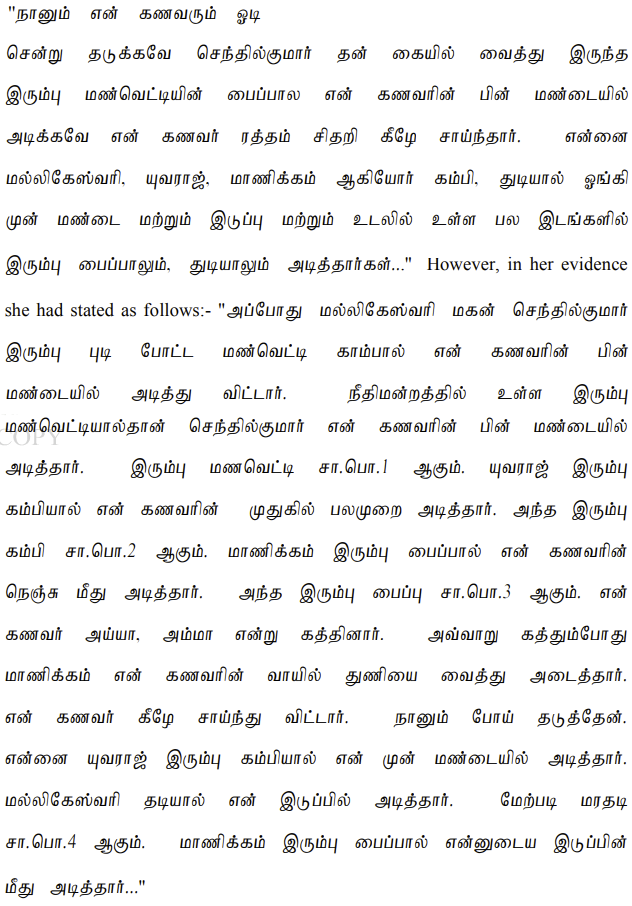
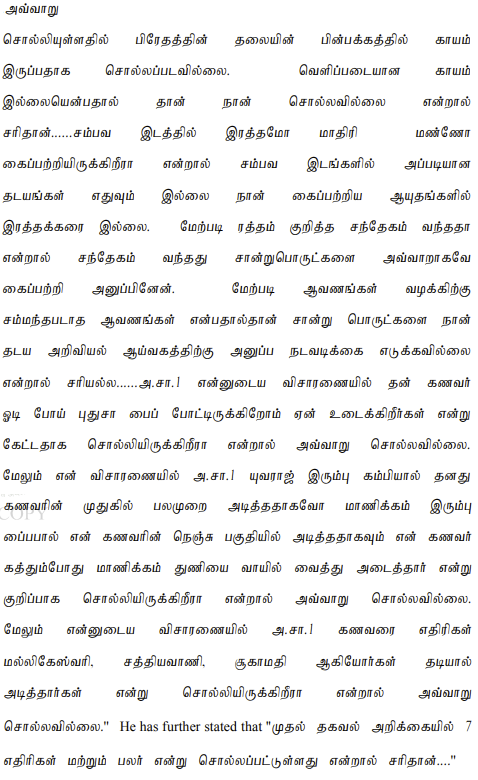
(c) PW1-Parameswari is the wife of the deceased. She had deposed that A1 had lands on the Northern and Southern side of her land in Thenkumarai village ; that on 15.10.2015, there was a dispute between them and the accused regarding laying of pipeline through her land ; that the accused made an attempt to lay pipe through the land by trespassing into the land of PW1 ; that when it was questioned by the deceased and his wife/PW1, the accused assaulted the deceased; that the deceased was thereafter admitted in the hospital and an enquiry was conducted by the police in that regard. Hence, there existed enmity between both parties. It is her further evidence that on the date of occurrence, i.e., 29.10.2015, at about 11.30 p.m., she heard a noise of breaking the drip irrigation pipeline laid in her land ; that PW1 and her husband/deceased went
AI

The court affirmed the conviction of the accused for murder, finding sufficient evidence of an unlawful assembly and individual culpability amid claims of inconsistencies in prosecution testimony.
A conviction for murder can be sustained based on the credible testimony of a single eyewitness, corroborated by medical evidence and circumstantial facts establishing motive.

The main legal point established in the judgment is the importance of reliable and convincing evidence in proving the guilt of the accused beyond reasonable doubt.

The lack of legal evidence and secondary hypothesis in the prosecution evidence led to the acquittal of the accused.

The prosecution must prove the guilt of the accused beyond reasonable doubt. If there is any doubt as to the guilt of the accused, the accused must be acquitted.
Eyewitness testimony, particularly from injured witnesses, is crucial in establishing guilt, even with minor inconsistencies in their accounts.

Injured eyewitness evidence stands on higher pedestal; reliable without corroboration unless improbable. Delay in FIR, hostile witnesses' partial support, and medical/forensic corroboration sustain c....
The main legal point established in the judgment is the importance of reliable and consistent evidence in establishing guilt beyond reasonable doubt.
The prosecution must establish guilt beyond reasonable doubt; inconsistencies and procedural failures in witness accounts can lead to acquittal.



An indispensable Tool for Legal Professionals, Endorsed by Various High Court and Judicial Officers
Please visit our Training & Support
Center or Contact Us for assistance

Scan Me!
India’s Legal research and Law Firm App, Download now!


For Daily Legal Updates, Join us on :



 Back to top


