
 Back
Back





IN THE HIGH COURT OF JUDICATURE AT MADRAS
THE HON'BLE MR.JUSTICE V.LAKSHMINARAYANAN
Bhuvaneswari and ors. - Appellants
Versus
Swariz Towraj and ors. – Respondents
S.A.No.1009 of 2013 & M.P.No.1 of 2013 & M.P.No.1 of 2015
Decided On : 03-01-2024
Locus Standi - Property Dispute - Code of Civil Procedure, 1908 - Section 100, Section 92; Transfer of Property Act; Specific Relief Act - The court analyzed the locus standi of the plaintiffs, determining that they had the right to sue as they were linked to the church managing the property. It interpreted Section 92 of the CPC, concluding that the suit did not fall under its provisions, and emphasized that the plaintiffs were not required to seek declaratory relief to challenge the alienation of trust property. The court also highlighted the obligations of the vendor under the Transfer of Property Act and the necessity of proper authorization for property alienation, ultimately ruling that the alienations were valid and the plaintiffs' suit was not maintainable.
Fact of the Case:
The plaintiffs filed a suit seeking mandatory and permanent injunctions against the defendants regarding the alienation of property belonging to the Society for Propagation of Gospel, which had merged with the Church of South India. The defendants claimed to be bona fide purchasers of the property. The trial court dismissed the suit, but the appellate court reversed this decision, leading to the present second appeal.
Finding of the Court:
The court found that the plaintiffs had locus standi to file the suit as they were connected to the church. It ruled that the suit did not fall under Section 92 of the CPC, and the plaintiffs were not required to seek a declaration to challenge the alienation. The court concluded that the alienations were valid and properly authorized, and the plaintiffs' claims were not maintainable.
Issues: 1. Did the plaintiffs have locus standi to question the alienation? 2. Was the suit barred by Section 92 of the CPC? 3. Should the plaintiffs have sought a declaration regarding the alienation? 4. Were the alienations beneficial to the trust and legally sustainable?
Ratio Decidendi: The court held that the plaintiffs had the right to sue based on their connection to the church. It clarified that Section 92 of the CPC did not apply, as the suit did not seek relief covered under that section. The court emphasized the vendor's duty to convey proper title and concluded that the alienations were valid and authorized, thus the plaintiffs' suit was not maintainable.
Final Decision: The second appeal was allowed, the judgment of the Subordinate Judge was set aside, and the trial court's decree was restored, with no costs imposed on the respondents.
ORDER :
THE HON'BLE MR.JUSTICE V.LAKSHMINARAYANAN
PRAYER: Second Appeal filed under Section 100 of Code of Civil Procedure against the decree and judgment passed in A.S.No.16 of 2011 on the file of the Sub court, Mannargudi dated 02.04.2013 reversing the decree and judgment passed in O.S.No.50 of 1997 on the file of the Additional District Munsif, Valangiman at Kumbakonam dated 18.12.2007.
The present second appeal arises against the judgment and decree passed in A.S.No.16 of 2011 on the file of the learned Subordinate Judge, Mannargudi dated 02.04.2013 in reversing the judgment and decree in O.S.No.50 of 1997 on the file of the learned Additional District Munsif, Valangiman at Kumbakonam dated 18.12.2007 and consequently, decreeing the suit as prayed for.
2. The appellants before me are the defendants 4 to 6 and 8 to 19. The suit was presented by the first and sixth respondents.
3. For the sake of clarity and convenience, the parties will be referred to as per their ranks in the suit.
4. The plaintiffs presented the suit for the following reliefs.
(a) to pass a decree for mandatory injunction directing the defendants 1 & 2 to take action against the defendants 3 to 8 in cancellation of the sale deeds and for vacancy of possession of suit lands.
(b) to pass a decree for permanent injunction restraining the defendants 3 to 12 and their men, agents and servants from any manner cultivating the suit lands.
(c) to award costs.
5. The case of the plaintiffs is that the suit schedule mentioned property belonged to the Society for Propagation of Gospel (hereinafter referred to as S.P.G. Mission). S.P.G. Mission merged itself with the Church of South India and its property started to be managed by the second defendant/Church of South India Trust Association. The Church of South India Association alienated the property to the defendants 3 to 19. The plaintiffs alleged that the alienations were not for proper consideration or under proper authorisation and therefore, it deserves to be interfered with.
6. Curiously enough in this suit, after having alienated the property in favour of the private defendants/appellants, the first and second defendants remained ex parte in the suit. The private defendants/appellants filed written statement stating that they are the bonafide purchasers of value and they have purchased the property on 06.10.1987 and 21.08.1987 for true and valid consideration. They also attacked the frame of the suit and further pleaded that previously a suit had been instituted by one C.J.Jayanathan and the suit had been dismissed on 08.01.1991 and since the said suit had been dismissed, the present suit is barred by res judicata.
7. The learned trial judge in O.S.No.50 of 1997 had framed the following issues:
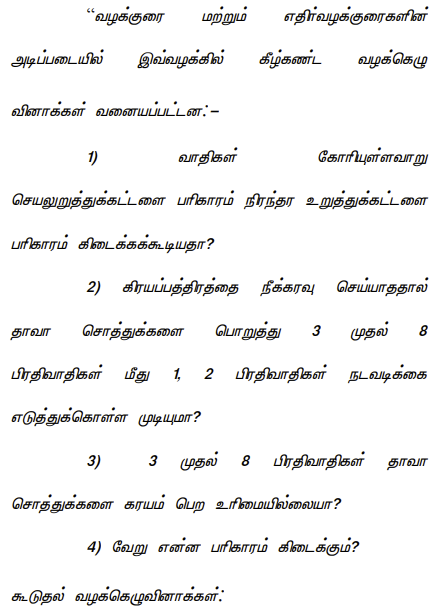
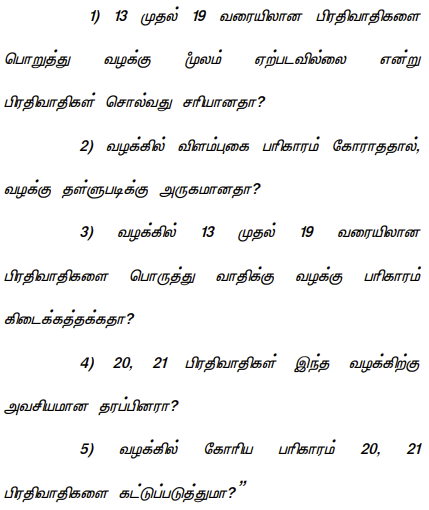
8. On behalf of the plaintiffs, PW1 and PW2 were examined and Ex.P1 to Ex.P6 were marked. Similarly on the side of the defendants, DW1 to DW4 were examined and Ex.D1 to Ex.D19 were marked.
9. After detailed examination of the case, the trial court dismissed the suit on 18.12.2007. An appeal was presented by the second plaintiff alone, arraying the first plaintiff as the 22nd respondent in A.S.No.16 of 2011. Learned Subordinate Judge at Mannarkudi who took up the appeal and allowed the same on 02.04.2013. She granted the decree for mandatory injunction as well as permanent injunction. Consequently, the present second appeal.
10. When the appeal came up for admission, the court framed the following substantial questions of law for consideration of the appeal:
“1. When the lands were sold lawfully by the competent person as per Ex.B19 and when proper procedure was adopted in regard to alienations whether plaintiffs have locus-standi to question the alienation?
2. When the suit was not filed by the plaintiffs in a representative capacity or under Section 92 of C.P.C, whether the decree and judgment granted by the appellate court sustainable in law?
3. When the alienations or the resolution passed to sell suit lands were not challenged was t
AI
The court established that worshippers or interested parties can file suits regarding trust properties even without formal authorization, and clarified the applicability of Section 92 of the CPC, emp....

The court ruled that temple property cannot be alienated by trustees without obtaining necessary permissions and demonstrating community consent as per applicable law.

A suit for possession must include a declaration of title when there is a dispute over ownership; mere possession cannot support recovery claims.
Trust properties cannot be alienated by trustees; a plaintiff can seek injunction without declaratory relief if the properties are prohibited from alienation.
A plaintiff can seek a mandatory injunction to remove encroachments on property even if the suit is effectively for recovery of possession, provided the plaintiff has established title and is willing....

Failure to establish ownership and possession of the property led to the dismissal of the suit.

Suit for Mandatory Injunction – Where there is construction raised on disputed property alleged to be owned by plaintiffs, appropriate and efficacious remedy available to them was to institute suit f....
In a suit for permanent injunction, if the plaintiff establishes title, a reasonable presumption of lawful possession can be drawn. The defendant's challenge to the title must be examined to determin....



An indispensable Tool for Legal Professionals, Endorsed by Various High Court and Judicial Officers
Please visit our Training & Support
Center or Contact Us for assistance

Scan Me!
India’s Legal research and Law Firm App, Download now!


For Daily Legal Updates, Join us on :



 Back to top


