
 Back
Back





IN THE HIGH COURT OF JUDICATURE AT MADRAS
THE HONOURABLE MR. JUSTICE P.B.BALAJI
S.Thilagam - Appellant
Versus
Palani – Respondent
S.A.No.483 of 2017
Decided On : 31-01-2024
MORTGAGE - EQUITABLE MORTGAGE AND REGISTRATION - Indian Registration Act, Section 17(1)(c); Code of Civil Procedure, Section 100 - The court discussed the necessity of registration for a memorandum acknowledging a mortgage by deposit of title deeds. It interpreted Section 17(1)(c) of the Indian Registration Act, concluding that a document merely recording the deposit of title deeds does not require registration unless it creates or extinguishes rights or liabilities. This interpretation influenced the court's decision to restore the trial court's decree in favor of the plaintiff.
Fact of the Case:
The plaintiff filed a suit for recovery of Rs.2,99,933.64 based on a mortgage by deposit of title deeds, claiming the defendant borrowed Rs.2,00,000 and executed a promissory note. The defendant contested the claim, asserting he only borrowed Rs.20,000 and had not created an equitable mortgage.
Finding of the Court:
The trial court found the defendant's defense unconvincing, upheld the validity of the promissory note, and ruled that the equitable mortgage was admissible without registration. The first appellate court reversed this decision, requiring registration of the memorandum of deposit of title deeds.
Issues: 1. Whether a memorandum acknowledging a mortgage requires registration under Section 17(1)(c) of the Indian Registration Act? 2. Is the lower appellate court correct in requiring registration when the loan transaction and deposit of title deed occurred on different days?
Ratio Decidendi: The court held that a memorandum recording the deposit of title deeds does not require registration unless it creates or extinguishes rights or liabilities. The mere acknowledgment of a mortgage does not necessitate registration.
Final Decision: The Second Appeal was allowed, restoring the trial court's judgment and decree in favor of the plaintiff.
JUDGMENT :
PRAYER: Second Appeal filed under Section 100 of the Code of Civil Procedure, against the Judgment and Decree dated 22.12.2016 in A.S. No.12 of 2016 on the file of the I Additional District Court, Salem reversing the Judgment and Decree granted on 30.06.2015 in O.S. No.436 of 2013 on the file of the Principal Subordinate Court, Salem.
The plaintiff is on Second Appeal against the reversing finding in a suit for recovery of money.
2. The parties are described as per their litigative status before the Trial Court.
3. The plaintiff filed O.S.No.436 of 2013 for recovery of a sum of Rs.2,99,933.64 from the defendant on the strength of a mortgage by deposit of title deeds dated 28.06.2009.
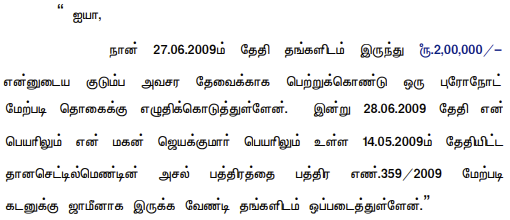
4. The case of the plaintiff is that on 27.06.2009, the defendant had borrowed a sum of Rs.2,00,000/- from the plaintiff, evidenced by the execution of a promissory note on the same day, agreeing to repay the said sum of Rs.2,00,000/- together with interest at 12% per annum. On the very next day i.e., 28.06.2009, defendant deposited the original settlement deed dated 14.05.2009 along with a covering letter of even date i.e, 28.06.2009, offering the said document as a security for the repayment of amount borrowed.
5. The defendant filed a written statement as well as additional written statement stating that the defendant had signed a blank stamp paper and blank promissory note and he had borrowed only a sum of Rs.20,000/- from one Kamal of Yercaud in the year 2009. According to the defendant he never gave the settlement deed nor created an equitable mortgage and the suit was liable to be dismissed. In the additional written statement, the defendant has stated that he has requested the said Kamal to return the blank promissory note and the registered settlement deed but the said the Kamal had handed over the same to the plaintiff, based on which the suit has been filed.
6. Before the Trial Court, the plaintiff examined herself as P.W.1 and P.W.2 and P.W.3 viz., Viswanathan and Prabhu were examined and Exs.A1 to A6 were marked as exhibits on the side of the plaintiff. On the side of the defendant, the defendant examined himself as D.W.1 and Ex.B1, a copy of the plaint in O.S.No.436 of 2013 was marked.
7. The Trial Court found that the defence set up by the defendant was not genuine and the suit pronote was infact executed only by the defendant and the plaintiff is entitled to seek the amount lent. Further, the Trial Court also after discussing the evidence of P.Ws.2 and 3 witnesses, found that the suit pronote was supported by consideration. The Trial Court also found that the plea of discharge was not proved. With regard to the deposit of title deeds, the Trial Court held that the equitable mortgage in Ex.A4 was admissible in law and it did not require registration and ultimately the Trial Court decreed the suit as prayed for.
8. Aggrieved by the said judgment and decree of the Trial court, the defendant preferred A.S.No.12 of 2016. The First Appellate Court referring to Ex.A4 and placing reliance on the decision of the Hon'ble Supreme Court in State of Haryana and Ors Vs. Navir Singh and another, reported in 2014 1 L.W. 97, held that a memorandum like Ex.A4 would require registration U/s.17 (1) (c) of the Registration Act and consequently allowed the Appeal.
9. The plaintiff, as against the reversal finding, has preferred the present Second Appeal. On 04.08.2017, this Court admitted the above Second Appeal on the following substantial questions of law :
“(i) Whether a memorandum of acknowledgement of mortgage, in the absence or recitals about the terms and conditions of mortgage engrossed therein, but merely evidencing creation of an equitable mortgage, require registration u/s.17(1) (c) of the Indian Registration Act?
(ii) When the loan transaction and deposit of title deed are on two different days, is the lower appellate Court is correct in law in holding that the memorandum of deposit of title deed requires registration”
10. Heard Mr.D.Shivaku
AI
A memorandum acknowledging a mortgage by deposit of title deeds does not require registration unless it creates or extinguishes rights or liabilities.

Mortgage by deposit of title deeds created by act of deposit; memorandum acknowledging without terms needs no registration.

The main legal point established in the judgment is the interpretation and application of the requisites for a valid mortgage by deposit of title deeds under Section 58(f) of the Transfer of Property....

The main legal point established in the judgment is that a memorandum of deposit of title deeds may not require registration if it is meant to record a concluded transaction and does not create an in....


The Agreement constituted a mortgage by deposit of title deeds under Section 58(f) of the Transfer of Property Act, and the Division Bench erred in concluding otherwise.

The court established that for an equitable mortgage by deposit of title deeds to be valid, the deposit must occur in a notified area as specified in Section 58(f) of the Transfer of Property Act, an....
The necessity of proving the execution of the memorandum of deposit of title deeds in the specified notified area and the intent to create a security thereon for establishing an equitable mortgage.



An indispensable Tool for Legal Professionals, Endorsed by Various High Court and Judicial Officers
Please visit our Training & Support
Center or Contact Us for assistance

Scan Me!
India’s Legal research and Law Firm App, Download now!


For Daily Legal Updates, Join us on :



 Back to top


