Back
Back





2024 Supreme(Mad) 1157
IN THE HIGH COURT OF JUDICATURE AT MADRAS
M.S. Ramesh, C.Kumarappan, JJ.
Nagaraj - Appellant
Versus
The State of Tamilnadu, Rep. by Inspector of Police, Thenkanikottai Police Station, - Respondent
Crl.A.No.576 of 2021 and Crl.M.P.Nos.16796 & 16797 of 2023
Decided On : 23-08-2024
Advocate Appeared:
For the Appellant : Mr.R.Selva Kumar
For the Respondent: Mr.A.Gokulakrishnan, Additional Public Prosecutor
IMPORTANT POINT
A conviction under Section 302 IPC requires reliable evidence beyond hearsay; mere allegations without corroboration are insufficient for a guilty verdict.
Headnote:
Criminal - Murder - IPC Section 302 - The court discussed the evidentiary requirements under IPC Section 302, emphasizing the need for corroborative evidence beyond hearsay to establish guilt, ultimately leading to the acquittal of the accused due to insufficient evidence.
Fact of the Case:
The accused was convicted for murdering his wife after a quarrel, but key eyewitnesses turned hostile, and the prosecution's evidence was primarily hearsay, leading to questions about the reliability of the evidence presented.
Finding of the Court:
The court found that the prosecution failed to establish the accused's guilt due to lack of corroborative evidence, as the key witnesses did not support the prosecution's case and the forensic evidence was not adequately presented.
Issues: Whether the prosecution proved the guilt of the accused beyond a reasonable doubt under Section 302 IPC, given the lack of reliable eyewitness testimony and forensic evidence.
Ratio Decidendi: The court held that mere hearsay and uncorroborated evidence are insufficient to sustain a conviction for murder under Section 302 IPC, necessitating direct evidence or reliable corroboration.
Result: The appeal is allowed, and the accused is acquitted of all charges.
JUDGMENT :
M.S.RAMESH, J.
Prayer: Criminal Appeal filed under Section 374(2) of the Criminal Procedure Code to set aside the judgment dated 27.02.2020 in S.C.No.88 of 2018 on the file of the learned Sessions Judge, Fast Track Mahila Court, Krishnagiri.
The appellant herein has been convicted and sentenced to undergo life imprisonment and to pay a fine of Rs.10,000/-, in default to undergo rigorous imprisonment for a period of one year for the offence under Section 302 of the Indian Penal Code (IPC), through the judgment of the learned Sessions Judge, Fast Track Mahila Court, Krishnagiri, dated 27.02.2020 passed in Sessions Case No.88 of 2018. This judgment is put under challenge in the present appeal.
2. For the sake of convenience, the parties to the appeal are addressed according to their ranks before the trial Court.
3.1. The brief case of the prosecution are as follows:-
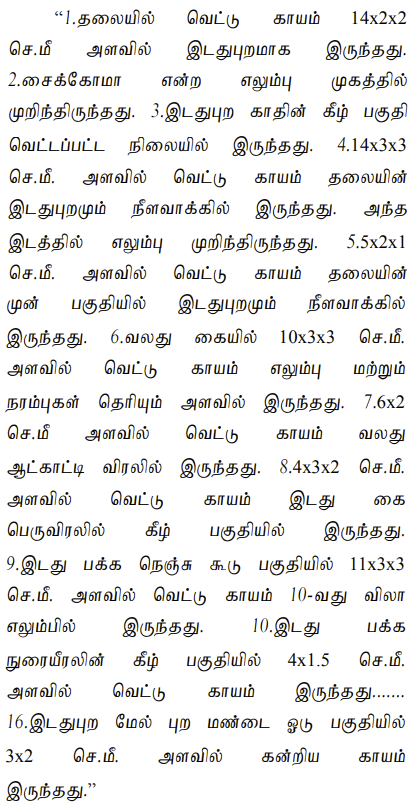
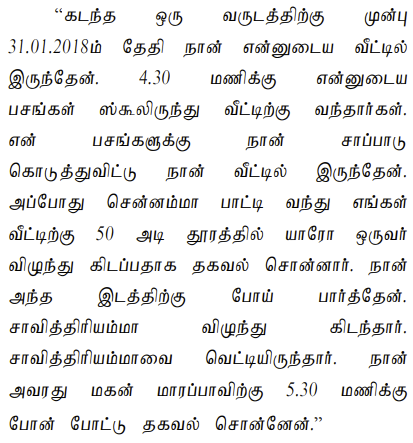
3.2. There were frequent quarrels between the accused and the deceased Savithriamma, since the accused did not want his son to pursue education, but rather work as a daily wage coolie. In consequence to these quarrels, on 31.01.2018 at about 05.30 P.M., the accused had attacked the deceased indiscriminately with a machete on her head, face, hands, stomach and toe, owing to which she died on the spot.
3.3. Based on the complaint given by the son of the deceased, a case in F.I.R.No.49/2018 came to be registered against the accused for the offence under Section 302 IPC. On completion of the investigation, a final report was filed against the accused, charging him of having committed the offence under Section 302 IPC.
3.4. The final report was taken on file by the Magistrate's Court in C.C.No.13/2018 and after compliance of the requirements under Section 207 of the Criminal Procedure Code (Cr.P.C.), it was committed to the Sessions Court, Krishnagiri, where the case was taken on file in S.C.No.88/2018 and transferred to the Fast Track Mahila Court, Krishnagiri. On perusal of the documents and after hearing both the parties, the trial Court had framed charges against the accused for the offence under Section 302 IPC. Thereafter, when the charges were read over and explained to the accused, he denied the same claiming that he was “not guilty”. The case then proceeded for trial.
4. Before the trial Court, the prosecution had examined 18 witnesses P.W.1 to P.W.18 and marked 13 documents Exs.P.1 to P.13, apart from material objects M.O.1 to M.O.8. No witnesses or documents were marked on the side of the accused.
5.1. The evidences let in by the prosecution before the trial Court are as follows:-
5.2. P.W.1, namely Marappa, is the son of the deceased and the accused. According to him, on 31.01.2018 at about 06.00 A.M., there was a wordy quarrel between his parents, after which he had left to college. On the same day, at about 05.45 P.M., P.W.2, namely Mathesh, had informed him over phone that the accused had murdered his mother and on hearing the news, he came back to his house at 05.50 P.M., and saw the dead body of his mother. Thereafter, he gave a written complaint (Ex.P.1) to the Police, which was registered in Crime No.49/2018 on the file of the Thenkanikottai Police Station, Krishnagiri District.
5.3. Mathesh (P.W.2) and Sennamma (P.W.3), who are the villagers where the deceased and the accused were residing, were projected by the prosecution as eye witnesses to the crime. However, both P.W.2 and P.W.3 did not support the case of the prosecution and were treated as hostile witnesses.
5.4. P.W.4 to P.W.7 are the close relatives of the deceased and the accused, who are hearsay witnesses.
5.5. Sivaraj (P.W.8) and Venkatesh (P.W.9) are the witnesses to the observation mahazar (Ex.P.2) prepared by the Investigating Officer and in their presence, soil with blood stains (M.O.1), soil without blood stains (M.O.2) and a money purse (M.O.3) were seized under a seizure mahazar (Ex.P.3).
5.6. Gaurammal (P.W.10) is the Village Administrative Officer, in whose presence the Investigating O