Back
Back





2024 Supreme(Mad) 1961
IN THE HIGH COURT OF JUDICATURE AT MADRAS
M.S. RAMESH, M. JOTHIRAMAN, JJ.
Murugan - Appellant
Versus
State rep. by The Inspector of Police, Peerkankaranai Police Station, Chengalpet Dist. – Respondent
Crl.A.No.162 of 2019
Decided On : 27-11-2024
For the Appellant : Mr. T.R. Ravi for Mr. R. Rajan.
For the Respondent: Mr. A. Gokulakrishnan, Addl. Public Prosecutor.
The prosecution must establish guilt beyond reasonable doubt, and mere motive or last seen theory is insufficient without corroborative evidence.
Headnote:(A) Indian Penal Code - Sections 302 and 201 - Conviction for murder and concealment of evidence - The trial court convicted the accused based on witness testimonies and circumstantial evidence; however, the appellate court found serious doubts regarding the credibility of the eyewitness and the establishment of the crime scene - The prosecution failed to provide concrete evidence linking the accused to the crime, leading to the conclusion that the trial court's judgment could not be legally sustained. (Paras 24 and 25)
(B) Eyewitness Testimony - The court emphasized the necessity of corroborative evidence to support eyewitness accounts, particularly when the testimony raises doubts about the occurrence and the accused's involvement. (Paras 20 and 22)
Facts of the case:
The accused was convicted for the murder of Palanivel, a fellow land broker, following a quarrel. The prosecution's case relied heavily on eyewitness accounts and circumstantial evidence, which were found to be unreliable. (Paras 3, 4, and 5)
Findings of Court:
The appellate court found that the prosecution did not establish the crime scene or the timeline of events convincingly, leading to the conclusion that the accused's conviction was not supported by credible evidence. (Paras 24 and 25)
Issues: The main issues included the reliability of eyewitness testimony and the adequacy of evidence linking the accused to the crime. (Paras 20 and 22)
Ratio Decidendi: The court ruled that the prosecution's failure to provide corroborative evidence and the presence of serious doubts regarding the eyewitness accounts necessitated the acquittal of the accused. (Paras 24 and 25)
Result: The judgment of the trial court was set aside, and the accused was acquitted of all charges. (Paras 24 and 25)
JUDGMENT :
(M.S. Ramesh, J.)
(Prayer: Criminal Appeal filed under Section 374(2) of the Criminal Procedure Code to set aside the judgment and conviction passed by the learned Additional District and Sessions Judge, Chengalpet, Chengalpet District, dated 31.07.2018 in S.C.No.144 of 2009.)
The appellant herein has been convicted and sentenced to undergo life imprisonment and to pay a fine of Rs.2,000/-, in default to undergo rigorous imprisonment for a period of one year for the offence under Section 302 of the Indian Penal Code (IPC) and to undergo seven years rigorous imprisonment, together with a fine of Rs.2,000/-, in default to undergo rigorous imprisonment for a period of three months for the offence under Section 201 r/w Section 302 IPC, through the judgment of the learned Additional District and Sessions Judge, Chengalpet, dated 31.07.2018 passed in S.C.No.144 of 2009. Both the sentences were ordered to run concurrently. This judgment is put under challenge in the present appeal.
2. For the sake of convenience, the parties in the appeal are referred according to their ranks before the trial Court.
3. The case of the prosecution as per the charge sheet is that the deceased Palanivel and the sole accused Murugan were involved in the business of land brokerage and there were frequent quarrels between them in connection with the land dealings, owing to which, the accused carried a grudge against the deceased. On 31.08.2008 at around 12.30A.M. in the midnight, the accused had assaulted the deceased with a clay stove and a hollow block in the front of Pachaiyammal's (P.W.11) house at No.3, Kakkanji 2nd Street, Rajiv Gandhi Nagar, Vengambakkam Village, which resulted in the instant death of the deceased and therefore, he was charged for the offence under Section 302 of the Indian Penal Code (IPC). Thereafter, with the intention of concealing the evidence, the accused had dragged the body of the deceased to Palanivel's house and thereafter dragged and dumped it in the front of one Durairaj's house, for which, he was charged for the offence under Section 201 r/w. Section 302 IPC.
4. In order to substantiate the charges, the prosecution had examined 18 witnesses P.W.1 to P.W.18 and marked 18 documents Ex.P.1 to Ex.P.18, apart from the material objects M.O.1 to M.O.3.
5.1. The evidences let in by the prosecution before the trial Court are as follows:-
5.2. The motive attributed by the prosecution against the accused for having committed the offences is that both the accused and the deceased were involved in land brokerage and had frequent quarrels in this regard. To substantiate motive against the accused, the prosecution had examined P.W.2, namely Muthulakshmi, who is the wife of the deceased. In her oral testimony, she had stated that, about ten days prior to the incident, her husband had told her that the accused had threatened to kill him. Insofar as the incident is concerned, P.W.2 was staying at her sister-in-law's house, four days prior to the incident and she had heard about the incident from others.
5.3. P.W.6 and P.W.7 were also examined by the prosecution to substantiate motive. According to P.W.6, there was a rival competition between the accused and the deceased with regard to land dealings. P.W.7 claims that he had seen the accused and the deceased the earlier day of the incident at about 06.00P.M. to 07.00P.M., when he had remarked that they were fighting all along and now are together. Both P.W.6 and P.W.7 were also projected as having seen both the accused and the deceased together on 31.08.2008. According to P.W.7, he had last seen both of them together between 06.00P.M. and 07.00P.M. on 31.08.2008, while P.W.6 had last seen them together at about 09.30P.M. on the same day.
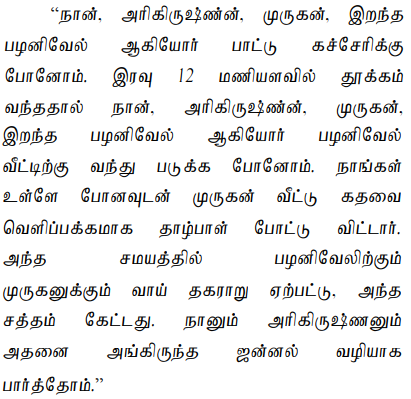
5.4. Insofar as the occurrence is concerned, the prosecution had examined P.W.9, namely Kanagarathinam, as an eye witness. According to his statement, he knows both the accused, as well as the deceased and they used to work together. On 30.08.2008, all