Back
Back





2024 Supreme(Mad) 1752
IN THE HIGH COURT OF JUDICATURE AT MADRAS
R. SAKTHIVEL, J.
Governor S/o Mayavan – Appellant
Versus
Arumugam – Respondent
S.A. No. 1552 of 2008, M.P. No. 1 of 2008
Decided On : 19-06-2024
Advocate Appeared:
For the Appellant : N. Suresh.
For the Respondent: Hemalatha Gajapathy.
IMPORTANT POINT
The court established that clear and unambiguous property descriptions are essential for granting injunctions in property disputes.
Headnote:
Property - Title Declaration - Civil Procedure Code Section 100 - The court interpreted the Partition Deed and established the rightful ownership of the property and service connection, emphasizing the necessity of clear property descriptions for injunctions.
Fact of the Case:
The plaintiffs sought a declaration of title and injunction regarding a service connection related to a property jointly allotted in a Partition Deed, claiming the second defendant wrongfully transferred the service connection to himself.
Finding of the Court:
The court found that the plaintiffs were entitled to the property and service connection as per the Partition Deed, rejecting the second defendant's claims based on the evidence presented.
Issues: Whether the plaintiffs had rights to the service connection and if the injunctions sought were consistent and valid under the law.
Ratio Decidendi: The court held that the Partition Deed clearly allocated the service connection to the plaintiffs, and the absence of clear property descriptions hindered the granting of mandatory injunctions.
Result: The Second Appeal is partly allowed, affirming the plaintiffs' ownership and directing the transfer of the service connection.
JUDGMENT :
R. SAKTHIVEL, J.
Prayer: Second Appeal filed under Section 100 of Civil Procedure Code against the judgment and decree in A.S. No. 4 of 2007 dated 22.08.2008 on the file of the Principal Subordinate Judge, Villupuram, reversing the judgment and decree in O.S. No. 119 of 2005 dated 28.07.2006 on the file of the Principal District Munsif, Ulundurpet.
1. This Second Appeal is directed against the judgment and decree dated August 22, 2008, passed in A.S. No. 4 of 2007 by the ‘Principal Subordinate Court, Villupuram’ [henceforth ‘First Appellate Court’ for the sake of brevity], reversing the judgment and decree dated July 28, 2006 passed in O.S. No. 119 of 2005 by the ‘Principal District Munsif Court, Ulundurpet’ [henceforth ‘Trial Court’ for the sake of brevity].
2. The appellant herein is the second defendant and respondents 1 to 4 herein are the plaintiffs in O.S. No. 119 of 2005. The plaintiffs filed a Suit for declaration of title with regard to ‘B Schedule of the Suit Property’ (henceforth ‘Suit Property’ for brevity and convenience) which comprises of an extent of 6 Cents within four specified boundaries along with the borewell and the ‘Agricultural Electricity Service Connection No. 16’ (henceforth ‘S.C. No. 16’) therein. Further, seeking an injunction against the 2nd defendant and his men or agents not to use the S.C. No. 16. Further, seeking a mandatory injunction effecting name transfer in favour of the plaintiffs and the first defendant, and for costs.
3. For the sake of convenience, the parties herein will be referred to as per their array in the Original Suit.
Case of the Plaintiffs:
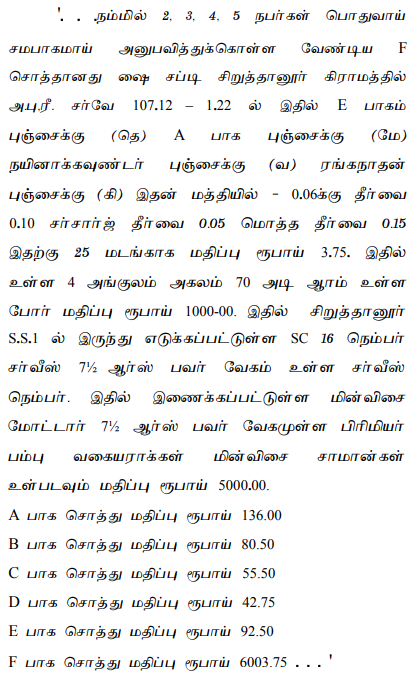
4. The case of the plaintiffs is that the Suit Property was jointly allotted to the plaintiffs and 4th plaintiff’s brother - Ranganathan vide Partition Deed dated March 5, 1980 as ‘F’ Schedule property therein. But due to inadvertence and omission, in the said Partition Deed, the S.C. No. 16 relating to ‘F’ Schedule property was omitted and Survey No. 107/13 relating to ‘F’ Schedule property was mistakenly recorded as Survey No. 107/12. Taking advantage of the said fact, the 2nd defendant claims title over the Suit property and have surreptitiously effected name transfer in his name in respect of S.C. No. 16. Hence, the Suit.
Case of the Defendant No. 1 & 2:
5. The second defendant filed written statement which was adopted by the first defendant. It is stated therein that the second defendant’s father - Mayavan is the exclusive owner of S.C. No. 16. After the demise of second defendant’s father, the second defendant transferred S.C. No. 16 in his name. The second defendant wants to shift S.C. No. 16 to his separate well. The second defendant alone is the exclusive owner of S.C. No. 16. Hence, he prayed to dismiss the Suit.
Trial Court’s Findings:
6. Before the Trial Court, the first plaintiff was examined as PW-1 and two other witnesses, namely Selvaraj and Devaraj, were examined as PW-2 and PW-3, and Ex-A.1 to Ex-A.8 were marked on the side of the plaintiffs. On the side of the defendants, second defendant was examined as DW-1 and Ex-D.1 to Ex-D.6 were marked. After hearing both sides, the Trial Court held that under Ex-A.1 - Partition Deed, ‘F’ Schedule Property was jointly allotted to the plaintiffs and the 4th plaintiff’s brother, and ‘F’ Schedule therein does not have any mention of S.C. No. 16; that the plaintiff failed to produce documents pertaining to S.C. No. 16 to prove that S.C. No. 16 stands on their name; that moreover, S.C. No. 16 is situated at Survey No. 107/13; that, hence, the plaintiffs are not entitled to the reliefs sought for. Accordingly, the Trial Court dismissed the Suit in its entirety.
First Appellate Court’s Finding:
7. Feeling aggrieved with the decision of the Trial Court, the plaintiffs preferred an Appeal Suit in A.S. No. 4 of 2007 before the First Appellate Court. The first defendant has not contested t