
 Back
Back





2024 Supreme(Mad) 1909
IN THE HIGH COURT OF JUDICATURE AT MADRAS
R.N. MANJULA, J.
M. Allimuthu S/o Munusamy – Appellant
Versus
A. Mariappan S/o Arumugam – Respondent
S.A. No. 706 of 2014, M.P. No. 2 of 2014, C.M.P. No. 11626 of 2024
Decided On : 16-12-2024
Advocate Appeared:
For the Appellants : T. Krishnappan, R. Swarnalatha
For the Respondent: S.V. Duraisolaimalai
The court upheld the First Appellate Court's ruling that the lane in question is a public lane, confirming that the plaintiff failed to establish exclusive rights over it.
Headnote:(A) Civil Procedure Code, 1908 - Section 100 - Second Appeal - Mandatory injunction sought for removal of pipeline laid in suit property - Trial Court decreed suit, but First Appellate Court reversed the decision - Appellant failed to prove exclusive rights over the lane, which was determined to be a public lane - The First Appellate Court's judgment was upheld. (Paras 1, 11, 12, 15)
(B) Appeal - Substantial questions of law - Whether the First Appellate Court erred in holding that the suit lane is a public lane belonging to the panchayat - The court found that the plaintiff did not provide sufficient evidence to establish exclusive rights over the lane. (Paras 7, 11, 12)
Facts of the case:
The plaintiff filed a suit for mandatory injunction against the defendants to remove a pipeline laid in a lane claimed to be private, but the defendants contended it was a public lane belonging to the panchayat. The trial court initially ruled in favor of the plaintiff, but the First Appellate Court reversed this decision.
Findings of Court:
The First Appellate Court found that the plaintiff failed to prove exclusive rights over the lane, which was determined to be a public lane.
Issues: The main issues included whether the First Appellate Court's judgment was maintainable and whether the trial court erred in its findings regarding the ownership of the lane.
Ratio Decidendi: The court ruled that the plaintiff did not provide adequate evidence to support claims of exclusive ownership over the lane, which was established as a public lane.
Result: Second Appeal dismissed.
JUDGMENT :
R.N. MANJULA, J.
Prayer: Second Appeal is filed under Section 100 of C.P.C. against to set aside the Judgment and Decree in A.S. No. 27 of 2012 passed by the learned Subordinate Judge at Sankari on 25.03.2014 reversing the appeal on setting aside the Judgment and decree passed in O.S. No. 23/2009 on 21.06.2012 on the file of the Principal District Munsif Court at Sankari.
1. The appellant is the plaintiff who has filed the suit for a mandatory injunction against the defendants to remove the pipeline laid in the suit property, which is marked as ‘X’ or ‘Y’ in the suit rough plan. The Trial Court decreed the suit and on the First Appeal preferred by the 1st defendant, the first Appellate Court allowed the first appeal by reversing the judgment and decree of the lower Court and the suit was dismissed. Aggrieved over that, the plaintiff has preferred this second Appeal.
2. The short facts leading to the case of the plaintiff as pleaded in the plaint are as under:
The portion shown as ABCD in the rough plan is a North-South lane over which the plaintiff and his brothers and one Suriyanarayanan alone have got rights, as they have houses on the Western side of the lane. But the said fact has been stated in the family partition deed of the plaintiffs dated 10.07.1996 and the lane has been used by the brothers without any hindrance. On the south of the North-South lane, there is a panchayat road. The 1st defendant is claiming rights over the suit lane and he has got a pipeline connection which has been given through the suit lane, which is shown as ‘X’ or ‘Y’ in the plaint rough plan and the 2nd respondent panchayat has given a pipeline through the private property; the plaintiffs raised objections to the 2nd respondent to remove the same. As the 2nd respondent did not remove the same, the plaintiff has filed the suit for a mandatory injunction to remove the above pipeline.
3. The written statement filed by the 1st defendant in brief is as follows:
The suit lane is a public lane and it belongs to the panchayat. Only in the panchayat lane, the water connection has been given and that cannot be obstructed by the plaintiffs. The said panchayat lane is situated in Survey No. 628/14. Similar connections have been given by the panchayat through the said lane to the neighbour of the defendant by name Ayyavu. As the plaintiff has claimed exclusive rights over the common public pathway, the suit should be dismissed.
4. The brief averments of the 2nd respondent’s written statement:
The suit has been filed without impleading proper parties and the suit claim itself has become infructuous.
5. On the basis of the above pleadings the trial Court has framed the following issues:
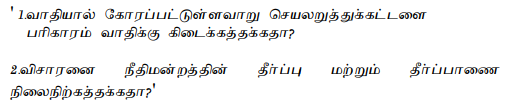
6. During the course of the trial, on the side of the plaintiffs, two witnesses have been examined as PW-1 and PW-2 and Ex.A1 to Ex.A10 were marked. On the side of the 1st defendant, one witness has been examined as DW-1 and Ex.B1 to Ex.B9 were marked. On the side of the 2nd defendant, he examined himself as DW-2 and Ex.B10 to Ex.19 were marked. The court documents i.e. commissioners report and plan have been marked as Ex.C1 and Ex.C2.
7. After the conclusion of the trial and on considering the materials available on records, the Trial Court has decreed the suit as prayed and on appeal preferred by the 1st respondent, the First Appellate Court allowed the first appeal by reversing the judgment and decree of the trial Court by setting it aside. Now the plaintiff has filed this second appeal by raising the following substantial questions of law:
“(a) Whether the judgment and decree of the First Appellate Court is maintainable, as the appellant before the First Appellate Court is not aggrieved on the judgment and decree of the trial court and as the second respondent/defendant Municipality having accepted the judgment and decree of the trial court on removing the pipe line laid in the suit land to the appellant house before the First Appellate Court?
(b) Whether the trial Court is












