Back
Back





2024 Supreme(Mad) 1975
IN THE HIGH COURT OF JUDICATURE AT MADRAS
R.N.Manjula, J.
Sankaranarayanan - Appellant
Vs.
Parry Confectionery Limited, By its Power Agent and Subrogee M/s. New India Assurance Co. Ltd. - Respondent
S.A.No.174 of 2011
Decided On : 15-11-2024
Advocate Appeared:
For the Appellant : Mr.Christopher Vijay
For the Respondents: Mr.S.Dhakshnamoorthy
The first plaintiff can maintain a suit through the second plaintiff as a power agent despite discrepancies in the policy number under the Letter of Subrogation.
Headnote:(A) Carriers Act - Section 10 - Second Appeal - Suit for recovery of money due to loss of consignment during transit - The plaintiffs, represented by their power agent, filed a suit against the defendant for the loss of goods valued at Rs.30,764/- due to theft during transit. The Trial Court decreed the suit, which was confirmed by the First Appellate Court. The substantial question of law addressed was whether the plaintiffs had authority to institute the suit under the Letter of Subrogation. The court found that the discrepancy in policy numbers did not invalidate the claim, as the first plaintiff could maintain the suit through the second plaintiff as a power agent. (Paras 8, 9, 19, 23)
(B) Subrogation - The term 'subrogation' means 'getting into the shoes of the other' - The second plaintiff, as an insurer, cannot maintain the suit if the letter of subrogation is improper, but the first plaintiff can still pursue the claim independently. (Paras 17, 18)
JUDGMENT :
This Second Appeal has been filed to set aside the judgment and decree dated 21.07.2009 passed in A.S.No.293 of 2008 on the file of the learned VII Additional Judge, City Civil Court, Chennai, confirming the judgment and decree dated 06.11.2007 passed in O.S.No.5180 of 2004 by the learned V Assistant Judge, City Civil Court, Chennai.
2. Heard Mr.Christopher Vijay, learned counsel for the appellant and Mr.S.Dhakshnamoorthy, learned counsel for the respondents and perused the materials available on record.
3. The appellant is the defendant against whom the plaintiffs have filed a suit for recovery of money. The Trial Court has decreed the suit and the First Appeal preferred by the defendant before the First Appellate Court has also confirmed the judgment and decree of the Trial Court by dismissing the First Appeal. Now the defendant has filed this Second Appeal.
4. The facts pleaded in the plaint are as under:
The first plaintiff is a limited liability Company incorporated under the Companies Act and having its Office at Chennai and it is being represented through its Power Agent M/s. New India Assurance Company Limited. The second plaintiff is a limited liability Company incorporated under the Companies Act and he is the Power Agent for the first plaintiff and having his office at Cuddalore.
4.1. The defendant carrying on business as a sole proprietor in the name and style of M/s.Sakthi Cargo Movers. The first plaintiff is engaged in the manufacture of confectioneries and he has entrusted a consignment of confectionery items for a total value of Rs.4,64,221/- as per Stock Transfer Advise No.0603 dated 27.09.2001 to the defendant under Goods Consignment Note (SCM) No.3769 dated 27.09.2001 for safe carriage by road from its factory at Nellikuppam to its office at Kannade (PO), Palghat. The defendant failed to deliver the consignment as how it has been taken. At the time of delivery effected on 01.10.2001, the first plaintiff found that there was a shortage of 13 cartons of Coffy Bite and 12 bags Lacto King of total value of Rs.30,775/-. The consignee had endorsed the shortage on the reverse of the original Goods Consignment Note delivered to the defendant. While taking delivery, the defendant has also confirmed the shortage by its Open Delivery Certificate dated 27.12.2001. The first plaintiff became aware of the shortage on 01.10.2001 at the time of delivery.
4.2. The first plaintiff had taken Marine Cargo Special Declaration Policy No.711004/21/01/00010 with the second plaintiff covering various consignments under transit including the suit consignment. Accordingly, the first plaintiff had lodged a claim with the second plaintiff for the value of shortage which was settled for a sum of Rs.38,526/- in terms of the insurance policy. In consideration of the settlement of the claim, the first plaintiff executed a letter of subrogation cum special power of attorney subrogating its right of recovery in favour of the second plaintiff. As the shortage has occurred due to the negligence or misconduct on the part of the defendant, he is liable to make good the loss.
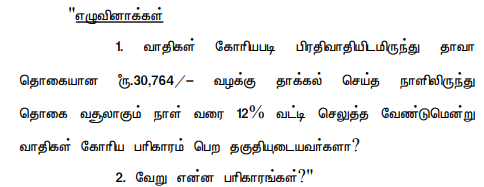
4.3. The first plaintiff had issued notice under Section 10 of the Carriers Act to the defendant on 18.03.2002 which was duly acknowledged. But the defendant did not choose to send any reply or make good the loss. Another notice was also sent by the plaintiffs on 16.08.2004 to the defendant, but that also did not evoke any positive response from the defendant. Hence, the plaintiffs have filed a suit for recovery of money by restricting their claim to Rs.30,764/- with interest at the rate of 12% per annum.
5. The short facts pleaded in the written statement of the defendant are as under:
The fact that the consignment was booked by the first plaintiff with the defendant on 27.09.2001 vide L.R.No.3769 for transportation is not denied or is admitted. The consignment was transported in a lorry bearing Registration No.TN 28 V2858. Unfortunately, there was a theft during transit, i