
 Back
Back





IN THE HIGH COURT OF JUDICATURE AT MADRAS
D. BHARATHA CHAKRAVARTHY, J.
South Indian Senguntha Mahajana Sangam - Appellant
Versus
The State of Tamil Nadu - Respondent
W.P. Nos. 4563, 4994, 5465 of 2025, W.M.P. Nos. 5084, 5087 of 2025
Decided On : 16-04-2025
| Table of Content |
|---|
| 1. common judgment for multiple writ petitions. (Para 1) |
| 2. details on caste-based societies and laws. (Para 2) |
| 3. caste associations must align their objectives with constitutional values. (Para 3) |
| 4. government response on caste societies. (Para 4 , 5) |
| 5. court's stance on maintainability of writs. (Para 6 , 7) |
| 6. legal perspective on caste societies. (Para 10 , 14 , 18) |
| 7. continuity of caste issues affects law. (Para 11 , 19 , 20) |
| 8. constitutional ideals against caste. (Para 12 , 13 , 15 , 16 , 17) |
| 9. caste identities in society must be abolished in context of constitutional goals. (Para 21) |
| 10. caste registration not valid under act. (Para 22 , 24) |
| 11. maintainability of writ petitions against caste-affiliated societies. (Para 28) |
| 12. directions for amending caste-based societies. (Para 29 , 35) |
| 13. formal disposition of writ petitions. (Para 36 , 37) |
ORDER :
1. These three writ petitions are filed for different prayers under various circumstances. However, they are considered together and addressed in this common order for the following reasons.
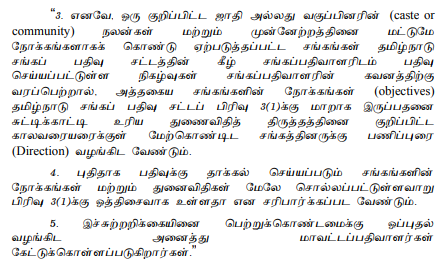
2. W.P. No. 4563 of 2025 is filed by a society registered under the Tamil Nadu Societies Registration Act, 1975. The name of the society is clear; it represents the members of a particular caste. The Memorandum of Association explicitly states its objective as follows :
“3. Objects: The Object of the Sangam shall be the upliftment of the Sengunthar Community Means:- This object shall be secured by (a) organising associations of Sengunthar Community in each and every locality where Sengunthar resides to elevate the community through these associations;
(b) Gathering and consolidating from time to time the opinions of such associations on important question relating to the community and promising communal sympathy, co-operation and solidarity among Sengunthars through such associations;
(c) Arranging for lectures and publishing pamphlets of an educative and propagandist value;
(d) promoting interest marriages among Sengunthars residing at various places and of different groups at the same place;
(e) Arbitrating and bringing union wherever there are factions among the members of the community;
(f) And doing further or other things as may be incidential and conductive to the betterment of the community.”
The Society also has by-laws, and the clause relating to membership reads as follows :
“4(a) Member-Ship: Branch Sangam: Members of either sex of the genuine Senguntha Community above the age of eighteen shall be entitled to become members of any branch Sangam.”
2.1. Thus, it can be seen that society is in the name of a caste, and its object is to strengthen the caste solidarity and caste sympathy and cooperation among the members of the caste, that is, to perpetuate the caste.
2.2. The petitioner in W.P. No. 5465 of 2025 is also a society representing a specific caste. Its Memorandum of Articles and by-laws similarly restrict membership to caste members, with the goal of perpetuating the interests of that caste.
2.3. Caste in our nation, more particularly in the State of Tamil Nadu, is not restricted to any religion, but it has percolated to all religions unequivocally and also among the rationalists. The petitioner in W.P. No.4994 of 2025 has no problem with its name as it is called Poor Educational Fund. However, its amended by-laws relating to the membership reads as follows :
“4. MEMBERSHIP a. Any one from the Catholic Gavaras / Balijas / Telagas belonging to the States of Tamilnadu /Andhra / Karnataka / Pondy are eligible to become members of the Fund by paying a membership fee of Rs.200/- along with an application. The Executive Committee shall have the power to accept or reject it.
b. A Register containing the names and addresses of the members shall be maintained.
c. The membership shall cease in the case of resignation, death or indulgence in any anti-Fund activities.”
2.4. Thus, it can be seen that the membership is restricted to a particular caste belonging to the catholic sect of Chr


AI
Caste-based societies and educational institutions must renounce caste names and restrict membership, aligning with constitutional principles promoting equality and social justice.

The provisions of Section 44(8) of the Tamil Nadu Societies Registration Act 1975, introduced later, cannot be applied retrospectively.

The main legal point established in the judgment is that a person migrating from one state to another does not carry their caste status to the migrating state, even if the same caste is recognized as....


Article 348(1)(b) of Constitution under Chapter III provides as authoritative text of all Acts passed by Parliament or Legislature of a State.

The Court affirmed the right to membership in a society under the Karnataka Societies Registration Act and clarified the broad writ jurisdiction of the High Court to enforce statutory duties.

The main legal point established in the judgment is that the absence of a public law element in the termination of employment renders a writ petition under Article 226 of the Constitution of India no....

Article 25 of the Constitution guarantees freedom of conscience, including the right to declare non-belief in any religion, but requires quantifiable evidence for public interest claims.



An indispensable Tool for Legal Professionals, Endorsed by Various High Court and Judicial Officers
Please visit our Training & Support
Center or Contact Us for assistance

Scan Me!
India’s Legal research and Law Firm App, Download now!


For Daily Legal Updates, Join us on :



 Back to top


