
 Back
Back





BEFORE THE MADURAI BENCH OF MADRAS HIGH COURT
K.K. Ramakrishnan, J.
Shelton Rajadurai - Appellant
Versus
The State rep by, The Inspector of Police, Tiruchendur Police Station - Respondent
CRL.A(MD).No.277 of 2020
Decided On : 07-04-2025
| Table of Content |
|---|
| 1. overview of the accusation and trial process. (Para 2) |
| 2. facts of the case and procedure. (Para 3) |
| 3. analysis of prosecution's burden of proof. (Para 7 , 8 , 10 , 11) |
| 4. legal standards for proving electricity theft. (Para 12 , 13 , 14) |
| 5. conclusion and acquittal of the appellant. (Para 17 , 18) |
JUDGMENT :
K.K. Ramakrishnan, J.
This appeal has been filed to set aside the judgment and conviction passed by the learned Principal Sessions Judge, Thoothukudi, Thoothukudi District, in Spl.C.C.No.1 of 2014, dated 13.08.2020.
2.The appellant, who is accused No.2 in Spl.C.C.No.1 of 2014 on the file of the learned Principal Sessions Judge, Thoothukudi, Thoothukudi District, has filed this appeal, challenging the conviction and sentence imposed on him for the offence under Sections 135 (1)(b), (c) and 135(1) (d) of Indian ELECTRICITY ACT , by the impugned order dated 13.08.2020, for the alleged act of electricity theft committed in the premises of Kiruba Ice Plant at Kurunji Nagar, Veerapandiapattinam.
3. The brief facts of the case are as follows:-
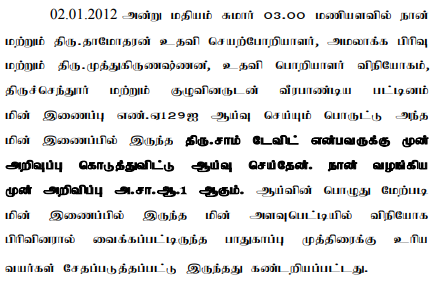
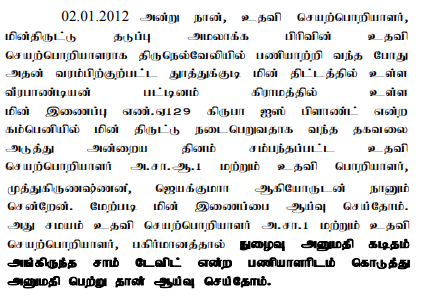
P.W.1 to P.W.4 are the officers in the Tamil Nadu electricity Board conducted the investigation on 02.01.2012 at 03.00 p.m, in the 'Kiruba Ice Plant' situated at Kurunji Nagar, Veerapandiapattinam. After causing notice to the accused on the ground that they are in occupation of premises. At that time, they found that there is tampering of the meter with an intention to commit the theft of electricity in the service connection No.A 129 available in the said Ice Plant. Thereby, caused loss of Rs.21,42,609/- to the Tamil Nadu Electricity Board. Hence, they preferred the material document in the presence of the VAO/P.W.5 and also recovered the incriminative material and lodged a complaint before the respondent police about the theft of electricity by tampering the meter. The respondent police registered a case in Crime No.11 of 2012 for the offence punishable under Section 135 (1)(b)(c) and (d) of the Indian ELECTRICITY ACT , 2003. Thereafter, investigation conducted. P.W.9 conducted investigation by collecting the material. Thereafter, P.W.10 continued the investigation and filed final report before the learned Principal Sessions Judge, Thoothukudi, Thoothukudi District, against the appellant and the original owner and the same was taken on file in Spl.C.C.No.1 of 2014.
3.1. After taking cognizance, the learned trial Judge framed the charges against the appellant for the offence punishable under Section 135 (1)(b), 135(1)(c) and 135(d) of ELECTRICITY ACT , 2003. On the basis of charges, the learned trial Judge, questioned the appellant and the appellant pleaded not guilty and hence, the trial was conducted and the prosecution adduced the evidence of P.W.1 to P.W.10 and marked the documents under Ex.P1 to Ex.P.16 and also marked 3 material objects under MO.1 to MO.3.
3.2. The learned trial Judge, considered the same, examined the appellant under Section 313 Cr.P.C., by putting the incriminating materials available against him and he denied the same and hence, the case was posted for examination of the defence witness. On the side of the defence, no one was examined and 7 documents were marked as Ex.D.1 to Ex.D.7.
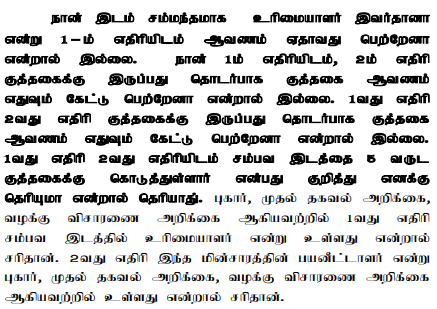
3.3. A1, who is the owner of the property filed Ex.D.1 to Ex.D7 and pleaded that there was energy theft in his Ice Factory. Therefore, he made a complaint to P.W.1's office. On the basis of the same, inspection was conducted and hence, he is noway connected with the tampering of meter and electricity theft.
3.4. The learned trial Judge after considering the explanation given by A1, acquitted him and convicted A2 on the ground that he was in occupation of premises at the time of inspection, for the offence under Sections 135 (1)(b),(c) and 135(1)(d) of Indian ELECTRICITY ACT , by the impugned order dated 13.08.2020, and sentenced him to undergo 3 years of Rigorous Imprisonment each and to pay a fine of Rs.5,000/- each in default, to undergo 6 months Simple Imprisonment each for

AI
Conviction for electricity theft requires proof of accused's ownership and control over the disputed service connection; mere tampering without clear evidence of occupation leads to acquittal.


Theft of electricity – Presumption is not of automatic application and instead, something is required to be established for it to apply.


Occupancy and benefit from electricity theft incur liability under Section 135 of the Electricity Act regardless of ownership, shifting the burden of proof to the accused.


The prosecution must prove beyond reasonable doubt that the accused committed theft of electricity, and the appellate court is reluctant to overturn acquittals without clear evidence of illegality.

The prosecution must establish evidence of ownership and presence for unauthorized electricity consumption, and failure to produce independent witnesses may result in benefit of doubt to the accused.
The accused is guilty of electricity theft under Section 135 of the Electricity Act, with the burden of proof on him to rebut the prosecution's established case.

Coherent evidence linking an accused to electricity theft must be established within statutory timelines; failure to prove ownership and timely complaints results in acquittal.



An indispensable Tool for Legal Professionals, Endorsed by Various High Court and Judicial Officers
Please visit our Training & Support
Center or Contact Us for assistance

Scan Me!
India’s Legal research and Law Firm App, Download now!


For Daily Legal Updates, Join us on :



 Back to top


