
 Back
Back





IN THE HIGH COURT OF JUDICATURE AT MADRAS
C.V.Karthikeyan, J.
Dr.A.G.Rajasri - Petitioner
Versus
The State of Tamil Nadu Rep. By its Principal Secretary to Government Health and Family Welfare Department and ors. - Respondents
W.P.No. 6491 of 2025 and W.M.P.No. 7149 of 2025
Decided On : 10-03-2025
(A) Tamil Eligibility Test - Evaluation and Key Answers - The petitioner challenged her disqualification from the Assistant Surgeon post due to scoring less than 20 marks in the Tamil Eligibility Test, claiming errors in key answers. The court upheld the expert committee's evaluation and stated that courts should not interfere in academic matters without clear evidence of error. (Paras 1, 12, 27)
(B) Judicial Review - Limits of Court's Role - The court reiterated that it should not re-evaluate answers or question the correctness of expert opinions in academic matters, emphasizing the need to respect the expertise of academic bodies. (Paras 14, 26)
Facts of the case:
The petitioner scored 18 marks in the Tamil Eligibility Test and sought additional marks for three questions, arguing that her answers were correct. The court examined expert opinions and reference materials but found no basis for altering the key answers.
Findings of Court:
The court concluded that the challenge to the key answers was unfounded and dismissed the writ petition.
Issues: The main issues included the correctness of answers in the Tamil Eligibility Test and the role of the court in re-evaluating academic assessments.
Ratio Decidendi: The court ruled that it lacks expertise to question academic evaluations and must respect the decisions of expert committees unless malafides are proven.
Result: Writ Petition dismissed.
ORDER :
C.V.Karthikeyan, J.
The Writ Petition has been filed in the nature of a Certiorarified Mandamus calling for the records of the second respondent dated 02.02.2025 by which it had been stated that the petitioner had obtained less than 20 marks in the Tamil Eligibility Test held on 05.1.2025 and therefore she was ineligible for the post of Assistant Surgeon (General) and to quash the same and direct the second respondent to grant three additional marks for question Nos. 10, 25 and 35 to the petitioner which would take the mark of the petitioner to 21 in the Tamil Eligibility Test and therefore make her eligible to be called for verification of certificates and counselling for the post of Assistant Surgeon (General) pursuant to the notification No.1/MRB/2024 dated 15.03.2024 issued by the second respondent.
2. The petitioner had applied for the post of Assistant Surgeon (General) consequent to the notification of the second respondent bearing No.1/MRB/2024 dated 15.03.2024. The scheme of the examination was Tamil Eligibility Test on 10th standard level for maximum of 50 marks in which the minimum qualification was 20 (40%) would be first held and the paper evaluated. Thereafter, the computer based test, objective type examination for Assistant Surgeon (General) with a maximum of 100 marks with qualifying marks of 30 for SC, SC Arunthathiyar and ST and 35 for others would be held. This would be evaluated only if the candidate obtains the qualifying mark in the Tamil Eligibility Test..
3. The petitioner had written her Tamil Eligibility Test and had obtained 18 marks. She claimed that the key answers for question Nos. 10, 25 and 35 were wrong and that the answers as given by her were correct. She therefore stated that if she had been given those three marks, her answer sheet for the main examination would have been evaluated.
4. The learned Additional Advocate General had produced the key answers for question Nos. 10, 25 and 35 as given by the Expert Committee and also the reference materials based on which those key answers had been determined.
5. The reference materials and the reasons for the key answers had also been disclosed to the learned Senior Counsel for the petitioner.
6. Thereafter, during arguments, the learned Senior Counsel for the petitioner conceded that the answer given by the petitioner for question No.10 was wrong but stated that the petitioner had correctly given the answer for question No.35 and further contended that there was an error in the question No.25. The learned Senior Counsel therefore contended that the petitioner must be granted two additional marks in the Tamil Eligibility Test.
7. Question No.25 is as follows:-
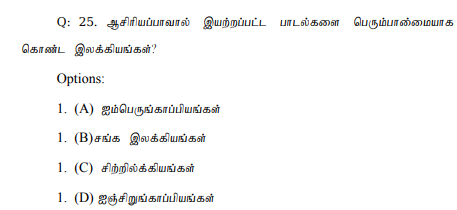
8. Both the petitioner and the respondents placed reliance on page No. 195 of the 10th standard text book prescribed by the Tamil Nadu Government School Education Department as the answer to the above question. In Page No.195, it had been given as follows:-
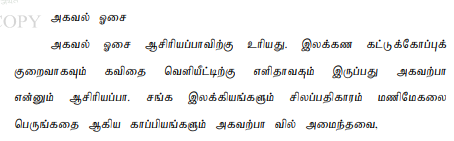
9. The learned Senior Counsel for the petitioner stated that the petitioner had chosen option (A) while according to the respondents the correct answer is option (B). The learned Senior Counsel stated that both (A) and (B) are correct answers. It is thus contended that the petitioner should be granted one additional mark.
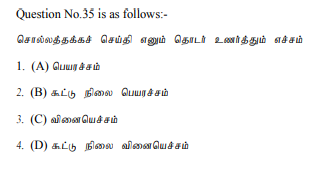
10. The petitioner had chosen an option (C). The respondents have stated that the correct answer option (B). The learned Senior Counsel stated that in the question in the word  had been wrongly given and therefore, claimed that the entire question is wrong and that therefore, one mark must be given.
11. The learned Additional Advocate General very fairly stated that he would not enter into a discussion on the correctness of the answers given by the experts and had placed a caution on the Court to venture into this exercise as the Court cannot consider itself as an Expert over and above, the Expert Committee which had examined the correctness of the question and the correctness of the key answer.
12. I have carefully consider

Courts should refrain from re-evaluating academic assessments and respect expert committee decisions unless clear evidence of error or malafides is presented.

Judicial review in academic matters is limited; courts should defer to expert opinions unless clear malafide is demonstrated.
The court upheld that key answers in examinations are presumed correct unless candidates clearly demonstrate errors; judicial interference in academic matters is limited and should respect expert opi....
Courts should defer to expert committees' evaluations in academic matters unless mala fides are alleged; presumption of correctness applies to expert answers.
The court reaffirmed that examination key answers should be presumed correct unless explicit evidence shows otherwise, emphasizing judicial restraint in academic matters.


Courts cannot re-evaluate exam answer keys or substitute expert opinions unless patently erroneous; presume key correctness; benefit of doubt to examination authority over candidates.



An indispensable Tool for Legal Professionals, Endorsed by Various High Court and Judicial Officers
Please visit our Training & Support
Center or Contact Us for assistance

Scan Me!
India’s Legal research and Law Firm App, Download now!


For Daily Legal Updates, Join us on :



 Back to top


