Back
Back





2025 Supreme(Mad) 3275
IN THE HIGH Court OF JUDICATURE AT MADRAS
SATHI KUMAR SUKUMARA KURUP, J.
Amutha - Appellant
Versus
Mani @ Bakthavachalam - Respondent
Criminal Appeal No.420 of 2016
Decided on : 03-03-2025
Advocate Appeared:
For the Appellant : Mr. N. Manoharan
For the Respondents: Mr. S.P. Yuvaraj
A valid marriage under the Hindu Marriage Act can be established without 'Saptapadi'; credible evidence proving a second marriage during the subsistence of the first valid marriage constitutes bigamy.
Headnote:(A) Indian Penal Code, 1860 - Sections 494 and 109 - Criminal Appeal against acquittal - Marriage established between Appellant and Respondent, followed by illicit relationship and second marriage lead to charges of bigamy - Trial Court convicted Respondents based on credible evidence of marriage and children, while Appellate Court acquitted them citing lack of proof of solemnization - Court restored trial verdict, emphasizing valid marriage under amended Hindu Marriage Act provisions. (Paras 3, 5, 26)
(B) Criminal Procedure Code, 1973 - Section 200 - Private complaint alleging bigamy dismissed by Appellate Court on grounds of burden of proof not met - Court clarified the complainant's proof of marriage and child births undermining Appellate reasoning, thus retaining trial court's conviction. (Paras 3, 23, 27)
Facts of the case:
The marriage between parties was solemnized in 1992, allegations of dowry demands initiated relational strife, leading to allegations of second marriage in 1997. The Appellant filed a complaint alleging bigamy after learning of the second marriage.
Findings of Court:
The initial ruling of the trial court was affirmed citing sufficient and compelling evidence of the first Respondent's second marriage during the existing marriage with the Appellant.
Issues: The court analyzed whether the Appellant successfully proved bigamy amidst previous complaints and evidences of marriage and child births.
Ratio Decidendi: The court determined that valid marriage can occur without the performance of 'Saptapadi' as per the amended Hindu Marriage Act, affirming the trial court’s findings against the Appellants’ satisfaction of proving the elements of bigamy.
Result: Criminal Appeal allowed; Appellate acquittal set aside, trial court’s conviction restored.
| Table of Content |
|---|
| 1. background of the marriage and allegations. (Para 1 , 2) |
| 2. arguments regarding the validity of the marriage evidence. (Para 3 , 4 , 5 , 6) |
| 3. legal interpretations of marriage rites under indian law. (Para 7 , 8 , 10 , 20 , 26) |
| 4. arguments against appellate court's reversal; necessity of proving second marriage. (Para 11) |
| 5. court's assessment of evidence and final decision. (Para 19 , 21 , 24 , 27) |
| 6. court's analysis of evidence supporting first marriage validation despite procedural challenges. (Para 22) |
JUDGMENT :
This Criminal Appeal had been filed against the order of acquittal dated 06.01.2016 made in C.A. No. 105 of 2015 on the file of the learned III Additional District and Sessions Judge, Salem reversing the judgment dated 29.06.2015 made in C.C. No. 2 of 2014 on the file of the learned Judicial Magistrate, Additional Mahila Court, Salem.
2. The brief facts, which are necessary for the disposal of this Criminal Appeal, are given below:
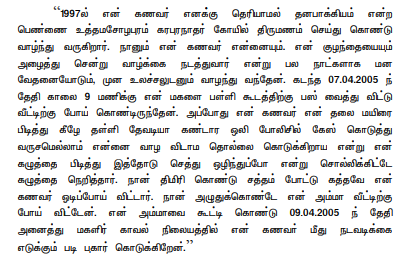
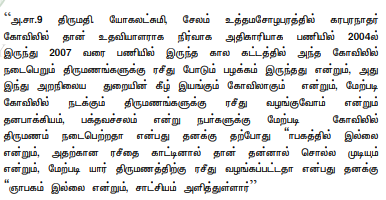
2.1. The marriage between the Appellant and the first Respondent was solemnised on 01.11.1992. In the course of the matrimonial life, the Appellant delivered a female child. After the birth of the female child, the first Respondent and his mother driven the Appellant out of the matrimonial home when their demand for payment of Rs.10,000/- as dowry was not met by her. Subsequently, there was a settlement talk made by elders of both the families and the Appellant was united with first Respondent in the matrimonial home, after paying the amount demanded by the first Respondent. After a year therefrom, once again, the first Respondent driven the Appellant out of the matrimonial home. It is alleged that after driving out the Appellant from the matrimonial home, the first Respondent developed illicit relationship with second Respondent and even married her at Uthamacholapuram Karapuranadhar Swami Temple. It is also alleged that the marriage between Respondents 1 and 2 was solemnised by the Respondents 3 to 7 and they are witnesses to the illegal marriage. The Appellant also alleged that out of such illegal marriage between the Respondents 1 and 2, three children have born and it stands testimony to their illegal relationship when the marriage between the first Respondent and the Appellant was subsisting. Therefore, the Appellant filed a private complaint under Section 200 of the Code of Criminal Procedure against the Respondents 1 to 7 praying to punish them for the alleged offences under Sections 494 read with 109 of the INDIAN PENAL CODE .
2.2. The learned Judicial Magistrate, Additional Mahila Court, Salem framed charges against the first Accused for the offence under Section 494 of the INDIAN PENAL CODE and Charge for the offence under Section 494 read with Section 109 of INDIAN PENAL CODE as against the Respondents 2 to 7 therein.
2.3. During trial in the private complaint, the Appellant herein examined herself as P.W-1 and one Balasubramaniam, Executive Officer of Karupunathar Temple as P.W-2. She marked 5 documents as Ex.P-1 to Ex.P-5 in support of the private complaint. On the side of the Respondents/Accused, no witness was examined, however, they have marked two documents as Ex.R-1 and Ex.R-2.
2.4. The learned Judicial Magistrate, Additional Mahila Court, Salem, upon considering the oral and documentary evidence passed the Judgment dated 29.06.2015 by holding that the first Respondent is guilty of offence under Section 494 of IPC and the Respondents 2, 4 and 5 have committed the offence under Section 494 of IPC read with Section 109 of IPC. However, the Respondents 3, 6 and 7 were found not guilty of the offences and therefore they were acquitted of the charges for the offence under Section 494 of IPC read with Section 109 of IPC. As far as the sentence is concerned, the Accused 1, 2, 4 and 5 were sentenced to undergo one year rigorous imprisonment and to pay fine of Rs.1,000/- in default to undergo simple imprisonment for three years.
2.5. Assailing the Judgment dated 29.06