Back
Back





2025 Supreme(Mad) 3393
IN THE HIGH COURT OF JUDICATURE AT MADRAS
A.D.MARIA CLETE, J.
The Management, Erode Sarvodaya Sangam - Appellant
Versus
B.Murugesan M/60, S/o. N.Balakrishnan - Respondent
Writ Petition No. 329 of 2020 and W.M.P.No.378 of 2020
Decided on : 21-02-2025
Advocate Appeared:
For the Appellant : Mr.N.Manoharan
For the Respondent: Mr.V.Ajay Khose
The management's failure to substantiate allegations of misconduct and conduct a domestic enquiry justified the Labour Court's reinstatement order under Section 11A of the Industrial Disputes Act.
Headnote:(A) Industrial Disputes Act, 1947 - Section 11A - Writ petition challenging Labour Court's award - The Labour Court set aside the dismissal order of the respondent and directed reinstatement with back wages, finding management failed to substantiate allegations of misconduct. (Paras 2, 5, 13)
(B) Disciplinary Action - The management's failure to conduct a domestic enquiry and lack of evidence for misconduct led to the Labour Court's decision. (Paras 6, 9, 13)
(C) Judicial Review - The court emphasized the Labour Court's authority to reassess evidence and determine misconduct under Section 11A. (Paras 11, 12)
Facts of the case:
The petitioner management dismissed the respondent for alleged misconduct, which was challenged through an industrial dispute. The Labour Court found no substantiation for the dismissal.
Findings of Court:
The Labour Court's award reinstating the respondent was upheld, as the management did not provide sufficient evidence for the allegations.
Issues: The main issues were whether the management substantiated the allegations of misconduct and the validity of the dismissal without a domestic enquiry.
Ratio Decidendi: The court ruled that the management's failure to conduct a domestic enquiry and lack of evidence for misconduct justified the Labour Court's reinstatement order.
Result: Writ petition dismissed.
JUDGMENT :
Heard.
2. The petitioner, a Sarvodaya Sangam, has filed the present writ petition challenging the award dated 27.08.2019 passed by the Labour Court, Salem, in I.D. No. 18 of 2007. By the impugned award, the Labour Court set aside the dismissal order dated 01.07.2006 issued by the petitioner management and directed the reinstatement of the respondent with back wages and all attendant benefits.
3. The writ petition was admitted on 08.01.2020, and an interim stay was granted on the same day for a period of four weeks. When the matter was subsequently listed on 22.10.2021, the interim stay was extended until 11.11.2021. The respondent was dismissed from service by an order dated 01.07.2006. Challenging the dismissal, he raised an industrial dispute before the Government Labour Officer, Erode, through a representation dated 24.07.2006. The Conciliation Officer, after issuing notice to the management and conducting discussions with both parties, was unable to facilitate a settlement. Consequently, he issued a failure report on 11.12.2006. Based on the failure report, the respondent filed a claim statement dated 02.01.2007. The Labour Court, Salem, registered the dispute as I.D. No. 18 of 2007 and issued notice to the petitioner management, which filed a counter statement on 15.02.2008.
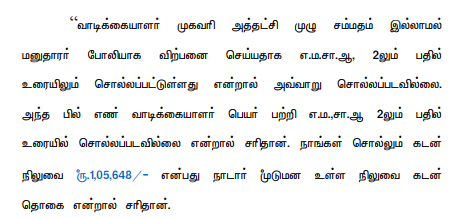
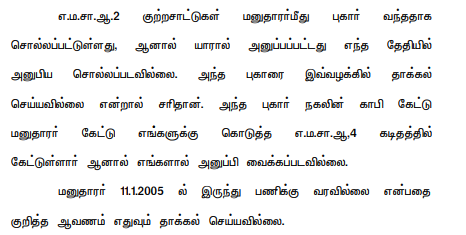
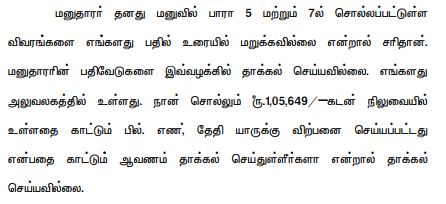
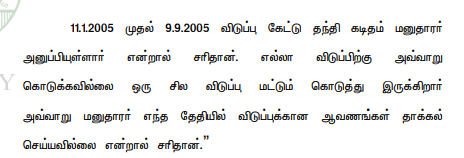
4. Before the Labour Court, the respondent workman examined himself as PW1 and submitted 16 documents, which were marked as Ex.P1 to Ex.P16. On behalf of the management, K. Murugesan, the Secretary of the Sangam, was examined as RW1, and the management produced 20 documents, marked as Ex.R1 to Ex.R20. Upon analyzing the evidence presented, the Labour Court concluded that the management had not initiated any criminal proceedings against the respondent, despite alleging that he had misappropriated a sum of Rs.1,05,648.80 from the society. No police complaint was lodged in this regard. Also, the management failed to consider the respondent’s leave application, and the Khadar godown in-charge had not raised any complaint about his alleged absence. The respondent had also sought to be readmitted on 27.08.2005. Furthermore, the attendance register, which purportedly recorded the respondent’s absence from 11.01.2005, was never produced before the Labour Court.
5. In light of the above findings, the Labour Court held that the petitioner management had failed to substantiate the allegations of unauthorized absence and misappropriation of funds against the respondent. Consequently, the Labour Court set aside the dismissal order and granted the respondent the relief of reinstatement with back wages and all attendant benefits. Accordingly, an award to this effect was passed on 27.08.2019, which has now become the subject matter of the present writ petition.
6. The learned counsel for the management contended that, under Byelaw No. 27, the society is empowered to initiate disciplinary action against the workman and has three available options: criminal prosecution, surcharge proceedings, and disciplinary action. It was argued that the disciplinary action taken by the management cannot be faulted merely because no criminal proceedings were initiated. The counsel further submitted that the workman had not disputed his absence, and given the seriousness of the alleged and proven misconduct, the workman is not entitled to reinstatement. The management also relied on the judgment of the Hon'ble Supreme Court in U.P.S.R.T.C. vs. Ram Kishan Arora, reported in 2007 (4) SCC 627, to contend that, in light of the serious misconduct, the management has lost confidence in the workman, justifying the denial of reinstatement.
7. However, the decision relied upon by the learned counsel for the management pertains to proceedings under Article 226 of the Constitution. In that context, the Hon'ble Supreme Court, in paragraphs 6 and 7 of the judgment, observed as follows:
“6. It is now well-settled that commission of a criminal breach of trust by a person holding a position of tru