Back
Back





2025 Supreme(Mad) 3516
IN THE HIGH COURT OF JUDICATURE AT MADRAS
D. BHARATHA CHAKRAVARTHY, J.
S. Sekar - Appellant
Versus
The Management of Sithilingamadam, Primary Agricultural Co-operative Bank Limited - Respondent
W.P. No. 29201 of 2010
Decided On : 13-02-2025
Advocate Appeared:
For the Appellants : K.M. Ramesh, V. Subramani
For the Respondent: S. Gopinathan
The court emphasized the necessity of a fair domestic enquiry, ruling that the absence of evidence rendered the dismissal unjustified, leading to compensation instead of reinstatement.
Headnote:(A) Industrial Disputes Act, 1947 - Section 11A - Writ Petition challenging Labour Court's award - Workman charged with unauthorized absence and misappropriation of funds - Labour Court upheld dismissal based on findings of misconduct - Court found domestic enquiry lacked evidence and was unfair - Compensation awarded instead of reinstatement. (Paras 1-18)
(B) Domestic Enquiry - Fairness and proper conduct of domestic enquiry is essential - Management must provide evidence to substantiate charges against the workman. (Paras 12-15)
(C) Compensation - Compensation equivalent to 39 months' salary deemed appropriate in lieu of reinstatement. (Paras 16-17)
Facts of the case:
The workman, S.Sekar, was dismissed for alleged unauthorized absence and misappropriation of Rs.15,961.50. The Labour Court found misconduct proven but the court found the domestic enquiry unfair due to lack of evidence.
Findings of Court:
The domestic enquiry was deemed unfair as no witnesses were examined and no documents were marked, leading to the conclusion that the charges were not substantiated.
Issues: The main issues were the fairness of the domestic enquiry and whether the charges against the workman were substantiated by evidence.
Ratio Decidendi: The court ruled that the domestic enquiry was not conducted fairly, lacking evidence to support the charges, and thus the dismissal was unjustified.
Result: Writ Petition allowed; compensation of Rs.2,50,000 awarded.
ORDER :
1. This Writ Petition is filed challenging the award of the Labour Court, Cuddalore, dated 06.10.2010 made in I.D.No.15 of 2005.
2. The brief facts leading to the filing of the Writ Petition are that the workman involved in this case, namely, S.Sekar, was working as a Salesman in the first respondent management, Sithilingamadam Primary Agricultural Co-operative Bank Limited. While so, a charge memorandum was issued to him on 29.09.2003 containing three charges. The first charge against the workman was that on various dates, mentioned in the statement of imputation of misconduct, the workman was unauthorisedly absent. The second charge was that even though he attended work on various periods, which are mentioned in the statement of imputation of misconduct, he did not perform his work that of the Salesman. The third charge against the workman is that even though he sold certain items that were verified during handing over of stock, he did not deposit all the sale proceeds and misappropriated a sum of Rs.15,961.50 ps.
3. The workman submitted his explanation to the charges on 01.11.2003. He denied the first two charges. He contends that he never remained unauthorisedly absent. On the periods mentioned in the statement of imputation of misconduct, he duly performed his duty, and the allegation to the contrary is incorrect. As far as the charge relating to misappropriation is concerned, it is his specific case that he was suddenly suspended, and the charge was handed over to the next Salesman. The next Salesman, at the time of handing over the charge, pointed out some of the goods and the stock and said that those stocks were damaged and rotten, and therefore, he will not be in a position to sell those stocks and refuse to take stock of the same. Under the said circumstances, the officials, who were present, made an entry as if those stocks of various goods were already sold, and that is now sought to be projected as the sale and misappropriation and, therefore, denied the charge.
4. Under the said circumstances, an Enquiry Officer was appointed. The first date of enquiry was fixed on 09.11.2003. On the said date, the workman sought an adjournment, and therefore, the enquiry was adjourned to 16.11.2003. On 16.11.2003, the Enquiry Officer asked for the explanation of the workman in respect of the same charges. The workman almost reiterated the same explanation. Apart from the explanation, there was some interaction between the workman and the Enquiry Officer, which was also recorded in the proceedings.
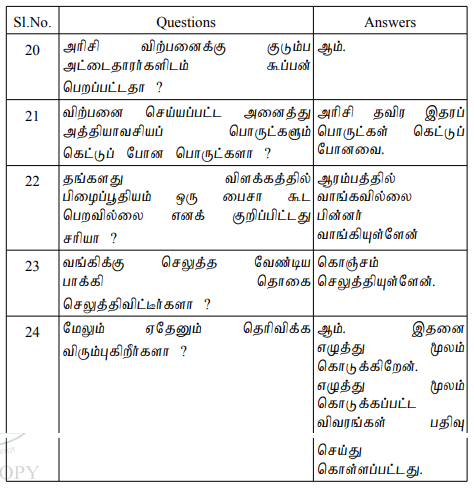
5. The Enquiry Officer stopped with the same and submitted his report on the same day i.e., 19.11.2003 holding that the charge Nos.1 and 2 were not proved and as far as the explanation of the workman relating to the charge No.3 is concerned, the same is not acceptable and from the very explanation, it can be seen that the workman would be responsible for the certain shortages and therefore, held that the third charge as proved. Based on the said report, a second show-cause notice was issued on 22.11.2003. The workman submitted his further explanation on 11.12.2003. After considering his further explanation, by a notice, dated 03.01.2004, a personal hearing was also granted. During the personal hearing, the workman again submitted the same written explanation. During the personal hearing, the Disciplinary Authority also interacted with the workman and asked certain questions and got the answers in respect thereof. After that, considering the same, by the order dated 03.01.2004, the Disciplinary Authority agreed with the Enquiry Report and held that given the charge No.3, punished with removal from service with effect from 31.01.2004. Aggrieved thereby, the workman raised a dispute. The conciliation did not fructify in any resolution.
6. Thereafter, the claim statement, filed by the workman, was taken on file as I.D.No.15 of 2005. The claim statement was resisted by the respondent management by a detailed counter. The Labour Court to