
 Back
Back





BEFORE THE MADURAI BENCH OF MADRAS HIGH COURT
M.S. RAMESH, A.D. MARIA CLETE, JJ.
The Managing Director, The Tamil Nadu State Transport Corporation (Kumbakonam) Ltd. and Anr. – Appellants
Versus
P .Mathiyazhagan – Respondent
W.A.(MD) No.2699 of 2024 and C.M.P.(MD) No.18681 of 2024
Decided On : 02-01-2025
| Table of Content |
|---|
| 1. employee's superannuation and withheld increments (Para 1 , 2) |
| 2. legality of recovering withheld increments (Para 3 , 4 , 5 , 6) |
JUDGMENT :
(M.S. RAMESH, J.)
On the ground that the respondent herein had attained the age of superannuation on 30.06.2023 and that the appellants/Corporation could not fully discharge punishment of increment cut with cumulative effect for 12 months, recovery of salary at the rate of Rs.7,000/- for the months of May and June, 2023, was made.
2. The respondent herein had filed a Writ Petition in W.P.(MD).No. 16084 of 2023 seeking for a direction to the Corporation to disburse the withheld increments. Through an order dated 20.07.2023, the learned Single Judge had directed the Corporation to disburse the withheld increment within a stipulated time. The said order is under challenge in the present Writ Appeal.
3. The reason assigned by the Corporation for deducting recovery in increments, claiming it to be an implemented portion of the increment, has been held to be impermissible in law, in various decisions of this Court.
4. In one such decision of the Hon'ble Division Bench of this Court in the case of 'The State Express Transport Corporation Vs. G. Senthil & another' passed in 'W.A.(MD).No.1270 of 2020 dated 15.06.2021, this proposition was upheld in the following manner:-
“.... 4. The appellant-Corporation is on appeal before us by contending that though the decision of the Division Bench in the case of J.Arumugam (supra), was confirmed by the Hon'ble Supreme Court, since the Special Leave Petition in SLP(C) No.1755 of 2018 was dismissed on 09.02.2018, all the Employees Unions have signed a Settlement under Section 12(3) of the Industrial Dispute Act 1947, dated 04.01.2018 and in terms of Clause 8 therein, the appellant-Corporation is entitled to recover the said amount with regard to the unimplemented order of punishment passed against the workmen postponing the increment.
5. First issue to be considered in this appeal is whether the judgment rendered by the Court can be settled or not by entering into the settlement under Section 12(3) or 18(1) of the Industrial Dispute Act, 1947. The Settlement signed between the employer and the employee can at best have the binding inter- partly qua the claims made by the workmen against the management. No settlement can be entered into between the parties to nullify a judgment which has been rendered interpreting the Statutory Rules and Regulations, which are applicable to the Organisation. Therefore, the argument of the appellant that the settlement would supersede the decision on the legal issue is not acceptable and it is rejected.
6. Be that as it may, if we examine the condition No.8 of the 12(3) of the Industrial Dispute Act 1947 Settlement, we find that there is no such leverage given to the appellant-Management. The said Clause 8 reads as follows:
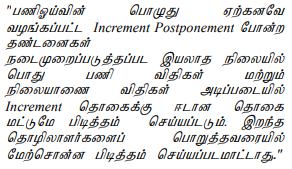
7. The above condition states that the increment postponement orders which could not be implemented prior to the superannuation of the employee can be implemented, but only in accordance with the Common Service Rules and the Standing Orders which are applicable to the organisation. This question was considered in the case of J.Arumugam (supra), as first among the several issues and it was held that there is no provision in the Certified Standing Orders enabling the Management to pass orders of recovery as passed in the instant case. In fact, the Court held that the Common Service Rules are not applicable to the workmen and there is no Standing Order framed by the Management and only Certified Standing Orders are in vogue and the Certified Standing Orders do not provide for any such recovery. The operative portion of the judgment reads as follows:
"5. Before deciding the merits of the case, firstly, it has to be seen, as to, under which Rule, the workmen of the Management are governed by. It is admitted by the Management that the workmen are governed by Certified Standing Orders, framed for the employe
AI
Settlement under Section 12(3) of the Industrial Disputes Act cannot nullify judicial decisions interpreting statutory rules; unauthorized recovery of increments invalid.
The management cannot recover the monetary value of unimplemented punishments post-retirement as there is no provision in the Certified Standing Orders allowing such actions.


Recovery of excess payments impermissible from retired employees, as per Rafiq Masih guidelines.


Point of law: The expression 'emoluments' means basic pay as defined in Rule 9(21) (a)(i) of the Fundamental Rules which a Government servant was receiving immediately before his retirement or on the....
The Labour Court lacks authority under Section 33C(2) to adjudicate claims involving industrial disputes; however, it can enforce recoveries for documented employee negligence under the Payment of Wa....



An indispensable Tool for Legal Professionals, Endorsed by Various High Court and Judicial Officers
Please visit our Training & Support
Center or Contact Us for assistance

Scan Me!
India’s Legal research and Law Firm App, Download now!


For Daily Legal Updates, Join us on :



 Back to top


