Back
Back





2025 Supreme(Mad) 3988
IN THE HIGH COURT OF JUDICATURE AT MADRAS
R. SAKTHIVEL, J.
Ganesan and Anr. – Appellants
Versus
Palaniammal (Died) and Ors. – Respondents
S.A. No.332 Of 2020
Decided On : 07-01-2025
For the Appellants : Mr. P .Valliappan, Senior Counsel for M/s. B. Shivani
For the Respondents: Passed away, Mr. D. Selvaraju, Mr. M.S. Shriram Narayanan.
The plaintiffs failed to establish title or prove fraudulent claims regarding partition; the properties were self-acquired, thus invalidating joint ownership claims by the defendants.
Headnote:(A) Indian Evidence Act, 1872 - Section 58 - Limitation Act, 1963 - Suit for declaration of title, recovery of possession and mesne profits - Plaintiffs failed to establish their title or show that the defendants were in permissive possession, leading to dismissal of the Suit - Plaintiffs admitted possession of certain sub divisions in their pleadings, undermining their claim of ownership over the entire property - The courts below erred in imposing certain findings without adequate evidence supporting the plaintiffs' claims. (Paras 17, 18, and 20)
(B) Property Law - Nature of property - Self-acquired vs. joint family property - The properties in question were determined to be self-acquired by the husband of the first plaintiff, hence, no joint ownership could be asserted by the defendants. (Paras 16 and 19)
(C) Fraudulent Conduct - Burden of proof - The burden to prove alleged fraud in obtaining the Partition Deed lay on the plaintiffs, which they failed to discharge satisfactorily. (Paras 16 and 19)
Facts of the case:
The plaintiffs claimed ownership and sought recovery of properties that they alleged were fraudulently claimed by the defendants. The trial court found in favor of the plaintiffs, which was upheld by the first appellate court. The defendants contested the assertion of ownership, citing the lack of evidence and the plaintiffs' acknowledgment of their limited possession.
Findings of Court:
The trial and appellate courts found that the plaintiffs did not adequately prove their claims and hence dismissed the further appeals from the defendants regarding partitioning and established possession of their properties.
Issues: The primary issues were whether the plaintiffs could prove their claims of title and possession, and whether the courts below properly evaluated the legal implications of the Partition Deed.
Ratio Decidendi: The court ruled that the properties were self-acquired and the burden of proof regarding the alleged fraud in obtaining the Partition Deed was on the plaintiffs, which they failed to meet. The admission regarding possession further weakened the plaintiffs' case.
Result: The Second Appeal is allowed and the Original Suit is dismissed.
| Table of Content |
|---|
| 1. ownership and history of property acquisition. (Para 3 , 4 , 5) |
| 2. arguments regarding titles and claims of ownership. (Para 9 , 10 , 11) |
| 3. proof burden and evidentiary standards. (Para 12 , 13 , 16) |
| 4. court's observation on burden of proof and admissions (Para 17) |
| 5. court's determination on ownership and possession. (Para 18 , 19) |
| 6. dismissal of original suit. (Para 20) |
JUDGMENT :
(R. SAKTHIVEL, J.)
This Second Appeal is directed against the Judgment and Decree dated November 28, 2018 passed in A.S.No.72 of 2016 by the 'Additional District and Sessions Court, Ariyalur' ['First Appellate Court' for brevity], whereby the Judgment and Decree dated April 30, 2012 passed in O.S.No.344 of 2004 by the 'District Munsif Court, Jayankondam' ['Trial Court' for brevity] was confirmed.
2. For the sake of convenience, hereinafter, the parties will be referred to as per their array in the Original Suit.
PLAINTIFFS' CASE
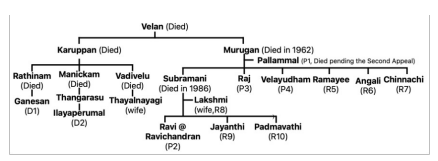
3. Murugan, the first plaintiff’s husband, moved to Malaysia in his young age, where he married the first plaintiff. Their children, including late Subramaniyan and Plaintiff Nos.3 and 4, were born there. The second plaintiff is Subramaniyan’s son. Murugan and the first plaintiff sent money from Malaysia to one Ayyakkannu, who used it to purchase 5.82 Acres in Survey No. 211/1 in Murugan’s name vide two Sale Deeds dated August 28, 1940 and September 6, 1940.
3.1. Ayyakkannu managed the land for over 10 years on behalf of the first plaintiff and Murugan. Due to Ayyakkannu’s illness, the first plaintiff and Murugan entrusted the purchased property to Rathinam, the son of Karuppan and father of the first defendant, along with original Sale Deeds around the year 1950. Karuppan who is none other than the elder brother of Murugan. Rathinam managed the land while Murugan and the first plaintiff sent funds for its maintenance and kist payments.
3.2. In 1961, the first plaintiff, Murugan, and their children returned to India. After Karuppan’s demise, Murugan and Rathinam divided the ancestral properties, each receiving 1.71 Acres of land and a house site. Later, Murugan fell ill and the first plaintiff was unable to manage the properties as her children were minors. Taking advantage of this situation Rathinam offered assistance but after Murugan’s demise in 1962 he began to explode.
3.3. Hence, the first plaintiff reclaimed the properties and personally managed them. Rathinam later agreed to cultivate 10 plots in Survey No. 211/1 and executed a waram chit on March 30, 1970. The Patta for the property was in Subramaniyan’s name, and the first plaintiff was paying the kist.
3.4. Subsequently, first plaintiff and Subramaniyan had conveyed 1 Acre ancestral land on September 23, 1971 to one Erudhiyam. At that time, first defendant and his father Rathinam and second defendant’s father – Thangarasu were present and they had mingled a false Partition Deed covering the plaintiffs’ Survey No.211/1 with the said Sale Deed. Upon learning the same, the plaintiffs refused to sign therein. On August 21,1972, the 3rd plaintiff, who did not sign the Sale Deed dated September 23, 1971, executed a Release Deed in respect of his shares in ancestral properties. Further, on the same day, the plaintiffs executed another Sale Deed to Erudhiyam in respect of 71 Cents of ancestral properties. At that time, on the pretext of assisting, the defendants fraudulently created a Partition Deed by mingling it with the other two documents and registered them on the next day. This came to light only on second week of September 2002, when first defendant stopped paying waram upon stealthily obtaining an Updating Registry Scheme [UDR] Patta. Hence, the 3rd plaintiff approached the Village Administrative Officer to mutate the Patta and during enquiry, the first defendant produced an unregistered deed dated September 23, 1971 and another registered deed dated August 21, 1972. After updating Survey, the plaintiffs are in possession and enjoyment of sub divisions - 1