Back
Back





IN THE HIGH COURT OF JUDICATURE AT MADRAS
R. SAKTHIVEL, J.
Alamelu and Anr. - Appellants
Versus
Palanisamy Gounder (Died) and Ors. – Respondents
S.A. No.481 Of 2021
Decided On : 29-11-2024
JUDGMENT :
(R. Sakthivel, J.)
(PRAYER: Second Appeal filed under Section 100 of the Code of Civil Procedure, 1908, praying to set aside the Judgment and Decree dated October 12, 2020 made in A.S.No.45 of 2018 on the file of the learned I Additional District Judge, Tiruppur confirming the Judgment and Decree dated February 27, 2017 made in O.S.No.130 of 2016 on the file of the learned Sub Court, Avinashi.)
This Second Appeal is directed by the unsuccessful plaintiffs. Challenge is to the Judgment and Decree dated October 12, 2020 passed in A.S.No.45 of 2018 by the 'I Additional District Court, Tiruppur' [henceforth 'First Appellate Court'], whereby the Judgment and Decree dated February 27, 2017 passed in O.S.No.130 of 2016 by the 'Sub Court, Avinashi' [henceforth 'Trial Court'] was confirmed.
2. For the sake of convenience, hereinafter, the parties will be referred to as per their array in the Original Suit.
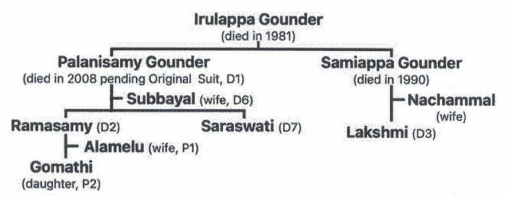
3. It is fruitful to refer to the following genealogy chart for better understanding:
TRAJECTORY OF THE PLAINT TO THE TRIAL COURT
4. The plaint in the present Suit was initially filed before the Subordinate Court, Erode on September 22, 1999 and numbered as O.S.No.608 of 1999 and thereafter, transferred to II Additional District Judge, Erode and renumbered as O.S.No.36 of 2003 and thereafter, again transferred to Subordinate Court, Perundurai and renumbered as O.S.No.39 of 2014 and thereafter, once again transferred to Subordinate Court, Tiruppur and renumbered as O.S.No.161 of 2014 and thereafter, finally transferred to the newly constituted Subordinate Court, Avinashi and renumbered as O.S.No.130 of 2016
PLAINTIFFS' CASE:
5. The first plaintiff [wife] married the second defendant [husband] in 1984 and in their wedlock, the second plaintiff was born to them in 1986. Thereafter, in 1997 the second defendant drove the first plaintiff out of her matrimonial house and since then they have been living estrange and separately. The second defendant is liable to maintain the first plaintiff, who has no income, as she is his legally wedded wife. Hence, the first plaintiff filed the present Original Suit praying for future maintenance of Rs.500/- per month and creating a charge on the Suit Properties as well for regular payment of maintenance.
5.1. The second plaintiff, who was a minor at the time of filing the Suit, represented by her mother / first plaintiff, filed the Original Suit seeking partition of Suit Properties. During the pendency of the Original Suit, fifth defendant informed that he purchased Item No. 1 of the Suit Properties including the share of the second plaintiff and therefore, he is ready to pay the share value of 1st plaintiff. Thereafter, he paid the market value of the 1st item of Suit Property to the second plaintiff. Hence, the plaintiffs filed an Interlocutory Application in I.A.No.808 of 2001 on the file of Trial Court praying to exonerate the fifth defendant and delete Item No.1 from the plaint description of property. The said Interlocutory Application was allowed on October 29, 2001. Thus, the plaintiffs restricted their claim to Item Nos. 2-A and 2-B alone.
5.2. The case of the plaintiffs is that the common ancestor - Irulappa Gounder owned ancestral garden land in his 1/6th share in an extent of Acre 3.46 Cents in Survey Nos.315, as well as an extent of Acre 0.15 Cents in Survey No.314-A of Santhipalayam Village, Gopichettipalayam Taluk. Irulappa Gounder sold the same on November 28, 1939 to one Chinna Palani Gounder under a registered Sale Deed and from and out of the sale proceeds and using joint family funds, Irulappa Gounder purchased the Item No.2-A of the Suit Properties under a registered Sale Deed dated December 12, 1939.
5.3. Further from the ancestral nucleus, the first defendant, as Karta of the joint family, along with the fourth defendant purchased the Item No.1 of Suit Properties under a registered Sale Deed dated February 1, 1972 (To be noted, as stated supra, Item No.1 has been deleted and hence



AI
The court affirmed that admissions made during trial are binding, and ancestral properties cannot be dismissed based on a registered Partition Deed that does not negate the rights of coparceners.
The court affirmed that items 1 and 2 of suit properties are ancestral, and items 3 to 11 are self-acquired, highlighting the plaintiffs' burden to prove family property claims.

The claim of property as ancestral requires proof of lineage and sufficient income, with living together not granting rights. The second appeal is restricted to substantial questions of law.

The judicial presumption of joint ownership requires proof of a family nucleus, and mere existence of a joint family does not automatically classify all properties as joint.
The absence of evidence proving the joint family status of properties allows a presumption that they are individual assets; thus, plaintiffs' claim for partition is dismissed.
The burden of proof lies on the person claiming property as self-acquired to establish that it was acquired without the aid of joint family funds.
Ancestral properties must be proven to remain joint family properties post-partition; otherwise, they are deemed separate and not subject to partition claims.
In a partition suit, the burden of proving that property standing in an individual's name is joint family property lies upon the party asserting it, requiring proof of a sufficient ancestral nucleus.....
The burden of proof lies with the plaintiff to establish that the properties are ancestral, and evidence must be pleaded and proved through evidence.



An indispensable Tool for Legal Professionals, Endorsed by Various High Court and Judicial Officers
Please visit our Training & Support
Center or Contact Us for assistance

Scan Me!
India’s Legal research and Law Firm App, Download now!


For Daily Legal Updates, Join us on :



 Back to top