
 Back
Back





IN THE HIGH COURT OF JUDICATURE AT MADRAS
M.S. Ramesh, C.Kumarappan, JJ.
R.Krishnamoorthy - Appellant
Vs.
The State represented by The Inspector of Police - Respondent
Crl.A.Nos.445 of 2019 & 12 of 2021
Decided On : 22-01-2025
JUDGMENT
C.KUMARAPPAN, J.
The instant Criminal Appeals arising against the order of conviction passed in SC.No.24 of 2017 vide order dated 06.03.2019, by and in which the accused were found guilty under Section 376(2) (g) and 302 IPC and sentenced to undergo life imprisonment.
2. There are two accused in this case. The first accused Krishnamoorthy preferred Crl.A.No.445 of 2019 and the 2nd accused Vadivel preferred Crl.A.No.12 of 2021. Since both the appeals are arise out of a judgment in S.C.No.24 of 2017, we deem it appropriate to dispose both the appeals jointly.
3. The necessary facts, which are relevant for the disposal of this case are narrated hereinbelow:-
(a) According to the prosecution, this is a case of rape and murder of 70 years old woman by name “(XXXXX)” (hereinafter called as “victim”), which took place on the intervening night of 20/21.09.2016 at about 1.00 AM. There is no direct evidence to say how, when and by whom the offence was committed. On 21.09.2016 at about 8.00.AM the deceased was first seen alive by one Prema [PW4]. Thereafter, the other witnesses had also visited the scene of occurrence and interacted with victim, and she was alive, till she reached the hospital for treatment. After PW4 neighbour noticed the condition of the victim, with the assistance of other neighbors, the victim was shifted to Rasipuram hospital. In the meantime, Ravikumar [PW1], who was the Village Administrative Officer came to know about the occurrence and visited the scene of occurrence. After knowing about the arrangements for shifting the deceased and on coming to know about the death of the deceased, he went to the police station, and gave the complaint [Ex.P1] before the Inspector of Police, Vennandur, and on receipt of the said complaint, an FIR [Ex.P22] was registered at about 11.00.AM.
(b) Immediately on receipt of the FIR, Mr.Sasikumar, the Investigating Officer [PW20] proceeded to the scene of occurrence at about 12.15 hours and prepared the Observation Mahazar [Ex.P2], and rough sketch [Ex.P23]. He also collected the blood stain samples from the scene of occurrence. During the investigation, he recorded the statements of Ravikumar [PW1], Vasanthi [PW2], Mani [PW3], Prema [PW4], Asokan [PW5] and Subramani @ Loganathan [PW6], and through them he fixed the involvement of these accused. Maheswari [PW7] had given statement before the Investigating Officer [PW20] about the last seen theory.
(c) While so, after some days, on 27.09.2016 at about 12.30 hours, the first accused voluntarily surrendered before the Keeranur Village Administrative Officer Mr.Jegadishkumar [PW10], and gave an extra judicial confession. After recording the said confession, he was produced before the Investigating Officer. On arrest, the first accused again voluntarily gave a confession statement before Mr.Jegadishkumar [PW10] and his assistant, and in furtherance of the confession statement, a blood stained shirt [MO.5] and Lungi [MO.6] were recovered. Thereafter, on 05.10.2016, the 2nd accused was arrested, who also gave a confession statement in the presence of PW10 and his assistant and a discovery of fact was effected through recovery of his blood stained shirt [MO.7] and Lungi [MO.8].
(d) The Investigating Officer had also recorded the statement from Dr.Dhamayanthi [PW11] who attended the deceased at Rasipuram Hospital. He also recorded the statement of Dr.Natrayan [PW12], who declared the death of the victim. Thereafter, the Investigating Officer [PW20] has also recorded the statement of the postmortem Doctor Ms.Sangeetha [PW17]. The postmortem report was marked as Ex.P21.
(e) According to the postmortem report, the following external and internal injuries were found in the body of the deceased:-
“INIURIES:-
1. DARK RED MULTIPLE SMALL IRREGULAR ABRASIONS OVER MEDIAL AND UPPER ASPECT OF LEFT THIGH M-0.5X0.5 CMS ONE BELOW THE OTHER.
2. SCRATCH ABRASION OVER LOWER ASPECT OF LEFT SIDE OF CHEST M-5X0.5 CMS, 0.5X0.5 CMS
3.1 CMS BELOW ANOTHER SCRATCH ABRASION

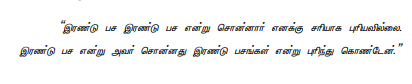

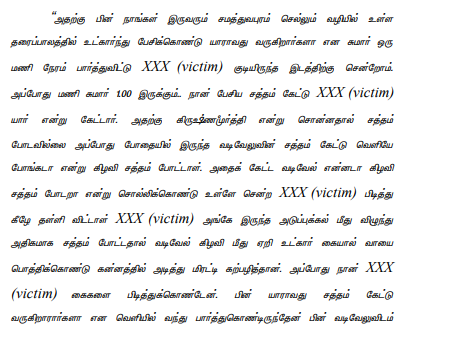

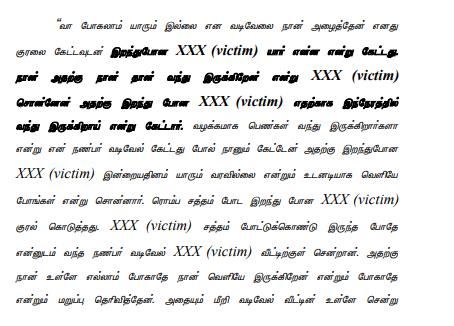
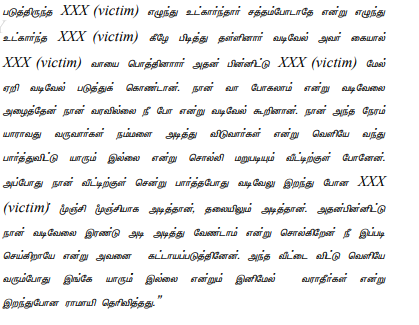

Confessions of co-accused cannot serve as substantive evidence; corroboration from other evidence is essential for conviction.

Confessions of co-accused cannot serve as substantive evidence; corroboration from other evidence is essential for conviction.
Circumstantial evidence must form a complete chain pointing to guilt, with the prosecution required to establish every link beyond reasonable doubt.

The judgment emphasizes the requirement for complete and unimpeachable evidence to prove guilt beyond reasonable doubt in a case of circumstantial evidence.


The admissibility of a confession under Section 27 of the Evidence Act and the mandatory provision of inflicting a fine under Section 302 of the Indian Penal Code.

The court established that circumstantial evidence can lead to a conviction when it forms a clear, unbroken chain pointing to the guilt of the accused, despite the lack of direct evidence.



An indispensable Tool for Legal Professionals, Endorsed by Various High Court and Judicial Officers
Please visit our Training & Support
Center or Contact Us for assistance

Scan Me!
India’s Legal research and Law Firm App, Download now!


For Daily Legal Updates, Join us on :



 Back to top


