
 Back
Back





IN THE HIGH COURT OF JUDICATURE AT MADRAS
R.N. MANJULA, J.
R. Raghupathy - Appellant
Versus
Dhanalakshmi and Ors. – Respondents
S.A. Nos. 147 & 148 of 2013 and M.P. No.1 & 1 of 2013
Decided On : 28-01-2025
JUDGMENT :
(R.N. MANJULA, J.)
The appellant in both the appeals is the first defendant. The respondents 1 to 5 as plaintiffs have filed the suit for claiming partition of their 1/3 share in the suit property and the same was partly decreed by the trial Court by allowing 1/8 share to the plaintiffs and the shares of the first defendant has been determined as 5/8. Aggrieved over the said judgment and preliminary decree passed by the trial court, both the plaintiffs and the first defendant preferred the first appeals in A.S.Nos.25 & 15 of 2008 respectively. The first appeal preferred by the plaintiffs in A.S.No.25 of 2008 has been allowed by modifying the share of the plaintiff from 1/8 to 1/3 and the other appeal preferred by the first defendant in A.S.No.15 of 2008 was dismissed. However, the plaintiff's share has been determined as 1/3. Aggrieved by both the orders passed in both the appeals, the first defendant has preferred these appeals.
2. The averments made in the plaint filed by the plaintiff in brief: The suit property was originally belonged to one Nagammal as a self acquired property and her husband died intestate. The defendants 1 to 3 and one Gopalsamy are the legal heirs of the deceased Nagammal and her husband. Gopalsamy died in the year 1995. The first plaintiff is the wife of the deceased Gopalsamy. The second and third plaintiffs are the sons of the deceased Gopalsamy. The third defendant had relinquished his share in the suit property and hence, the defendants 1 and 2 and Gopalsamy would get 1/3 share each in the suit property. But, so far partition has not been effected. Hence, the plaintiffs have filed the suit for claiming partition of their 1/3 share in the suit property.
3. The first respondent resisted the suit by filing the written statement which is given in brief as under:
The original owner Nagammal was in enjoyment of the property till her lifetime. During her lifetime, on 05.02.1991 Nagammal had executed a Will and bequeathed the suit property in favour of the first defendant.
Nagammal died on 12.06.1992 and thereafter, the Will came into effect. So the property absolutely belongs to the first defendant and no other person has got any share over the same.
4. On the basis of the above pleadings, the trial Court has framed the following issues:
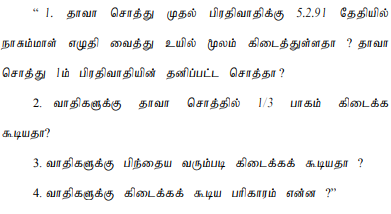
5. During the course of trial one witness was examined as P.W.1 and Exs.A1 to A5 were marked. On the side of the defendants four witnesses were examined as D.W.1 to D.W.4 and Exs.B1 to B6 were marked.
6. At the conclusion of trial and on considering the evidence available on record, the trial Court had decreed the suit by determining the share as 1/8 and the share of the first defendant as 5/8. Both the first defendant and the plaintiffs have preferred first appeal in A.S.Nos.25 and 15 of 2008 respectively. The first appellate Court dismissed the appeal filed by the first defendant in A.S.No.15/2008 and allowed the first appeal filed by the plaintiffs in A.S.No.25 of 2008 and modified the share of the plaintiffs as 1/3. Now the first defendant has filed these Second Appeals by challenging the judgment passed in both appeals in A.S.No.25 & 15 of 2008.
7. Mr.S.Parthasarathy, the learned counsel for the appellant / first defendant, submitted that the appellant's mother Nagammal had executed Ex.B1-Will dated 05.12.1991 and through which the whole of the property has been bequeathed to him and he had acquired the absolute title over the same subsequent to the death of the testator Nagammal; even according to the plaintiffs there is a settlement deed executed by Nagammal on 27.01.1980 in favour of her husband and the first defendant in respect of the suit property and hence, the first defendant is entitled to 5/8 share in the suit property and the first appellate Court had ignored the above fact and had proceeded to allot 1/3 share to the plaintiffs and the first defendant which is not correct.
8. Mr.N.Sudharsan, the learned counsel for the respondents / plaintiffs submitted t
An irrevocable settlement deed supersedes a Will, and the validity of a Will is contingent on its execution and absence of a prior effective settlement.
The settlement deed dated 04.04.1941 was not acted upon, confirming entitlement to a share in the property.
The court ruled that the failure to join necessary parties and the lack of substantial evidence from key witnesses undermined the plaintiff's claims, leading to the dismissal of the suit.
![R. Gajendran [Died] VS R. Shanmugam [Deceased] - 2023 Supreme(Mad) 1233](https://supremetoday-s3.b-cdn.net/Madras_2.png)
The central legal point established in the judgment is the interpretation and application of Section 8 of the Hindu Succession Act in determining the validity of Settlement Deeds and the entitlement ....

The main legal point established in the judgment is the interpretation of the Hindu Succession Act and the determination of entitlement to shares in ancestral and self-acquired properties.
A will must be probated to convey title; without probate, a settlement deed executed based on an unproven will is ineffective.
The mere description of property as ancestral does not establish its nature; evidence of purchase and settlement deeds is essential for determining ownership.
Co-owner not party to sale deed need not cancel it to claim partition of undivided share in joint family property.
The main legal point established in the judgment is the determination of property rights based on the source of purchase and the validity of settlement deeds executed within a family.



An indispensable Tool for Legal Professionals, Endorsed by Various High Court and Judicial Officers
Please visit our Training & Support
Center or Contact Us for assistance

Scan Me!
India’s Legal research and Law Firm App, Download now!


For Daily Legal Updates, Join us on :



 Back to top


