
 Back
Back





IN THE HIGH COURT OF JUDICATURE AT MADRAS
R.SAKTHIVEL, J.
Selvaraj (Died) – Appellant
Versus
Arulmigu Sreenivasa Perumal Devasthanam, represented by its Executive Officer and Trustees – Respondent
S.A.NO.801 OF 2017 AND CMP NO.20108 OF 2017
Decided on : 15-10-2024
| Table of Content |
|---|
| 1. background of the appeal and parties involved. (Para 1 , 2) |
| 2. contentions of plaintiffs and defendants. (Para 3 , 4) |
| 3. arguments presented by the appellants and respondents. (Para 9 , 10 , 11) |
| 4. court's observations on maintainability and burden of proof. (Para 12 , 13 , 20 , 25) |
| 5. the significance of procedural compliance with statutory norms. (Para 22) |
| 6. ratios on alienation compliance under hr & ce act. (Para 29 , 30) |
| 7. final decision and terms for appeal dismissal. (Para 32 , 33 , 34) |
JUDGMENT :
R. SAKTHIVEL, J.
This Second Appeal is directed against the Judgment and Decree dated December 16, 2016 made by the ‘VI Additional Judge, VI Additional City Civil Court, Chennai’ ['First Appellate Court' for short] in A.S.No.494 of 2011, whereby the Judgment and Decree dated November 21, 2007 of the 'learned V Assistant Judge, City Civil Court, Chennai' ['Trial Court' for short] made in O.S.No.8140 of 1993 was set aside.
2. Hereinafter, for the sake of convenience, the parties will be de-noted as per their array in the Original Suit.
PLAINTIFFS CASE:
3. ‘Arulmigu Sreenivasa Perumal Devasthanam’ [‘Devasthanam’ for brevity] is a Denominational Temple belonging to the Sadhu Chetty Community. In view of Section 107 of the ' TAMIL NADU HINDU RELIGIOUS AND CHARITABLE ENDOWMENTS ACT , 1959' ['HR & CE Act' for brevity], Devasthanam’s autonomy is vouchsafed by the Constitution of India. The Commissioner and the Officials of the ‘Hindu Religious and Charitable Endowments Department’ ['HR & CE Department' for short] have only a regulatory and supervisory control. The power of management is vested with the Board of Trustees constituted under the Scheme Decree passed by this High Court in C.S.No.553 of 1928. The Plaintiff Nos.2 to 6 were appointed as Trustees of the first plaintiff - Devasthanam by this High Court in W.P.No.15564 of 1989 and they assumed charge on January 22, 1991. The Suit Property solely belonged to the first plaintiff - Devasthanam.
3.1. Upon assuming charge, the Plaintiff Nos.2 to 6 came to know that one of the then Executive Officer inducted certain persons as lessees in the outer prakaram within the campus of the Devasthanam for carrying on business by putting up superstructures there. One late K. Parthasarathy is one such lessee who had taken the Suit Property for lease and built a superstructure thereupon.
3.2. The then Executive Officer collusively and fraudulently filed a Suit for ejectment in ‘O.S.No.6699 of 1980 on the file of City Civil Court, Chennai’ (henceforth 'earlier Suit') in order to afford an opportunity to late K. Parthasarathy to invoke the provision under Section 9 of 'the Madras City Tenants’ Protection Act, 1921' [in short 'MCTP Act'] (now the MCTP Act has been renamed into ‘Chennai City Tenants’ Protection Act, 1921’). In the earlier Suit, the said Parthasarathy has filed an ‘Interlocutory Application, numbered as I.A.No.5376 of 1981, under Section 9 of the MCTP Act praying to direct the Executive Officer to sell the Suit Property in his favour’ (‘said Interlocutory Application’ for short). The then Executive Officer, being in collusion with late K. Parthasarathy, did not properly contest the said Interlocutory Application. An Order was passed in the said Interlocutory Application, and on the strength of the said Order, the Sale Deed dated December 9, 1986 was executed without complying the procedure contemplated under Section 34 of the HR & CE Act. Further, the Sale Deed was not communicated to the Commissioner of HR & CE Department by the then Executive Officer to enable the Commissioner to intervene into the matter, and to file an appeal in time.
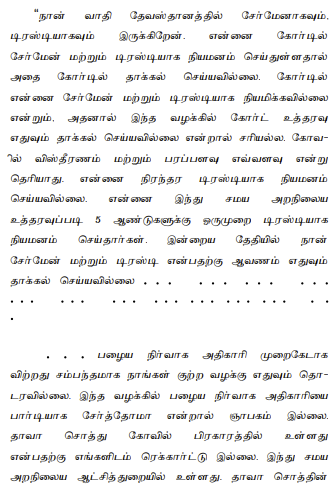
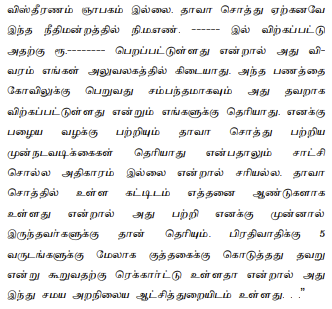
3.3. The then Executive Officer had no power to file the earlier Suit as well as to lease out the land to late K. Parthasarathy in contravention of Sections 34 , 77, 78 and 107 of the HR & CE Act. Therefore, the Sale Deed dated December 9, 1986 executed in favour of the first defendant's father – late K. Parthasarathy is invalid, non-est and vo
AI
Plaintiffs must prove the validity of property transactions under the HR & CE Act, and the failure to produce adequate evidence resulted in the dismissal of their suit.

The requirement of prior sanction for sale of temple properties under the TamilNadu Hindu Religious and Charitable and Endowments Act, 1959, and the legal principle that an agreement to sell does not....
The HR & CE Department is a necessary party in title disputes involving temple properties, and amendments to include declarations must be timely filed within the limitation period.
The court ruled that temple property cannot be alienated by trustees without obtaining necessary permissions and demonstrating community consent as per applicable law.

An exchange deed executed by alleged trustees of a deity without proper authority is valid under current jurisdictional provisions; the High Court's review is limited to substantial questions of law ....

A deity, being a perpetual minor, holds title to its assets; a worshipper may institute a suit as a next friend to recover property when a trustee acts fraudulently or fails to protect the trust, all....
The main legal point established in the judgment is that the Executive Officer has the right to file a suit for temple properties, and the Civil Court has jurisdiction to decide the title of the prop....

The court established that a sale deed transferring property of a deity without proper authorization is invalid, making recovery suits unmaintainable if the deity is not a party.



An indispensable Tool for Legal Professionals, Endorsed by Various High Court and Judicial Officers
Please visit our Training & Support
Center or Contact Us for assistance

Scan Me!
India’s Legal research and Law Firm App, Download now!


For Daily Legal Updates, Join us on :



 Back to top


