Back
Back





2024 Supreme(Mad) 2374
BEFORE THE MADURAI BENCH OF MADRAS HIGH COURT
G.R.SWAMINATHAN, J.
Joshita Lawrence - Petitioner
Versus
The Sub Registrar, Eraniel, Kanyakumari District. – Respondent
W.P.(MD)No.7645 of 2023
Decided on : 15-10-2024
Advocate Appeared:
For the Petitioner: Mr.R.J.Karthick
For the Respondent: Ms.D.Farjana Ghoushia, Mr.C.Kishore
Restrictive conditions in a settlement deed must be interpreted to not bar a mother from receiving property from her sons, as she is not a third party under Section 10 of the Transfer of Property Act, 1882.
Headnote:(A) Transfer of Property Act, 1882 - Section 10 - Restrictive conditions in settlement deeds - The court addressed the validity of a restraint on alienation imposed by a settlement deed executed by the husband in favor of his wife and sons, allowing the question of whether a mother can receive property from her sons without violating the condition. (Paras 5, 6, 7, 8)
(B) Legal interpretation - Restrictive conditions in settlement deeds should be strictly construed, indicating that a mother is not considered a 'third party' in this context, allowing the sons to settle properties in her favor. (Paras 7, 8)
Facts of the case:
The petitioner, the wife of the second respondent, sought to register the sale of property that had been settled in her favor and her sons. The registration authority denied registration based on a restrictive condition in the original settlement deed prohibiting alienation without consent.
Findings of Court:
The court found that the condition did not prevent the sons from settling the property with their mother and ruled that the petitioner is the absolute owner of the property, allowing the registration of the sale deed.
Issues: Whether the restraint on alienation applied to the petitioner and the effect of the registration of the subsequent settlement deed.
Ratio Decidendi: The court stated that the restriction in the settlement deed must be interpreted to exclude the mother from the definition of 'third parties,' permitting the sons to settle the property with her.
Result: Writ petition allowed.
| Table of Content |
|---|
| 1. property settlement and conditions on alienation. (Para 2 , 3) |
| 2. urgent necessity and moral considerations in disputes. (Para 4 , 5) |
| 3. interpretation of restrictive conditions in settlement deeds. (Para 6) |
| 4. legal validity of property ownership and registration. (Para 8) |
ORDER :
G.R. SWAMINATHAN, J.
Heard both sides.
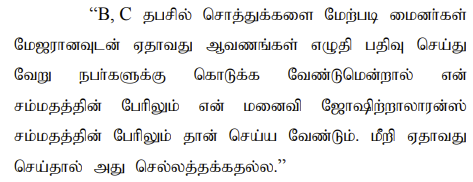
2. The petition-mentioned property comprised in survey Nos.358/4, 429/1 and 429/2 Aaloor “A” Village, Kalkulam Taluk, Kanyakumari District measuring 181 cents belonged to the second respondent, husband of the writ petitioner. The property was divided into three parcels namely, “A”, “B” and “C”. “A” schedule was settled in favour of the writ petitioner. “B” schedule was settled in favour of Anshijo, elder son. “C” schedule was settled in favour of the younger son Joel Jackson. The second respondent settled the said property in favour of the writ petitioner and her two sons vide settlement deed dated 10.04.2012 (document No.1684 of 2012). A condition was imposed that the sons should not alienate the property to third parties without the consent of the petitioner and the second respondent. Subsequently, vide settlement deed dated 27.04.2022 (document No.2471 of 2022) the sons (Anshijo and Joel Jackson) settled the “B” and “C” properties in favour of the writ petitioner herein(their mother).
3. According to the petitioner, she had to urgently pay her sons' college fees and hence, she sold 52.259 cents in survey No.429/1 and 429/2 in favour of one Naina Mohamed Rajik vide sale deed dated 20.02.2023. The sale deed was presented for registration. The registering authority / first respondent herein refused registration citing the restrictive condition set out in the settlement deed dated 10.04.2012.Questioning the same, this writ petition came to be filed.
4. Since the learned counsel appearing for the petitioner submitted that the petitioner needs to raise funds urgently for her sons' education, the matter was referred for mediation. The second respondent entered appearance through counsel. The mediation efforts could not succeed.
5. The second respondent had already settled the property in favour of his wife and sons. He no longer has any claim or right over the property. I fail to understand as to why the second respondent should put spokes in the writ petitioner's wheel. I understand that his relationship with the writ petitioner / his wife is under strain. But that need not come in the way of permitting the land to be used for raising funds to finance the sons' education. Morally, I feel that the second respondent's position cannot be justified. But I have to adjudicate the legal issue and I cannot anchor my decision on moral grounds.
6. It is true that in the settlement deed dated 10.04.2012 executed by the second respondent, there is restriction of alienation by the sons. In Gomti Singh V. Anari Kuar ( AIR 1929 All 492 ), the issue as to whether the restraint on alienation by the husband was an absolute restraint within the meaning of Section 10 of the Transfer of Property Act, 1882, was considered. The relevant paragraph reads as follows:-
“5. ... But in order to determine whether the restraint was absolute or partial one must gather the intention of the transferor from the contents of the document. It seems to us that the idea underlying the execution of the tamliknama was to protect the property and retain it in the family and prevent it from passing out of the family. Although on the one hand the donor transferred ?rds share to his wives he reserved to himself the power to refuse consent for alienation. It seems to us that for all practical purposes Basdeo Singh reserved to himself the absolute power of preventing alienation of any kind. Unless he himself was prepared to waive this condition, he gave no power to his wives to transfer the property gifted to them under any circumstances. We therefore think that this amounted to an absolute restraint on alienation within the meaning of S. 10.''
The sett