
 Back
Back





IN THE HIGH COURT OF JUDICATURE AT MADRAS
C.KUMARAPPAN, J.
Guru Ramalingm - Appellant
Vs.
Balaiyan - Respondent
S.A.Nos. 639 & 502 of 2012
Decided On : 26-04-2024
| Table of Content |
|---|
| 1. identification of parties in litigation. (Para 1 , 2) |
| 2. factual establishment of property ownership and transactions. (Para 3 , 4) |
| 3. defendants' arguments against the plaintiff's claims. (Para 5 , 6 , 7) |
| 4. final rulings and total impact on appeals. (Para 9 , 31) |
| 5. maintainability of suits and contractual relationship. (Para 13 , 14 , 15) |
| 6. arguments presented by the appellant's counsel on the sale deed's legality. (Para 16 , 18) |
| 7. impact of lease agreements under special statutes. (Para 20 , 21 , 24) |
| 8. sale deed validity requires proper authority under religious property law. (Para 22) |
| 9. validity of sale deed under hindu religious & charitable endowments act. (Para 26 , 30) |
JUDGMENT :
C. KUMARAPPAN, J.
1. The 2nd defendant in O.S.No.465 of 2005 before the Trial Court is figured as appellant herein in S.A.No.639 of 2001. The plaintiff is the 1st respondent and 1st and 3rd defendants are arrayed as the respondents 2 and 3 in S.A.No.639 of 2001. Similarly in S.A.No.502/2012, the sole defendant in O.S.No.161 of 2006 is the appellant herein and the plaintiff is the respondent. The plaintiff as well as the defendant are the sons of one Pichai Pillai.
2. For the sake of convenience, the parties will be referred to according to their litigative status in O.S.No.465 of 2005.
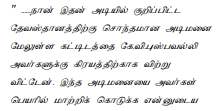
3. The brief facts which give rise to the instant two Second Appeals are that, the land in which the house was built belongs to the 1st defendant. It appears that the 1st defendant has leased out the site to one Nagarathinam Thavilkarar, as he was doing service to the temple. After the lease it appears that he put up a superstructure thereon and he sold the superstructure to one Govindan Nainakar and after the demise of Govindan Nainakar, the superstructure devolves upon her wife Angammal. It appears that said Angammal had executed a Will in favour of her sister's daughter namely Janaki by virtue of a Will dated 26.08.1933, giving life estate to the property and leaving the vested remainder to her sons namely Pichaipillai, Radhakrishnan and Chinnaniayan. It appears that Chinnaiyan died as a bachelor. Thus, the estate devolves upon Pichaipillai and Radhakrishnan. According to the plaintiff, there was a partition between Pichaipillai and Radhakrishnan on 31.08.1967. In that partition 'A' schedule property namely the northern half of the property was allotted to Pichaipillai and 'B' schedule property namely the southern half was allotted to Radhakrishnan. While so, the plaintiff has purchased the southern half of the superstructure from Radhakrishnan on 25.06.1997.
4. It is the case of the plaintiff that he being the teacher and away from the suit property, the 2nd defendant has encroached upon the same and took possession over the superstructure. It is also the case of the plaintiff that after encroaching upon the suit property, he has subleased the portion of the property to the 3rd defendant. Therefore, the plaintiff has come up with a prayer for mandatory injunction directing the 1st defendant to enter the lease hold right of the plaintiff in the register maintained by them and also directing the defendants 2 & 3 to handover the vacant possession of the suit property.
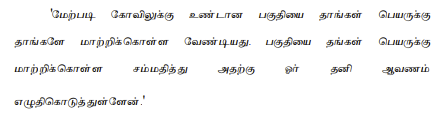
5. The said suit was resisted by the 1st defendant by contending that they have already recognised the 2nd defendant as their lessee as he has been doing service to the temple. It is also the contention of the 1st defendant that the alleged sale deed which was obtained by the plaintiff will in no way bind upon them as the same it is contravene the Section 34 of the Hindu Religious & Charitable Endowments Act,1959. Hence prayed to dismiss the suit.
6. The 2nd defendant has filed separate written statement, wherein he has disputes the sale deed executed by Radhakrishnan on 25.06.1997. It is also the contention of the defendant that after the demise of Radhakrishnan, he took care of his wife Amirthavalli. While so, the said Amirthavalli had permitted him to use the superstructure of the suit

AI
The court held that a sale of a superstructure on land belonging to a religious institution is invalid without specific sanction, impacting leasehold rights and the legitimacy of injunction claims.
Tenancy rights must be legally established as per applicable laws; mere possession without proper tenancy is insufficient.

The requirement of prior sanction for sale of temple properties under the TamilNadu Hindu Religious and Charitable and Endowments Act, 1959, and the legal principle that an agreement to sell does not....
The main legal point established in the judgment is the requirement for proper stamping and registration for a valid sale deed, the distinction between dedication to a temple and a sale transaction, ....

The court established that a sale deed transferring property of a deity without proper authorization is invalid, making recovery suits unmaintainable if the deity is not a party.
The court ruled that temple property cannot be alienated by trustees without obtaining necessary permissions and demonstrating community consent as per applicable law.

Transactions regarding religious endowments must demonstrate absolute legal necessity and obtain prior authorization, or they will be deemed void such that any resulting deeds or certificates lack le....



An indispensable Tool for Legal Professionals, Endorsed by Various High Court and Judicial Officers
Please visit our Training & Support
Center or Contact Us for assistance

Scan Me!
India’s Legal research and Law Firm App, Download now!


For Daily Legal Updates, Join us on :



 Back to top


