
 Back
Back





BEFORE THE MADURAI BENCH OF MADRAS HIGH COURT
G.R. SWAMINATHAN, J.
G. Pandi - Petitioner
Versus
The District Collector, Madurai - Respondent
W.P. (MD) No. 17824 of 2024, W.M.P. (MD) No. 15275 of 2024
Decided On : 30-07-2024
| Table of Content |
|---|
| 1. historical context of temple disputes. (Para 1 , 2 , 3) |
| 2. claims on temple closure and management. (Para 4 , 5) |
| 3. rituals as rights; temple as a juristic person. (Para 6 , 7) |
| 4. constitutional rights to religious practice. (Para 8 , 9) |
| 5. court orders reopening and preservation of worship rights. (Para 10 , 11 , 12) |
ORDER :
G.R. SWAMINATHAN, J.
"An orthodox Brahmin once brought with him his puja casket with a view to give it to His Holiness and receive it back with his blessings. His Holiness took it and opened it, and scanned the several images therein. Then he picked up a saligrama stone (Where it is believed some aspect of Maha Vishnu is immanent) and exclaimed, 'Why, the Lord here has been starved for seven years.'
The disciple was taken aback at this accusation and said, 'So far as I remember, I have not been remiss in my worship to justify such a charge. If I have unconsciously erred, I am certainly prepared to abide by your Holiness's directions.
His Holiness replied, 'I am sorry but you have not performed the worship properly. The deity immanent here required daily Kshirabhisheka (bathing in milk) and Payasanaivedya (offering of milk food) and I note that these have not been done for the past seven years.
The disciple then said, 'I now recollect that when my father was alive he used to give the bathing and offering mentioned by your Holiness. As I had begun my own puja even during his life- time, I added his puja to mine soon after he died and worshipped all the deities together without making any distinction and they all had the same kind of bathing and offering.
His Holiness said, 'Evidently it is now seven years since your father died ?
"Yes", replied the disciple.
'You did wrong in putting all the deities together and treating them all alike' pointed out His Holiness. This murti requires special worship and naivedyam. Please offer them as I have mentioned'.”
From 'The Life and Times of H H Sri Chandrasekhara Bharathi'
–by Prof.N.Nanjunda Sastry –
What is the relevance of the above anecdote in the life of the pontiff of Sringeri Mut to this case? Read on.
2. Uthapuram Village of Peraiyur Taluk in Madurai District shot to notoriety in the year 2010. Dispute arose between Pillaimar Community and Pallar Community members over what came to be known as “Untouchability wall”. Writ Petitions were filed and eventually disposed of in terms of the agreement arrived at between the parties. The compromise was as follows:
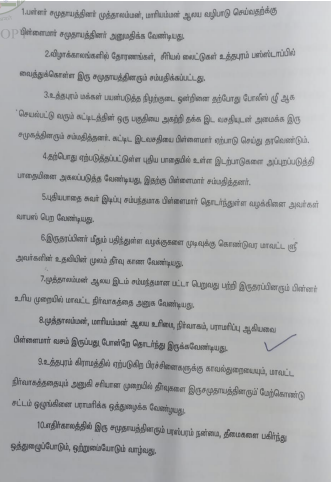
Shri Asra Garg, I.P.S was the then Superintendent of Police, Madurai (Rural) and consensus was arrived at only due to his tireless efforts. That is why encomium was paid to him vide order dated 20.03.2012 in W.P(MD)No.10500 of 2010 etc batch. Following the disposal of the writ petitions, Kumbabishekam (Consecration ceremony / renovation) was performed for the village temple.
3. It appears that in April 2014 persons belonging to Scheduled Caste wanted to introduce new forms of worship and once again disputes arose. Crime No.64 of 2014 was registered on the file of Elumalai Police Station. The temple remains closed for the last 10 years. Hence this writ petition has been filed for forbearing the authorities from stopping the Pillaimar Community from opening the temple and offering customary worship.
4. When the matter was taken up for hearing, the respondents claimed that the temple was closed by the Pillaimar Community on their own. While admitting that the temple remains closed since April 2014 the respondents categorically submitted that they have not passed any closure order. And that they did not lock the temple.
5. The petition mentioned temple is a public temple. The HR&CE Department has not assumed supervisory jurisdiction over it. It is beyond dispute that it has been traditionally managed by the persons belonging to Pillaimar Community. It is however conceded that the temple is open to worship by persons of all communities. Persons irrespective of caste can offer their worship and participate in the ann
AI
Closure of a temple without just cause violates the fundamental right to religious practice under Article 25 of the Constitution, emphasizing protection of rituals and religious freedom.

The court affirmed that access to public temples cannot be restricted based on caste or community, emphasizing the fundamental right to worship under Article 25 of the Constitution.

The fundamental right to worship under Article 25 of the Constitution of India guarantees the right to open the temple for worship and allows all devotees to participate in the festival without discr....
The appointment of a fit person for temple administration can be a solution to resolve clashes and restore peace in cases of repeated disturbances during temple functions and festivals.
The fundamental rights to assemble peaceably and practice religion, as well as the significance of centuries-old customs and religious practices, were central to the judgment.

Court does not adjudicate on disputes relating to temple customs under Article 226; appropriate remedy lies with the Civil Court.
Caste-based restrictions in the appointment of priests violate constitutional rights to equality and must align with qualifications, not caste.



An indispensable Tool for Legal Professionals, Endorsed by Various High Court and Judicial Officers
Please visit our Training & Support
Center or Contact Us for assistance

Scan Me!
India’s Legal research and Law Firm App, Download now!


For Daily Legal Updates, Join us on :



 Back to top


