
 Back
Back





IN THE HIGH COURT OF JUDICATURE AT MADRAS
V. SIVAGNANAM, J.
Rajambal – Appellant
Versus
President, Tamilnadu Electricity Board, Chennai. – Respondent
S.A.No.1545 of 2010
Decided on : 28-06-2024
| Table of Content |
|---|
| 1. electrocution due to maintained negligence. (Para 1 , 3) |
| 2. court's analysis of negligence and evidence. (Para 2 , 8 , 12 , 13 , 14) |
| 3. defendants deny negligence and blame deceased. (Para 4 , 10) |
| 4. issues framed by the trial court. (Para 5) |
| 5. issues addressed during the trial and appellate evaluations. (Para 6) |
| 6. substantial questions of law on negligence. (Para 9 , 15) |
| 7. arguments by counsel regarding evidence and negligence. (Para 11) |
| 8. second appeal allowed; trial court restored. (Para 16 , 17) |
JUDGMENT :
V. SIVAGNANAM, J.
1. Challenge in this second appeal is made to the Judgement and Decree dated 28.06.2010 passed in A.S.No.4 of 2010 on the file of Principal District Judge, Namakkal, reversing the Judgment and Decree dated 25.08.2009 passed in O.S.No.141 of 2008 on the file of Subordinate Judge, Namakkal.
2. For the sake of convenience, the parties are referred to as per their rankings in the trial Court.
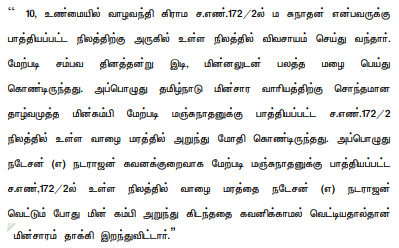
3. The plaintiffs in O.S.No.141 of 2005 on the file of the Subordinate Court, Namakkal, is the appellants in this second appeal. The first plaintiff is the wife and the plaintiffs 2 and 3 are children of the deceased Natesan @ Natarajan. They filed the suit for compensation for a sum of Rs.5 lakhs with interest at 12 % p.a., for the death of the deceased Natesan @ Natarajan due to electrocution. The deceased Natesan @ Natarajan was cultivating lands as a cultivating tenant in the lands of one Kamalasekaran. On 13.12.2006, while he was cutting plantain tree in Survey No.172/2 belonging to one Manjunathan, electricity line running over the field touched the planted leaf and thereby, he was electrocuted and he died. Electrocution was occurred only due to the negligence of the Electricity Board and also the high tension in the electric wires hae not properly maintained by the Electric Board and only because of their negligence and their inadvertance in maintaining the wires the electrocution occurred. This incident took place because of the electrical line touching the plantain tree. Hence, the suit.
4. The respondents/defendants filed written statement denying the allegations and averments as contained in the plaint besides contended that the incident had not occurred due to the fault of the Electricity Board and they had properly maintained the electricity lines and only due to the negligence of the deceased the incident occurred and hence, they are not liable to pay any compensation and thus, pleaded to dismiss the suit.
5. On the basis of the abovesaid pleas set out by the respective parties, the following issues were framed by the trial Court for consideration:
1. Whether the incident on 13.12.2006, i.e.the electrocution had happened only due to the negligence of the defendants?
2. Whether the plaintiffs are entitled for compensation for a sum of Rs.5,00,000/-?
3. To what relief?
6. Before the Trial Court, in support of the plaintiff's case, the first plaintiff examined herself as PW1 and One Selvi and Sundaram examined as P.W.2 & P.W.3 and 7 documents were marked as Ex.A.1 to Ex.A.7. On the side of the defendants, one Sujatha, the fourth defendant examined as DW1 and no documents were marked on the side of the defendants.
7. On a consideration of the oral and documentary evidence adduced by the respective parties and the submissions made, the trial Court awarded a compensation of Rs.4,32,000/- to the plaintiffs.
8. Aggrieved over the same, the plaintiffs have preferred the First Appeal in A.S.No.4 of 2010 before the Principal District Court, Namakkal. The First Appellate Court, after considering the entire materials, fixed 50% contributory negligence on the part of the deceased and 50% negligence on the part of the Electricity Board. Apart from that, the First Appellate Court reduced the compensation to Rs.2,64,000/-. Now, challenging the same, the present Second Appeal has been filed.
9. The second appeal has been admitted on the following substantial question of law:
1. Whether the Lower Appellate Court was right
AI
The Electricity Board has an obligation to maintain electrical infrastructure safely and any failure thereof constitutes negligence, barring unsupported claims of contributory negligence against affe....

Electricity providers have a strict liability to maintain safety standards, and failure to do so resulting in harm establishes negligence.

Electricity providers have a high duty of care to maintain safe conditions; failure to do so results in presumed negligence and liability for damages.

The judgment established the principle that those involved in the transmission of high-voltage electric energy are liable for damages caused by its uncontrolled escape, and it applied the principles ....

The duty of care owed by the Electricity Board in hazardous activities and the application of the multiplier method for determining the quantum of compensation.
The main legal point established is that just compensation should be awarded based on the actual income sources of the deceased and the evidence presented.

Negligence involves failure to exercise due care, which includes foreseeability of harm, and leads to liability when conduct results in damage.
The main legal point established in the judgment is the duty of authorities to prevent mishaps related to electricity transmission lines, and the liability of the supplier of electric energy in cases....


Electricity suppliers are strictly liable for injuries caused by their infrastructure, regardless of negligence, and must compensate victims for losses incurred.



An indispensable Tool for Legal Professionals, Endorsed by Various High Court and Judicial Officers
Please visit our Training & Support
Center or Contact Us for assistance

Scan Me!
India’s Legal research and Law Firm App, Download now!


For Daily Legal Updates, Join us on :



 Back to top


