
 Back
Back





IN THE HIGH COURT OF JUDICATURE AT MADRAS
R. Subramanian, N. Senthilkumar, JJ.
R.Rayappan (Died) and ors. - Appellants
Versus
Rajammal (Died) and ors. - Respondents
A.S.No.189 of 2017 and C.M.P.No.7926 of 2017
Decided On : 21-12-2023
| Table of Content |
|---|
| 1. background of the partition dispute. (Para 1 , 2 , 3 , 4) |
| 2. court’s analysis of ouster and limitation. (Para 6 , 7 , 12 , 18 , 20 , 21 , 22 , 24 , 26 , 28 , 30) |
| 3. arguments regarding ouster and limitation. (Para 10 , 11 , 16) |
| 4. legal principles on knowledge of exclusion. (Para 19 , 25 , 27 , 29) |
| 5. conclusion dismissing the suit. (Para 31) |
JUDGMENT :
R. SUBRAMANIAN, J.
1. The defendants in O.S.No.66 of 2012, who had suffered a decree for partition and separate possession of the plaintiffs' 2/3rd share in the suit properties are on appeal.
2. Originally, the suit was laid by the three plaintiffs, who are daughters and grand daughters of Rangaiya Gowder @ Rangappa Gowder against his only son, his children and the tenants. The geneology is as follows:-
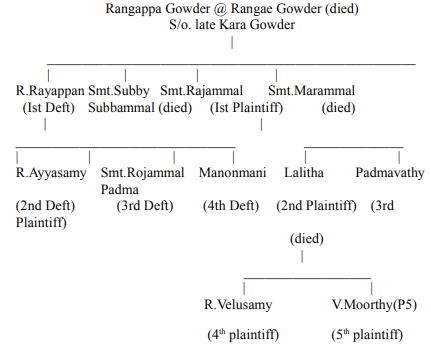
3. Upon the death of the 2nd plaintiff / Lalitha, her heirs were impleaded as plaintiffs 4 and 5. The plaintiffs would claim that the suit properties originally belonged to one Rangappa Gowder @ Rangae Gowder, son of Kara Gowder, who died before 1955 leaving behind his only son Rangaiya Gowder @ Rangappa Gowder, who also died some time in early 1970s. The said Rangaiya Gowder died leaving behind one son namely, Rayappan / 1st defendant in the suit, three daughters namely, Subby Subbammal, Rajammal and Marammal. The Subby Subbammal is stated to have died without issues. Marammal had died leaving behind the plaintiffs 2 and 3 during the pendency of the suit. Since the 2nd plaintiff / Lalitha died pending suit, her husband and son were brought on record as plaintiffs 4 and 5. Contending that the suit properties belonged to Rangaiya Gowder, who died some time in early 1970s, the plaintiffs as daughters and the children of Marammal, another daughter, claimed 2/3rd share in the properties.
4. The suit was resisted by the defendants 1 to 4, who are son of Rangaiya Gowder @ Rangappa Gowder and his children, contending that the plaintiffs are not entitled to any share in the suit properties in as much as the defendants have prescribed their title by ouster. It was contended that the father of the 1st defendant, Rangaiya @ Rangappa Gowder died even in the year 1955 and hence, the 1st defendant alone is entitled to the entire suit properties and his daughters will not get any right over the properties. It was also contended that the defendants have been in open hostile exclusive possession of the properties for over 57 years and they have also effected improvements by constructing several houses in the suit properties and they have been enjoying the same by letting out the same to the exclusion of the plaintiffs. It was also contended that they had entered into a partition on 15.02.1995 effecting a division of some other properties that were left behind by Rangappa @ Rangae Gowder and therefore, this action of entering into a partition as between the defendants themselves would demonstrate that the plaintiffs were excluded from enjoyment of the properties and the same would constitute ouster.
5. On the above contentions, the defendants sought for dismissal of the suit. The 1st defendant died pending suit and the other defendants, who are his legal heirs were already on record. His wife, Rajammal was impleaded as 8th defendant. On the above pleadings, the learned Trial Judge framed the following issues:-
i) Whether the plaintiffs are entitled to any right in the suit properties.
ii) Whether the plaintiffs are in joint possession and enjoyment of the properties.
iii) Whether the Court fee paid in the suit is correct.
6. At trial, P.W.1 and P.W.2 were examined on the side of the plaintiffs. P.W.1 is the 1st plaintiff and the P.W.2 is the 3rd plaintiff and Exs.A1 to A19 were marked. On the side of the defendants, D.W.1 to D.W.3 wre examined and Exs.B1 to B15 were marked. The 2nd defendant was examined as D.W.1 and one Tmt.Manonmani / 4th defendant, daughter of Rayappan was examined as D.W.2. One Senthil was examined as D.W.3. Though there was specific plea regarding ouster, the learned Tri
AI
The court affirmed that joint possession must be established for heirs to claim rights over ancestral property, and failure to act on exclusion for over 12 years barred the suit under Article 110 of ....

A claim for partition can prevail despite long possession by others if there is insufficient proof of ouster or adverse possession against a co-parcener. Limitation Act principles apply to claims acc....

A co-parcener's possession is presumed to be joint; mere exclusive possession by another does not constitute adverse possession without evidence of hostile intent, supporting the right to partition.
Possession of one co-parcener is deemed possession of all; mere long possession does not establish adverse possession without evidence of ouster.

The court affirmed that daughters are entitled to equal shares in ancestral properties post-amendment, invalidating wrongful transactions made without their consent.
A partition suit filed after 14 years of a co-owner's death is barred by limitation if the other co-owner has established exclusive possession and adverse possession.
In a partition suit, registered documents act as constructive notice, initiating the limitation period. Prolonged exclusive possession of ancestral property by a co-owner establishes ouster. Addition....
Ouster among co-sharers requires hostile animus, long exclusive possession known to other co-owner; mere possession insufficient.
A suit for partition filed after the limitation period is barred; knowledge of exclusion triggers the 12-year limit under the Limitation Act. Ancestral property cannot be alienated unilaterally by a ....



An indispensable Tool for Legal Professionals, Endorsed by Various High Court and Judicial Officers
Please visit our Training & Support
Center or Contact Us for assistance

Scan Me!
India’s Legal research and Law Firm App, Download now!


For Daily Legal Updates, Join us on :



 Back to top


