
 Back
Back





IN THE HIGH COURT OF JUDICATURE AT MADRAS
RMT.TEEKAA RAMAN, J.
S.Devarajan - Appellant
Versus
The State of Tamil Nadu - Respondent
W.P.No.33234 of 2016 and W.M.P.No.28721 of 2016
Decided on : 02-06-2025
| Table of Content |
|---|
| 1. factual background of the case details (Para 1 , 2 , 3) |
| 2. details of the disciplinary action and its history (Para 4 , 5 , 6 , 8 , 9) |
| 3. provisions for departmental inquiry and appeals (Para 7 , 10 , 11 , 12) |
| 4. analysis of misconduct and necessity for disciplinary responsibility (Para 14 , 21 , 25) |
| 5. determination of charge validity and evidence presented (Para 15 , 16 , 17 , 18) |
| 6. final decision dismissing the writ petition (Para 19 , 26) |
| 7. findings of the enquiry and evidence evaluation. (Para 20) |
| 8. arguments on evidence relevance and conclusions drawn (Para 22 , 23 , 24) |
ORDER :
RMT.TEEKAA RAMAN, J.
The above writ petition has been filed to call for the records of the proceedings issued by the third respondent in C.No.D1/PR.11/2010, dated 27.07.2013, and the order passed in appeal by the second respondent in RC.No.167282/Con.3(1)/2008, dated 15.02.2006, and to quash the same, with a consequential direction to the respondents to grant the petitioner all consequential benefits, including seniority, promotion, and monetary benefits, on par with his batchmates.
2. The chequered history of the case is as follows:
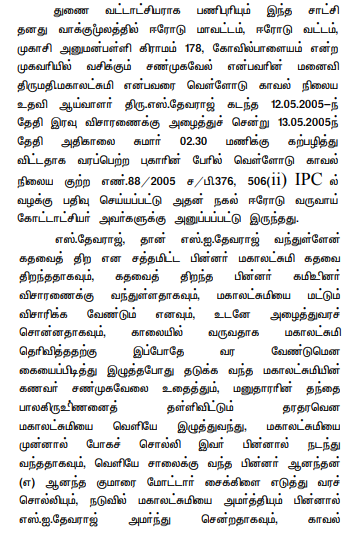
(i) The petitioner herein was serving as Sub-Inspector of Police at Vellode Police Station from 21.01.2005 to 17.05.2005. On 12.05.2005, one Shanmugam @ Sakthi, S/o. Arumugam, lodged a complaint at Vellode Police Station against one Shanmugavel and one Vignesh. The complaint was registered as Vellode Police Station Crime No.86/2005 under Section 294(b) of the INDIAN PENAL CODE , 1860. The petitioner registered the case, arrested the accused, and subsequently released them on bail.
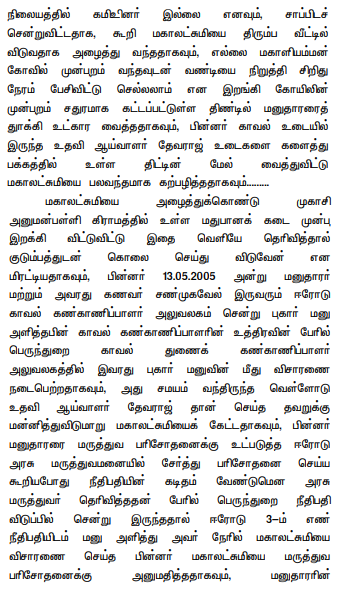
(ii) It was later alleged that the petitioner abducted Mahalakshmi, W/o. Shanmugavel (the accused in Crime No.86/2005), by trespassing into her residence on the night of 12/13.05.2005 at around 2:30 a.m., under the pretext of an enquiry. He was accompanied by one Anandan @ Anandkumar, a "Friend of Police," and used a Government-allotted motorcycle bearing Registration No. TN 33 G 0285. It was further alleged that the petitioner raped Mahalakshmi in the premises of the Ellai Maraiamman Temple near Muhaasi Anumanpallai Village.
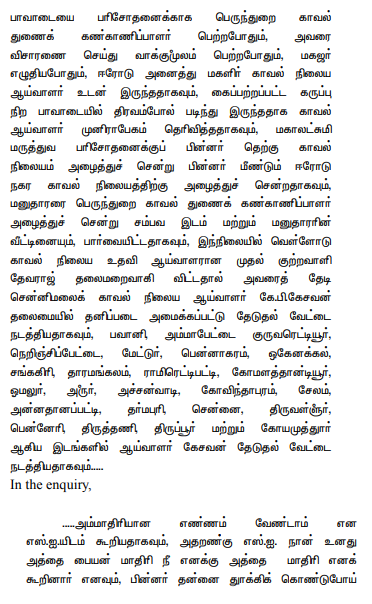
(iii) Based on the complaint filed by Mahalakshmi, a case was registered as Vellode Police Station Crime No.88/2005 under Sections 451, 352, 366, 376(i), read with Sections 376(i), 511, and 212 of the IPC, against the petitioner and Anandan @ Anandakumar. The case was tried in S.C.No.135 of 2006 before the learned Additional Sessions Judge, Erode, and ended in acquittal by judgment dated 13.11.2006. Due to his involvement in the said criminal case, the petitioner was placed under suspension by the third respondent, the Deputy Inspector General of Police, Coimbatore Range, under Rule 3(e)(i)(ii) of the Tamil Nadu Police Subordinate Service (Discipline and Appeal) Rules, 1955, vide R.O.No.187 of 2005 in C.No.D1/4294/2005, dated 16.05.2005.
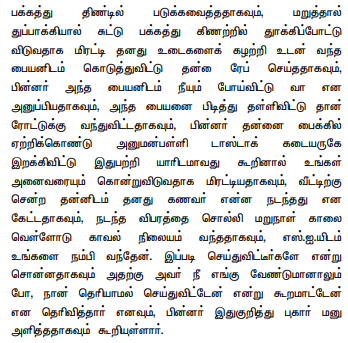
(iv) The petitioner was charged under Rule 3(b) of the Tamil Nadu Police Subordinate Services (Discipline and Appeal) Rules, 1955, in PR.No.41 of 2006, based on the preliminary enquiry report submitted by the Deputy Superintendent of Police, Perundurai Sub-Division. The enquiry covered six charges, all of which were held to be proved after an oral enquiry was conducted under Rule 3(b).
(v) A further representation was obtained from the petitioner, and the punishment order in the PR was at the final stage. Meanwhile, the petitioner filed W.P.Nos.1748 and 1749 of 2007 before this Court, seeking to quash the charge memo issued in PR.No.41 of 2006 under Rule 3(b) and the suspension order. Subsequently, both writ petitions were dismissed as withdrawn by this Court on 28.04.2010.
3. The petitioner was directed to be dealt with under Rule 3(b) of the Tamil Nadu Police Subordinate Service (Discipline and Appeal) Rules, 1955, in P.R.No.41 of 2006, based on six charges framed pursuant to the preliminary enquiry report submitted by the Deputy Superintendent of Police.
4. The enquiry was con
AI
Departmental disciplinary findings can sustain charges independently of criminal acquittal, emphasizing the distinct standards applicable to misconduct in public service.

Disciplinary proceedings must adhere to procedural rules and principles of natural justice; judicial review does not extend to re-evaluating evidence unless there are violations of these principles.

Disciplinary findings must be based on legally admissible evidence; lack of evidence warrants judicial intervention under Article 226.

The court emphasized the importance of adhering to procedural rules and highlighted the impermissibility of relying on statements made during preliminary enquiry in disciplinary proceedings.

The dismissal of a police officer was quashed due to procedural irregularities in the inquiry process, emphasizing the necessity of compliance with established rules.


Disciplinary action against government employees must comply with statutory provisions, and jurisdictional authority must be respected; lack of proper procedure and reasoning renders proceedings void....

The admissibility of evidence from a criminal trial in a departmental proceeding, the burden of proof, and the standard of proof required in a departmental proceeding.



An indispensable Tool for Legal Professionals, Endorsed by Various High Court and Judicial Officers
Please visit our Training & Support
Center or Contact Us for assistance

Scan Me!
India’s Legal research and Law Firm App, Download now!


For Daily Legal Updates, Join us on :



 Back to top


