
 Back
Back





BEFORE THE MADURAI BENCH OF MADRAS HIGH COURT
S. SRIMATHY, J.
Muthukumar – Petitioner
Versus
Pari – Respondent
C.R.P(MD)Nos.706 & 986 of 2020
Decided On : 28-10-2024
ORDER :
S. SRIMATHY, J.
The issue involved in both the Civil Revision Petitions are arising out of the suit filed in O.S.No.142 of 2001 and hence the following common order is passed.
2(i). The Civil Revision Petition in C.R.P.(MD)No.706 of 2020 is filed by the defendant in the suit to set aside the Fair and Decreetal Order, dated 01.02.2020 passed in E.A.No.41 of 2018 in E.P.No.10 of 2010 in O.S.No.142 of 2001 on the file of the Subordinate Court, Paramakudi. The said E.A.No.41 is filed inter alia praying to return of articles found in the inventory report dated07.05.2013.
2.(ii). The Civil Revision Petition in C.R.P.(MD)No.706 of 2020 is filed by the defendant in the suit to set aside the Fair and Decreetal Order, dated 01.02.2020 passed in E.A.No.90 of 2013 in E.P.Nos.10 of 2010 in O.S.No.142 of 2001 on the file of the Subordinate Court, Paramakudi. The petition in E.A.No.90 of 2013 is filed under section 47 of CPC to dismiss the execution petition.
3. The defendant in the suit is the revision petitioner herein and the plaintiff in the suit is the respondent herein in both the revision petitions. For sake of convenience, the parties are referred as plaintiff and defendant as per the ranking in the suit.
4. The suit in O.S.No.142 of 2001 was filed for specific performance. The defendant after receiving notice had entered appearance and filed written statement. Thereafter failed to appear for trial. Hence, the defendant was called absent and exparte decree was passed. Based on the decree, the plaintiff had filed E.P.No.10 of 2010.
5. In the meanwhile, the defendant had preferred petitions to set aside the exparte decree along with delay condonation petition and the same were dismissed. Thereafter, the defendant had filed E.A. No.90 of 2013 taking a plea that even though it is an exparte decree the Trial Court ought to have discussed the case on his written statement and on merits. But the Trial Court has passed only three line judgment and the same is extracted hereunder:
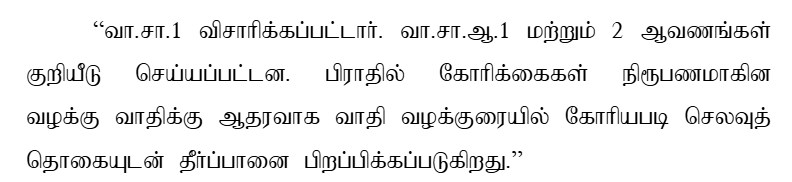
6. After perusing the above judgment, this Court is of the considered opinion that the Trial Court has terribly erred in passing such cryptic judgment, without any reasoning. The Trial Court is duty bound to consider the case on merits, especially in the suit for specific performance the Trial Court ought to consider whether the alleged sale agreement is genuine, the plaintiff was ready and willing, the plaintiff has means to pay, the plaintiff had performed his part of the contract, whether the sale agreement was executed for any loan transaction, limitation etc. Further, in the suit for specific performance the entire burden is on the plaintiff. Even if the defendant failed to appear, even if the defendant filed written statement and failed to appear thereafter, even if the defendant failed to prove the counter plea, the plaintiff ought to prove his case since the entire burden is on the plaintiff to prove his case. Thereafter the pendulum may shift to defendant. The Trial Court failed to see whether the plaintiff had proved his case. And the cryptic judgment discloses the Trial Court had not analyzed whether the plaintiff had proved his case. Hence the Trial Court had failed to exercise its jurisdiction and the plaintiff had not proved his case at all.
7. Under section 2(9) of CIVIL PROCEDURE CODE the word “judgment” is defined, wherein it states “judgment means the statement given by the judge on the grounds of a decree or order”.
8. Under Order 20 Rules 4 (1) & (2) are also referable, which read as under:-
“4. Judgment of Small Cause Courts.--(1) Judgments of a Court of Small Causes need not contain more than the points for determination and the decision thereon.
(2) Judgments of other Courts.--Judgments of other Courts shall contain a concise statement of the case, the points for determination, the decision thereon, and the reasons for such decision.”
9. Hence, as per C.P.C. the judgment for Small Cause Courts shall contain points for determination and decision t
AI
A judgment must comprehensively analyze issues and provide a reasoned basis for decisions, failing which it is deemed cryptic and invalid.

A judgment must contain a concise statement of the case, points for determination, decision, and reasons, failing which it is deemed ex facie illegal. The High Court may set aside such judgments to e....
Ex parte decrees must adhere to principles of natural justice, including proper notice to defendants; failure to do so invalidates the decree.

A judgment must contain a concise statement of the case, points for determination, and reasons for the decision; failure to comply renders it invalid.
Ex parte judgments must adhere to procedural requirements of the CPC; otherwise, such judgments can be ruled illegal and set aside, especially when they affect public rights.
The court emphasized that a petitioner must act with diligence and clean hands when invoking Article 227, especially when challenging an ex-parte decree after an unreasonable delay.
The main legal point established in the judgment is that a party approaching the court must do so with clean hands and must not engage in forum shopping. Additionally, the judgment and decree passed ....
Ex-parte judgment – Ex-parte judgment should show the application of minimum requirement of consideration of the pleadings, issues, evidence and the relief sought for rendering such judgment - Litiga....



An indispensable Tool for Legal Professionals, Endorsed by Various High Court and Judicial Officers
Please visit our Training & Support
Center or Contact Us for assistance

Scan Me!
India’s Legal research and Law Firm App, Download now!


For Daily Legal Updates, Join us on :



 Back to top


