Back
Back





2026 Supreme(Mad) 160
IN THE HIGH COURT OF JUDICATURE AT MADRAS
N.ANAND VENKATESH, J.
M/s KRK Education Trust, Rep. by its Managing Trustee Mr. K.R. Ilanghovan – Petitioner
Versus
M/s. Aintiram Developers (P) Ltd. – Respondent
Arbitration O.P.(Com.Div.) No.49 of 2021 & O.P.No.442 of 2021 & A.No.2474 of 2021
Decided On : 13-02-2026
For the Petitioner: Ms. Tanya Kapoor
For the Respondent: Mr. R. Karthikeyan
The court upheld that inaccurate findings in an arbitration award necessitate judicial interference, allowing for the severance of valid and invalid portions of the award.
Headnote:(A) Arbitration and Conciliation Act, 1996 - Section 34 - Challenge to arbitration award - Claims for excess payment and counter claims for deductions - Award issued by Arbitral Tribunal dated 06.2.2020 challenged by both parties - Claimant alleged excess payment made to respondent and respondent sought counter claims for unpaid dues - Court evaluated issues regarding terms of contracts, certification of final bills, and the award's validity - Court held that certain factual inaccuracies in the award necessitated interference and that valid portions of the award could be severed from invalid ones. (Paras 4, 45-50)
(B) Arbitration Proceedings - Scope of court’s interference - Arbitral award may be set aside where findings are based on inaccuracies, unreasonable deductions, or poor evidential support. (Anti-substituting principle). (Paras 23, 48)
Facts of the case:
Claimant, a charitable trust, contracted with the respondent for construction work, with disputes arising over final bills, payments, and deductions. Claimant sought recovery of excess payments while the respondent made counter claims.
Findings of Court:
The court found that various claims were supported by evidence and that the Arbitral Tribunal made significant errors warranting judicial intervention, except for certain portions deemed valid.
Issues: Main issues included determining the excess payments made and validation of deductions made by the Architect.
Ratio Decidendi: The court emphasized the need for correct evidential backing for deductions and the necessity for accuracy in the award, concluding that some findings were fundamentally flawed.
Result: Both original petitions allowed in part, with directions for the claimant regarding a previously deposited sum.
| Table of Content |
|---|
| 1. factual backdrop leading to arbitration (Para 4 , 10) |
| 2. arguments concerning contractual claims and defenses (Para 5 , 6 , 9 , 19 , 20 , 21) |
| 3. court's analysis on construction disputes (Para 12 , 30 , 38) |
| 4. legal standards for severable arbitration awards (Para 33 , 49) |
| 5. final judicial order and disposition of parties (Para 51 , 52) |
ORDER :
N.ANAND VENKATESH, J.
Both the claimant and the respondent before the Arbitral Tribunal have filed the above petitions under Section 34 of the Arbitration and Conciliation Act , 1996 (for short, the Act) challenging the award passed by the Arbitral Tribunal dated 06.2.2020.
2. Heard both.
3. For the sake of convenience, the parties will be assigned the same rank as was assigned before the Arbitral Tribunal.
4. The facts leading to filing of these petitions are as follows:
(i) The claimant is a public charitable trust to promote and run educational institutions in all faculties. They approached the respondent with a request to undertake construction works of a college and the scope of work was for construction of a building and interior contract. The respondent also introduced two other potential contractors to complete the work.
(ii) A work order was issued to the respondent by the claimant on 18.3.2010. Further, an agreement was entered into between the parties on 22.3.2010.The respondent was awarded the contracts for execution of the works such as Block A, Block B – second floor, Workshop – ground, first and second Floors and Hostel – second and third floors. The project was to be executed between March 2010 and December 2011 and the claimant had to supply all materials like steel, cement, etc. The respondent was paid a sum of Rs.842.42 lakhs, which was inclusive of the materials supplied amounting to 107.78% of the total contract value.
(iii) When the final bill namely bill No.8 was raised and submitted by the respondent, the same was approved by the Architect. However, vide letter dated 25.12.2012, the claimant disputed the said approval given by the Architect and pointed out the mistakes. Further, the Architect, vide letter dated 01.2.2013, rectified the mistakes and revised the certified bill.
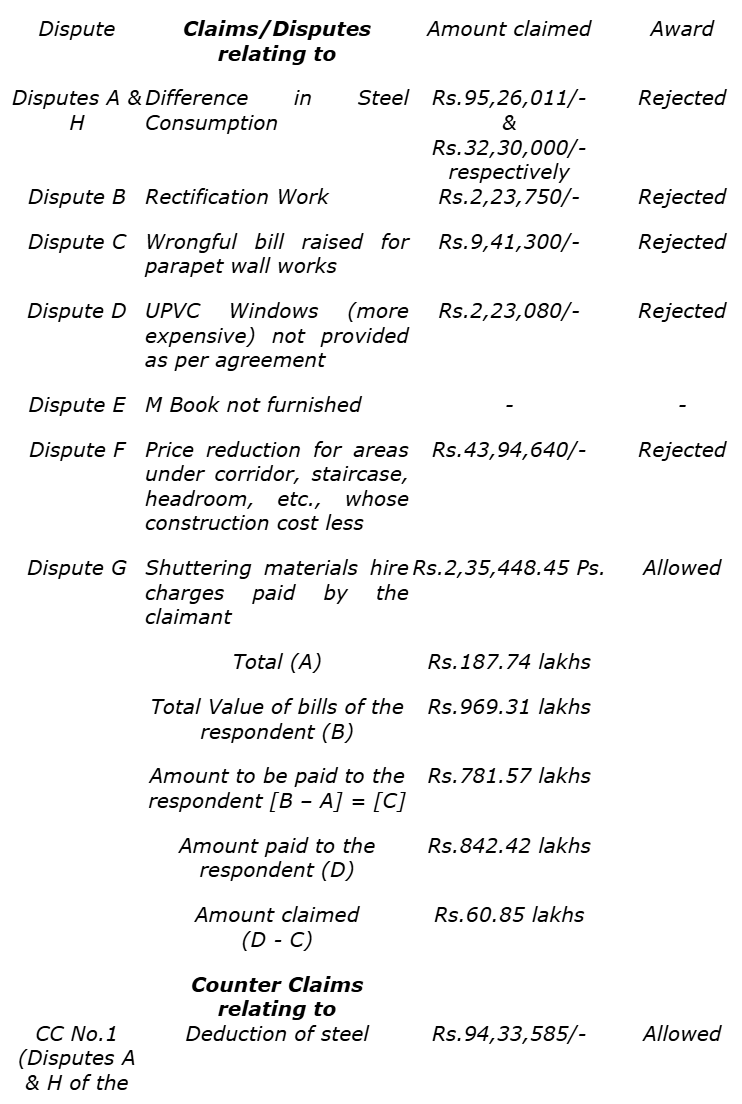
(iv) The dispute arose between the parties, which resulted in making 8 claims by the claimant. The respondent raised the bills for a sum of Rs.969.31 lakhs. The Architect certified the bills for Rs.833.40 lakhs. The claimant paid a sum of Rs.842.42 lakhs. Hence, the claimant took a stand that excess payment was made to the respondent and that the respondent was liable to refund Rs.60.85 lakhs, which was paid in excess by the claimant.
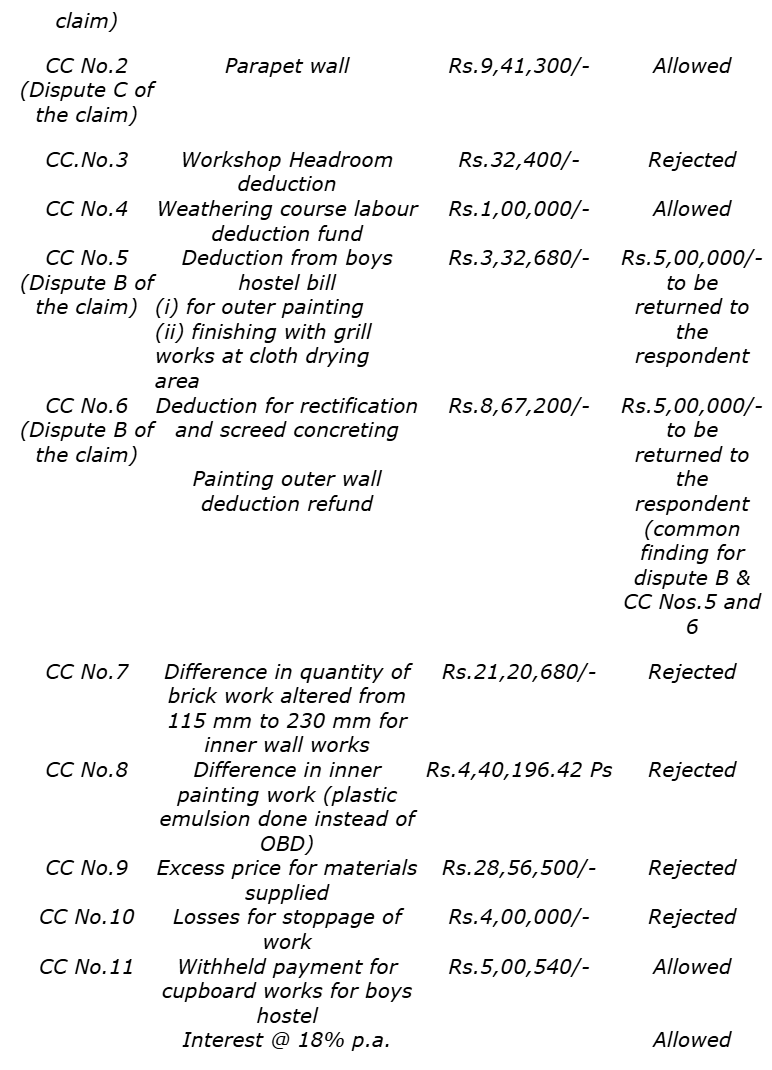
(v) Before the Arbitral Tribunal, the claimant prayed for an award against the respondent for a sum of Rs.60.85 lakhs towards the amount paid in excess along with interest at the rate of 8% per annum. In turn, the respondent filed a statement of defence and made counter claims. According to the respondent, the contract was limited to civil works to be carried out in terms of the drawings of the Architect.
(vi) In the statement of defence, the respondent also took a stand that there was no understanding of steel calculation of 5 Kgs per sq.ft., between the parties, that, apart from that, the respondent undertook additional works on the request made by the claimant vide letters dated 08.8.2011 and 19.12.2011 and that the construction of second floor of Blocks A and B was agreed at the revised rate of Rs.750/- per sq.ft., while the construction of the hostel and the workshop was agreed at the price quoted by the claimant.
(vii) The respondent also took a stand that the constructed buildings were handed over (a) during July 2010 – Block A - ground and first floors; (b) during May 2011 – Blocks A & B – II Floor; and (c) during July 2011 – workshop - ground and first floors. Totally, 13 bills were raised by the respondent for the main building and the workshop, 3 bills for the hostel block and 2 bills for the work shop second floor. Further, 11 bills were certifie